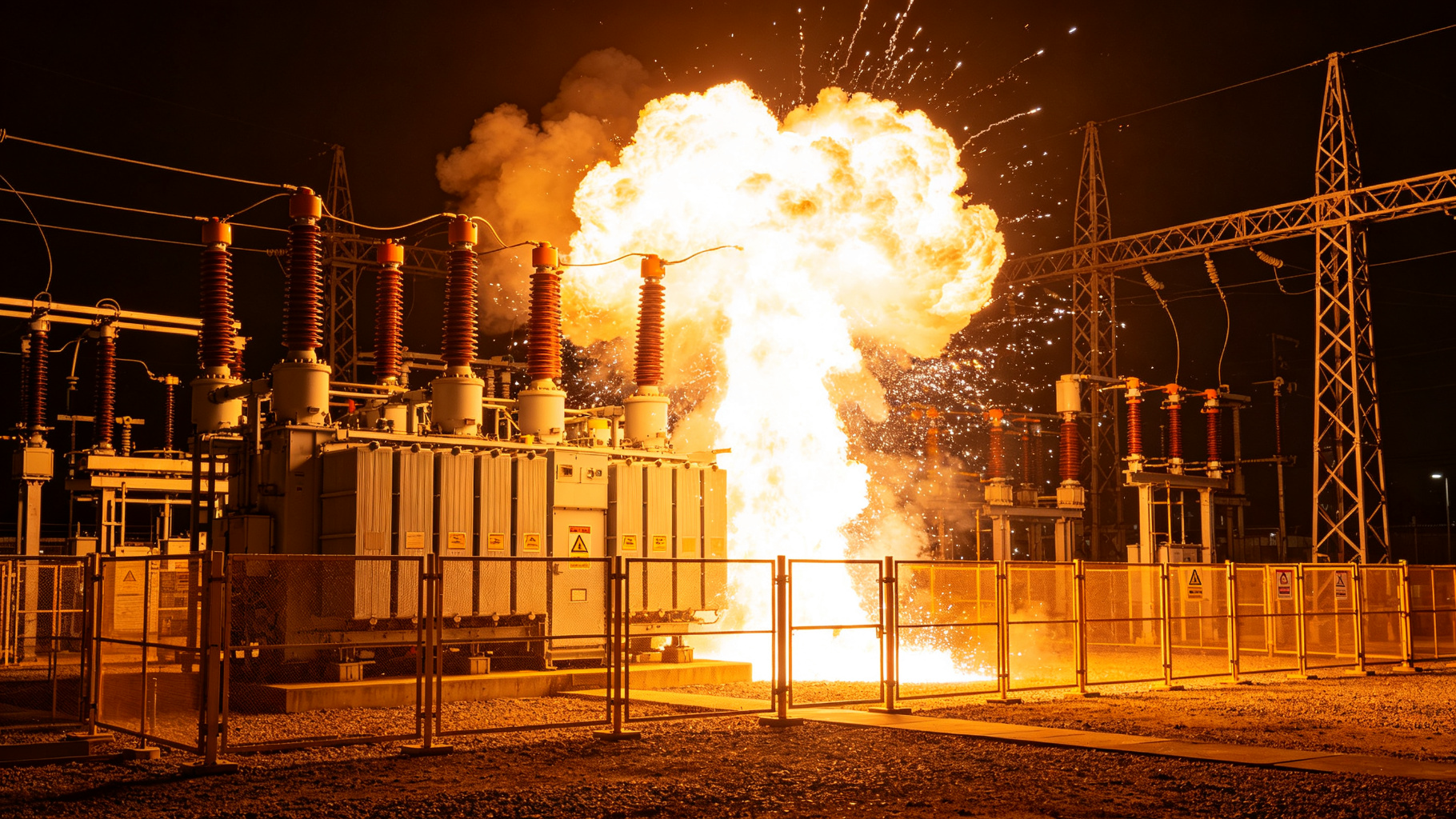
Technical guide on arc flash for electrical fire protection
An arc flash can release temperatures exceeding 19,000°C and eject molten metal at supersonic speeds. For electrical assets, the thermal and pressure wave damage often extends far beyond the initial arc point. Protecting against this risk requires more than circuit interruption; it demands fire-suppression strategies that respond within milliseconds of fault detection.
An arc flash is one of the most severe electrical hazards in industrial, commercial, and utility installations. It begins as an unintended electrical discharge through air or across contaminated insulation, but its consequences extend far beyond a momentary fault: temperatures can exceed 19,000 °C, copper conductors can vaporize, and the resulting pressure wave can eject doors, hardware, and molten metal. For personnel working on or near energized equipment, the electrical arc hazard produces burns, blast injuries, hearing damage, and fatalities even when the event lasts only a few electrical cycles.
Effective arc flash protection requires a layered strategy: engineering controls to reduce fault duration, qualified work practices, appropriate arc flash PPE, and measures that limit post-event fire spread. This article examines the physics of arc flashes, the role of standards-based hazard assessment, and how passive clean-agent suppression products such as the QuellPatch product line can be integrated into enclosure-level protection. It also defines where such patches fit within a broader safety system: they are designed to suppress fires that develop after an arc event, not to replace de-energization, overcurrent protection, or PPE.
An arc flash typically starts when the dielectric strength of air or insulation is exceeded. Common causes include dropped tools, loose connections, tracking across contaminated insulation, corrosion, rodent intrusion, accidental contact during maintenance, and failure of insulating barriers. Unlike a bolted fault, where current follows a low-impedance metallic path, an arcing fault is sustained through ionized gas. The arc itself is a conductive plasma channel with rapidly changing impedance, and arcing current is often lower than the bolted-fault current, making it harder for some overcurrent devices to clear quickly.
Once established, the arc heats surrounding air and conductor materials. Copper vaporizes at roughly 1,085 °C, but arc plasma can reach temperatures several times hotter than the surface of the sun. Vaporized metal can expand by a factor on the order of 67,000, creating a rapid pressure rise inside enclosed equipment. This blast effect can occur before a worker can react and may cause injury even if radiant heat exposure is brief.
Incident energy, usually expressed in cal/cm², describes the thermal energy arriving at a specified working distance. The IEEE 1584 empirical model relates incident energy to arcing current, fault clearing time, system voltage, electrode gap, enclosure dimensions, and distance from the arc. Because energy scales strongly with duration, reducing clearing time is one of the most effective engineering methods for reducing exposure: changing a clearing time from seconds to cycles can lower incident energy substantially when other variables remain constant.
Injury mechanisms include direct flame contact, radiant heat burns, molten metal deposition, blast pressure, shrapnel, eye damage from ultraviolet and infrared radiation, and inhalation of ionized or toxic byproducts. The 1.2 cal/cm² threshold is commonly used as the arc flash boundary because it corresponds to the onset of second-degree burns under standardized test conditions. PPE arc ratings, such as ATPV or EBT, are selected so that the predicted incident energy does not exceed the garment or system rating.
A defensible arc flash program begins with a documented hazard assessment. Engineers typically calculate bolted and arcing fault currents, evaluate overcurrent device clearing times, and determine incident energy at working locations using IEEE 1584 procedures. The results are used to label equipment, establish arc flash boundaries, and define required PPE. NFPA 70E then ties the assessment to work practices: de-energization when feasible, lockout/tagout, justified energized-work permits, approach boundaries, and PPE selection based on calculated exposure.
Engineering controls may include current-limiting fuses, zone-selective interlocking, arc-flash detection relays, maintenance switches that temporarily reduce clearing time, and arc-resistant switchgear. These measures address the arc itself by shortening its duration or redirecting its energy. PPE addresses worker exposure but does not reduce the energy released inside the enclosure.
Arc flash PPE is a last line of defense, not a control that makes energized work safe by itself. Garments, face shields, hoods, gloves, and hearing protection are rated for thermal exposure and must be selected as a system; mixing unrated layers can reduce protection. PPE categories commonly associated with NFPA 70E range from lower ratings around 4 cal/cm² to higher ratings of 40 cal/cm² or more, depending on the calculated incident energy.
However, PPE does not prevent equipment damage, internal fires, pressure rupture, or secondary ignition of cable insulation and dust. After an overcurrent device clears, a persistent flame can continue to burn in cable compartments, control transformers, or insulating materials. This is where passive suppression can support arc flash protection by reducing the chance that a short-duration arc becomes a larger enclosure or room fire.
QuellPatch patches use microencapsulated FK-5-1-12 clean agent, a fluorinated ketone that is electrically nonconductive and leaves little or no residue after discharge. The agent is contained in small polymer capsules distributed across the patch. When the capsule material reaches its designed thermal threshold, it softens or ruptures and releases FK-5-1-12 directly into the compartment. Because activation is thermal and passive, the patch requires no external power, detector wiring, control panel, or pressurized cylinder.
FK-5-1-12 acts primarily by absorbing heat and interrupting the combustion reaction at the flame zone. Its clean-agent characteristics make it suitable for electrical enclosures where residue from dry chemicals or water could damage sensitive components. The microencapsulated format also allows distributed placement: patches can be applied near cable bundles, busbar compartments, control sections, or other localized ignition sources rather than relying solely on a central total-flooding system.
QuellPatch variants are offered with activation temperatures of 80 °C, 140 °C, and 180 °C. The appropriate variant depends on normal operating temperatures, enclosure ventilation, ambient conditions, and the surface where the patch is installed. The 80 °C variant may be considered for cable compartments or lower-temperature surfaces where normal operating temperatures remain well below the threshold. The 140 °C variant is commonly used in general low-voltage switchgear, motor control centers, and similar equipment. The 180 °C variant is more suitable for high-ambient compartments or surfaces near current-carrying components that run hotter under load.
Selection should include a margin above measured or nameplate normal surface temperatures. An activation threshold too close to normal operating temperature could lead to premature discharge, while one too high may delay response to a developing fire. Because arc flashes produce extreme thermal transients, the patches are not intended to react within the first few milliseconds of an arc; they are intended to respond to residual heat and post-arc combustion after the fault has been cleared or as a fire develops.
QuellPatch is installed inside electrical enclosures during scheduled outages, with placement guided by the likely fire load: cable trays, insulation, connector areas, and control power components. Surface preparation, adhesion limits, and clearance from moving parts must follow the manufacturer’s installation instructions. The patches have a 5-year service life under specified service conditions. Because they contain no pressure gauge, maintenance consists of visual inspection for damage, displacement, or evidence of discharge, with replacement at the end of rated service life or after activation.
For arc flash protection programs, patch installation should be documented in the equipment record and coordinated with the facility’s electrical safety committee. It should not change the calculated incident energy label or PPE category unless a formal engineering study demonstrates a reduction in hazard through a recognized protection method. The patches are a fire-suppression layer, not a substitute for overcurrent device coordination or arc-resistant equipment ratings.
Passive thermal activation has practical boundaries. A patch cannot detect an incipient electrical fault before heat reaches its surface, and it cannot extinguish an energized arc plasma while full fault current continues to flow. Its value lies in suppressing flames that persist after protective devices operate or that develop from overheated insulation, tracking, or component failure. In larger enclosures, multiple patches may be required to address separate compartments, and they may be used alongside total-flooding systems, sprinklers, or detection systems depending on the facility’s risk assessment.
FK-5-1-12 is generally compatible with common electrical materials, but post-event investigation remains necessary. After any discharge, equipment should be inspected for hidden damage, insulation degradation, and the root cause of the arc. The clean agent’s low-residue characteristic can reduce cleanup compared with dry chemicals, but it does not eliminate the need for qualified electrical evaluation before re-energization.
Arc flash risk is driven by fault current, clearing time, enclosure geometry, and worker distance. A complete arc flash protection strategy combines hazard analysis, engineering controls, safe work practices, and properly selected arc flash PPE. PPE protects personnel, but it does not prevent internal enclosure fires or limit property damage after an electrical arc hazard has occurred.
QuellPatch adds a passive, localized suppression layer using microencapsulated FK-5-1-12 with 80 °C, 140 °C, and 180 °C activation options and a 5-year service life. When selected and installed as part of a documented engineering program, it can help reduce post-arc fire spread in electrical infrastructure. It should be viewed as a complementary control within a layered safety system, not as a replacement for de-energization, protective device coordination, or PPE.
A: No. QuellPatch is a passive FK-5-1-12 clean-agent suppression product intended to control post-arc fires and heat-driven combustion inside electrical enclosures. It does not prevent the initial electrical fault, reduce incident energy, or replace arc-flash PPE, lockout/tagout, or overcurrent protection.
A: Arc-rated PPE protects workers from thermal exposure during a fault, typically using categories such as NFPA 70E PPE Levels 0–4 based on incident energy in cal/cm². QuellPatch addresses a different risk: after an arc or ignition event, it releases FK-5-1-12 to help suppress enclosure fires before they escalate.
A: Select the activation threshold based on measured maximum normal air and surface temperatures at the mounting location, with a margin above expected operating conditions. The 80 °C variant is for cool, controlled spaces; 140 °C is the general-purpose choice for many electrical enclosures; 180 °C is for high-ambient or high heat-flux locations.
A: Arc-flash hazard assessment is commonly performed under NFPA 70E and IEEE 1584, with equipment labeling and PPE selection tied to calculated incident energy. For clean-agent suppression, relevant references include NFPA 2001 and ISO 14520 for FK-5-1-12-type systems, while installation must also comply with local electrical and fire codes.
A: QuellPatch is designed for a 10-year service life under specified installation and environmental conditions. It should be inspected during routine enclosure maintenance and replaced if it is damaged, activated, exposed beyond rated conditions, or past its replacement date.
FIREQUELL QuellPatch delivers automatic, maintenance-free clean-agent protection for electrical panels, battery cabinets and control rooms — designed to meet FM Approved, UL Listed, CE and UKCA requirements.
Request a Site Assessment