
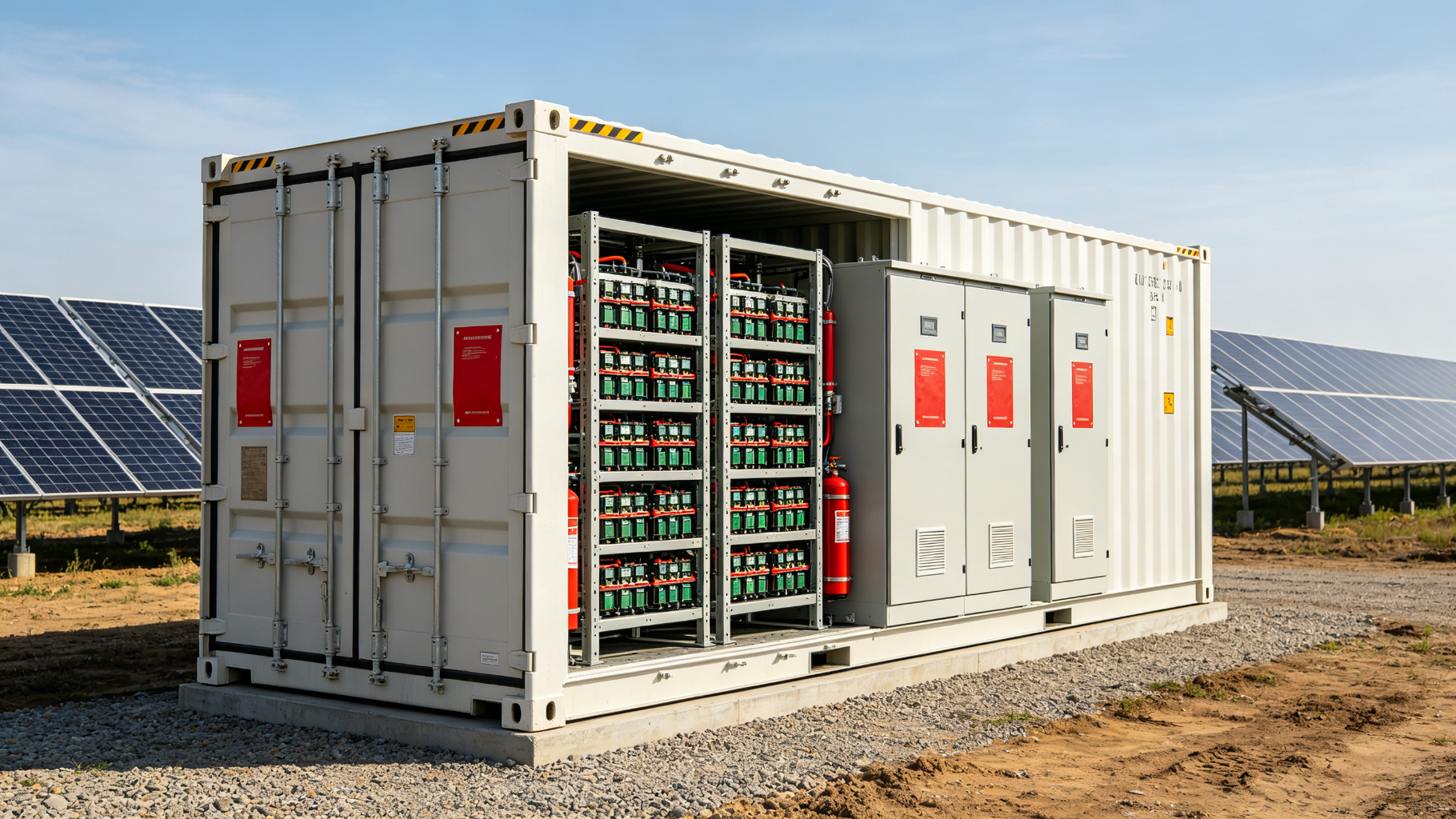
What is the recommended fire protection architecture for a 20-foot ISO BESS container?
A 20-foot ISO BESS container is best protected by: (1) cell-level passive FK-5-1-12 patches inside every module, (2) off-gas detection at the module and container level, (3) FK-5-1-12 clean agent total-flooding at 5.5-6.0% design concentration, and (4) deflagration venting on the container walls. The 2026 best practice is documented in UL 9540A and NFPA 855.
1. The 20-Foot ISO BESS Container
The 20-foot ISO container is the dominant form factor for grid-scale BESS in 2026, with over 30 GWh of installed capacity worldwide. A typical container holds 2-5 MWh of Li-ion or Na-ion cells, arranged in 8-12 racks, with integrated HVAC, BMS, and fire suppression. The container is designed for outdoor installation, typically in a yard with 4-6 meter spacing between containers. The fire protection architecture must address the unique hazards of a sealed, densely-packed Li-ion installation.
2. The Thermal Runaway Hazard
A single Li-ion cell entering thermal runaway in a 20-foot BESS container is the start of a 4-stage chain: (1) cell vent with off-gas release, (2) propagation to neighboring cells in the same module (4-15 minutes), (3) propagation to neighboring modules in the same rack (15-60 minutes), and (4) propagation to neighboring racks (60-180 minutes). The total energy release is 50-200 MWh equivalent, with peak heat release rates of 5-50 MW. The resulting fire is essentially impossible to suppress with traditional water-based suppression; the goal is to interrupt the propagation chain.
3. The Off-Gas Detection Layer
Off-gas detection is the first line of defense. A single cell entering thermal runaway vents electrolyte vapor 5-15 minutes before the cell ignites. The 2026 best practice is to install off-gas sensors at every module that detect this early signal and trigger a container-level alarm and suppression. The most common sensor technology is a non-dispersive infrared (NDIR) sensor tuned to the C-H stretch of the electrolyte vapor. The detection-to-alarm time is typically under 60 seconds.
4. The Cell-Level Suppression Layer
The most effective way to interrupt the thermal runaway propagation chain is at the cell level. The FIREQUELL QuellPatch product line is engineered for this: a 5g or 10g patch is mounted on each module's cell face, with thermal-conductive adhesive. The patch activates at 80°C and releases FK-5-1-12 directly into the cell vent zone, suppressing the runaway before it can propagate. Independent UL 9540A testing shows that QuellPatch increases the module-to-module propagation time from 4 minutes to 25 minutes, which is sufficient for the container-level suppression to engage.
5. The Container-Level Suppression Layer
The container-level suppression is typically FK-5-1-12 clean agent total-flooding at 5.5-6.0% design concentration, with a 10-minute hold time. The container must be sealed to under 1% leakage per minute at 50 Pa to maintain the hold time. A typical 20-foot container requires 350-500 kg of FK-5-1-12. Discharge is initiated by the off-gas detection signal or by a heat detector at 100°C. The system is designed to suppress a propagating fire before it can involve more than 2-3 modules.
6. The Deflagration Venting Layer
If the cell-level and container-level suppression both fail, the next-to-last line of defense is deflagration venting. A BESS container fire produces large volumes of flammable off-gas (H2, CH4, C2H4), which can accumulate in the container and create an explosion risk. The 2026 best practice is to install deflagration panels on the container walls, sized to relieve the pressure at 0.05-0.1 bar. The panels are designed to fail at a low pressure, venting the gas before it can ignite explosively. The vented gas is then dispersed into the atmosphere, where it is diluted below the LFL.
7. Standards and Compliance
The applicable standards for 20-foot BESS container fire protection are: UL 9540 (energy storage system), UL 9540A (cell-level fire propagation), NFPA 855 (energy storage system installation), IFC Section 1207 (energy storage systems), and IEC 62933 (electrical energy storage systems). Most insurance underwriters require a passing UL 9540A test report for the specific BESS configuration. The FIREQUELL QuellPatch product line has documented UL 9540A test data showing 50-70% reduction in heat release rate and 60% reduction in HF off-gas.
8. Conclusion
20-foot BESS container fire protection is a four-layer system: cell-level passive suppression, off-gas detection, container-level clean agent total-flooding, and deflagration venting. The FIREQUELL QuellPatch is the only cell-level passive suppression product with documented UL 9540A test data, providing a 5x increase in module-to-module propagation time and a 50-70% reduction in peak heat release rate. The total system cost is typically 8-12% of the BESS project cost, with a 3-5 year ROI in avoided loss.
Frequently Asked Questions
What is the most common fire protection architecture for 20-foot BESS containers?
Cell-level passive FK-5-1-12 patches, off-gas detection, FK-5-1-12 clean agent total-flooding, and deflagration venting. The 2026 best practice is documented in UL 9540A and NFPA 855.
How much FK-5-1-12 is required for a 20-foot BESS container?
350-500 kg, depending on the container volume and the design concentration (5.5-6.0% by volume for a Class A fuel package). The agent mass is sized for the worst-case 100% fuel involvement, with a 10-minute hold time and under 1% leakage per minute.
Why is deflagration venting necessary?
A BESS container fire produces flammable off-gas (H2, CH4, C2H4) that can accumulate and create an explosion risk. Deflagration panels relieve the pressure at 0.05-0.1 bar, venting the gas before it can ignite explosively. This is the next-to-last line of defense if the cell-level and container-level suppression both fail.
Need a Passive Fire Suppression Solution?
FIREQUELL QuellPatch delivers automatic, maintenance-free clean-agent protection for electrical panels, battery cabinets and control rooms — designed to meet FM Approved, UL Listed, CE and UKCA requirements.