
What do the IEC 60332-3 and IEEE 1584 cable tray fire tests actually measure, and how do the results apply to real installations?
IEC 60332-3 measures flame spread along a vertical cable bundle in a test chamber, while IEEE 1584 calculates the incident energy from an arc event. The two standards address different hazards but both are required for a complete fire risk assessment of an electrical installation.
1. Why Cable Tray Fires Are Different
Cable trays are a unique fire hazard because they combine (a) a high fuel load per unit area (cable insulation is 30-50% of the tray volume), (b) a chimney effect that promotes vertical flame spread, (c) a network topology that can propagate fire horizontally between floors and buildings, and (d) a high density of electrical conductors that can re-ignite the fire if the circuit is not de-energized. A single arcing fault in a 480V cable tray can ignite the cable bundle within 30 seconds and propagate 5-10 meters vertically within 5 minutes.
2. The IEC 60332-3 Test Method
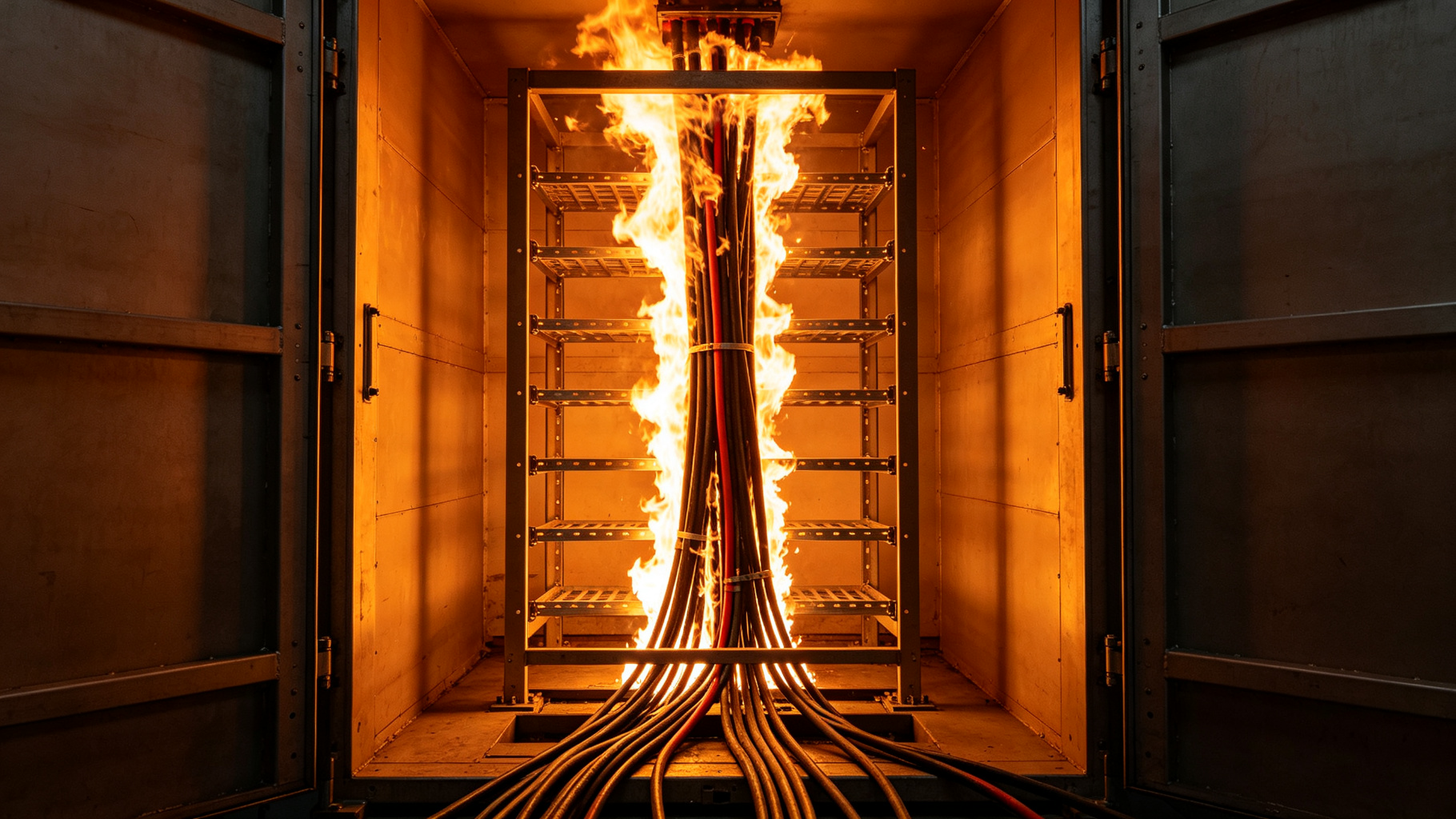
IEC 60332-3 is a flame spread test for bunched cables. The standard specifies a vertical cable bundle in a test chamber, with a ribbon burner applied for a specified duration (20-40 minutes depending on the category A, B, C, or D). The pass criterion is that the flame does not propagate more than 2.5 meters above the burner. The test measures the cable's resistance to vertical flame spread in a chimney-like configuration. It is the most common fire performance test for power and control cables.
3. The IEEE 1584 Calculation
IEEE 1584 is a calculation method, not a test. It calculates the incident energy at a working distance from an arcing fault, based on the bolted fault current, the equipment geometry, the working distance, and the protective device clearing time. The 2018 revision added the electrode configuration factor and extended the model to 34.5 kV. The result is expressed in cal/cm² and is used for PPE selection, arc-flash labeling, and incident energy zoning.
4. The Two Standards Address Different Hazards
IEC 60332-3 measures whether a cable will self-extinguish after the ignition source is removed, and how far the flame will propagate along the cable. IEEE 1584 calculates the thermal energy released by an arcing fault and the resulting incident energy at a working distance. The two are complementary: IEC 60332-3 is about the cable as a fuel, while IEEE 1584 is about the arc as an ignition source. A complete cable tray fire risk assessment requires both: the cable must not propagate the fire (IEC 60332-3), and the protective system must clear the arc fast enough to limit the incident energy (IEEE 1584).
5. Limitations of IEC 60332-3
IEC 60332-3 is a single-cable-bundle test in a 4-meter vertical chamber. It does not measure: (a) horizontal flame spread, (b) the contribution of multiple parallel trays, (c) the effect of cable derating due to bundling, (d) the effect of cable aging on fire performance, (e) the smoke and toxic gas production, or (f) the post-ignition behavior with continued arc exposure. For real-world installations, additional tests such as IEC 60332-1 (single cable), IEC 60332-2 (small bundle), IEC 61034 (smoke density), and IEC 60754 (gas acidity) are required for a complete picture.
6. Limitations of IEEE 1584
IEEE 1584 is a calculation method, so it depends entirely on the input data. Common errors include: (a) using the bolted fault current instead of the arcing current, (b) using an incorrect electrode configuration factor, (c) using a working distance that does not match the actual installation, (d) using protective device clearing times that are based on the bolted fault current instead of the arcing current. The 2018 revision addressed many of these issues, but a careful engineer will re-verify each input against the actual installation.
7. The Combined Risk Assessment
A complete cable tray fire risk assessment considers: (1) the cable's IEC 60332-3 category (A, B, C, or D); (2) the IEEE 1584 incident energy at the worst-case working distance; (3) the protective device clearing time at the arcing current; (4) the layout of the cable trays (vertical, horizontal, derating factors); (5) the presence of any active or passive fire suppression in the tray or the surrounding room. The FIREQUELL QuellPatch is increasingly specified inside the cable tray itself, with one patch every 3-5 meters, to suppress any incipient fire before it can propagate.
8. Conclusion
IEC 60332-3 and IEEE 1584 are complementary standards: the first measures the cable as a fuel, the second calculates the arc as an ignition source. Both are required for a complete cable tray fire risk assessment. The FIREQUELL QuellPatch product line, installed inside the cable tray itself, provides an additional layer of protection: it suppresses the incipient fire regardless of the cable's IEC category or the arc's incident energy.
Frequently Asked Questions
What does IEC 60332-3 actually measure?
IEC 60332-3 measures the vertical flame spread along a bunched cable bundle in a 4-meter test chamber with a ribbon burner applied for 20-40 minutes. The pass criterion is that the flame does not propagate more than 2.5 meters above the burner. The standard categories A, B, C, and D specify different amounts of cable per meter of tray.
What does IEEE 1584 actually calculate?
IEEE 1584 calculates the incident energy (in cal/cm²) at a working distance from an arcing fault, based on the bolted fault current, the equipment geometry, the working distance, and the protective device clearing time. The 2018 revision is the current consensus standard.
Are the two standards related?
Not directly. IEC 60332-3 measures the cable as a fuel (will it self-extinguish?). IEEE 1584 calculates the arc as an ignition source (how much thermal energy is released?). A complete cable tray fire risk assessment requires both, plus a third layer: passive suppression (QuellPatch) inside the tray itself.
Need a Passive Fire Suppression Solution?
FIREQUELL QuellPatch delivers automatic, maintenance-free clean-agent protection for electrical panels, battery cabinets and control rooms — designed to meet FM Approved, UL Listed, CE and UKCA requirements.