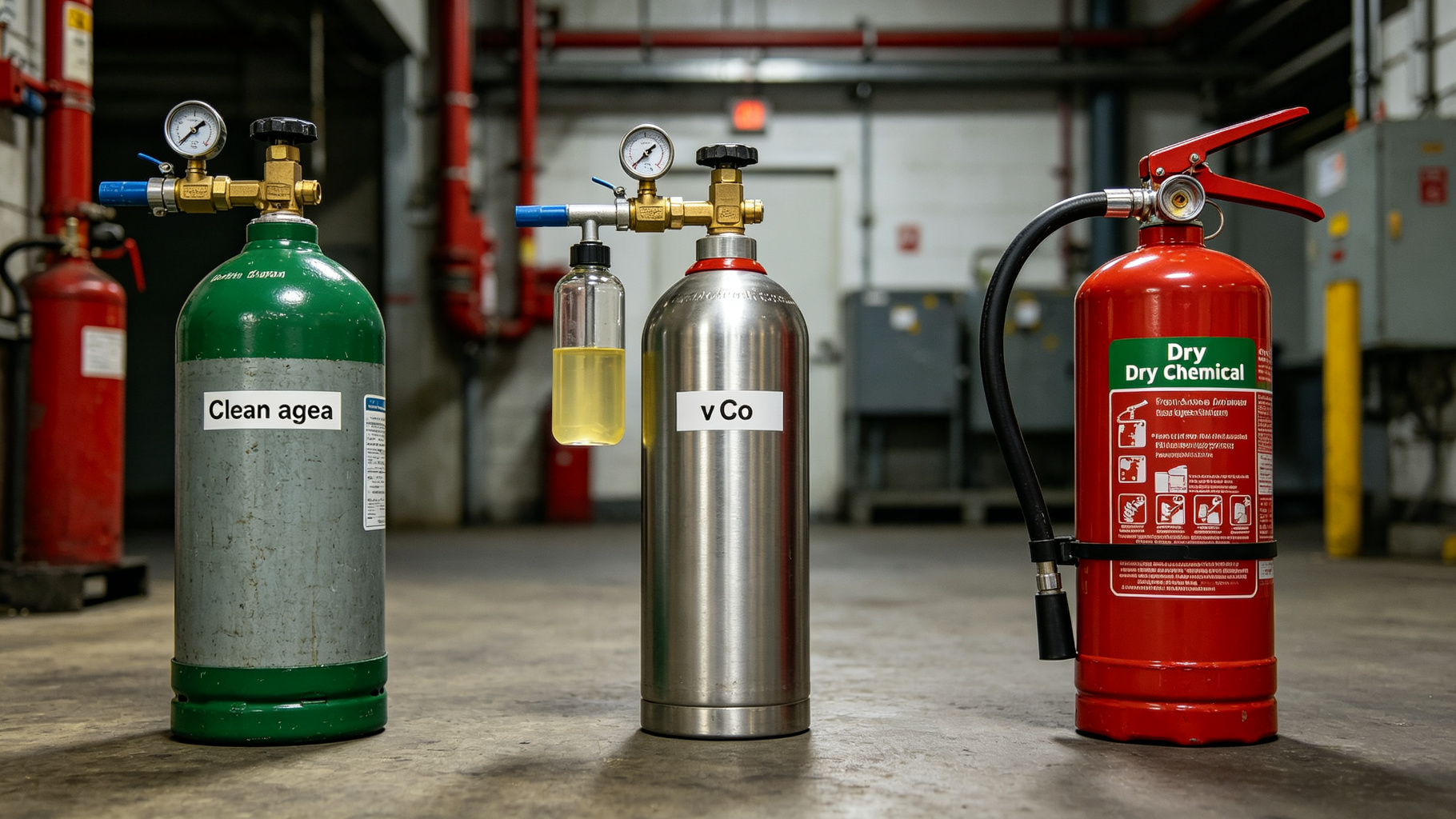
Technical guide on clean agent CO2 dry chemical for electrical fire protection
When a fire erupts inside a control panel or server cabinet, the choice between clean agent, CO2, and dry chemical systems can determine whether your equipment survives or is written off. Each agent extinguishes flames differently, and their suitability varies with the electrical hazard class and room occupancy. Understanding these differences is critical for selecting the right protection.
Selecting a suppression medium for electrical infrastructure requires balancing extinguishing effectiveness, personnel safety, equipment compatibility, enclosure conditions, and post-fire recovery. For control panels, switchgear cabinets, battery racks, and similar compartmentalized hazards, the three options most often compared are clean agent CO2 dry chemical systems. Each acts through a different mechanism and creates different consequences after discharge. This article compares those media in engineering terms and explains where the QuellPatch product line, a passive clean-agent suppression patch, fits into an overall fire-protection strategy.
QuellPatch uses microencapsulated FK-5-1-12 clean agent and passive thermal activation. Rather than relying on pressurized piping, detectors, or control panels, the patch releases agent locally when heat from an developing fire raises its surface to a rated activation temperature. The discussion below focuses on how that approach compares with CO2 and dry chemical in real electrical enclosures.
FK-5-1-12 is a fluorinated ketone that vaporizes readily and suppresses fire primarily through heat absorption, with a secondary chemical effect on combustion reactions. It is electrically nonconductive and leaves no residue after discharge. In engineered total-flooding systems, typical design concentrations are approximately 4.5% for Class A hazards and 5.9% for Class B hazards, with electrical Class C hazards treated according to the associated fuel arrangement. Its observed no-observed-adverse-effect level is commonly reported as 10%, which provides a margin between typical design concentrations and personnel exposure limits when systems are correctly designed.
In QuellPatch, the agent is held in microencapsulated cells. When the patch reaches its rated temperature, the polymer shells rupture and release FK-5-1-12 directly adjacent to the overheating component. This local application is intended for early-stage fires in enclosed or semi-enclosed electrical spaces rather than as a whole-room total-flooding replacement.
CO2 suppresses fire mainly by reducing oxygen concentration below the level needed for combustion. It is electrically nonconductive and leaves no residue, but it requires high discharge concentrations, often in the range of 34% to 50% depending on the fuel and hazard type. At those concentrations, CO2 presents a serious asphyxiation risk to occupants. CO2 discharge can also create strong cooling, thermal shock, static charge concerns, and pressure forces that must be accounted for in enclosure design.
Dry chemical agents, including sodium bicarbonate, potassium bicarbonate, and monoammonium phosphate, interrupt the combustion chain reaction. They can be effective on flammable-liquid and electrical fires, but they do not cool deeply and may not secure smoldering Class A materials. Their principal limitation in electrical infrastructure is residue: fine powder can enter connectors, relays, ventilation paths, and motor bearings, and some formulations are corrosive or hygroscopic. Even when the fire is extinguished quickly, cleanup may require disassembly, solvent washing, and replacement of sensitive electronics.
CO2 and most clean-agent systems are designed as total-flooding systems: they must develop and hold a uniform concentration throughout an enclosure. That requires enclosure integrity testing, pressure venting, and often a minimum hold time. Leakage around cable penetrations, doors, or cooling openings can reduce effectiveness. Dry chemical can be used for local application or total flooding, but distribution is affected by obstructions and by the momentum of the discharge.
QuellPatch operates differently. It is a point-of-incident device mounted near likely ignition sources, such as terminal blocks, contactors, busbar connections, battery modules, or cable bundles. Its passive thermal activation means it responds to heat at the protected surface rather than to a room-average temperature. The patch does not require a cylinder, solenoid, or control circuit, which reduces failure points associated with detection and release logic.
QuellPatch is available with activation temperatures of 80°C, 140°C, and 180°C. The 80°C variant is suited to sensitive electronics or cabinets with low normal operating temperatures where early intervention is desirable. The 140°C variant is a common choice for general electrical enclosures with moderately elevated ambient temperatures. The 180°C variant is intended for higher-ambient locations or equipment where temporary temperature excursions could otherwise produce nuisance response. Selection should be based on measured surface temperatures, ambient cycling, and the expected ignition temperature of nearby combustibles.
Pressurized CO2 and clean-agent discharges can generate significant over- and under-pressure events. Enclosures may need pressure-relief openings, structural review, and coordination with HVAC shutdown. Dry chemical discharge can also pressurize a space and deposit powder into ducts. A passive patch releases a much smaller local agent volume and does not create the same bulk pressure loading, although it should not be used as a substitute for required explosion relief or room-scale suppression where those are mandated.
CO2 is generally not appropriate for spaces that may be occupied during discharge unless specialized lockout, warning, and pneumatic time-delay systems are provided. Dry chemical can reduce visibility and irritate the respiratory tract, and discharge in a confined room may impede egress. FK-5-1-12 at listed design concentrations has a more favorable personnel-safety profile, but any gaseous suppression system still requires managed egress, door signs, and lockout procedures. Because QuellPatch releases locally and does not produce a room-wide oxygen-displacing concentration, it may be suitable for normally occupied areas when used as part of a reviewed design.
After a CO2 discharge, the main concerns are ventilation, re-occupancy, and checking for cold-related damage; there is no residue to remove. After a dry chemical discharge, equipment restoration can be substantial. Powder may need to be vacuumed, blown out, washed, or neutralized depending on the agent, and relays, switches, and circuit boards may require replacement. FK-5-1-12 evaporates without powder or oily residue, which can reduce post-fire cleaning. The fire itself may still produce soot and corrosive byproducts, so equipment should be inspected before re-energization.
Engineered CO2 and clean-agent systems require cylinder weighing, pressure checks, hydrostatic testing, detector maintenance, and control-panel supervision. Dry chemical systems require inspections for caking, pressure loss, and nozzle obstruction. QuellPatch has a 5-year service life under specified environmental conditions and is monitored through visual inspection for physical damage, detachment, or prior activation. Its microencapsulated format avoids the slow leakage concerns associated with pressurized cylinders, although storage and installation temperature limits must still be observed.
For compact panels containing sensitive electronics, dry chemical is often difficult to justify because of residue and cleanup. CO2 can be effective but introduces life-safety and thermal-shock concerns. A passive FK-5-1-12 patch mounted above high-risk components can provide early local suppression without residue or pressurized hardware. The 80°C or 140°C activation variant is commonly selected, depending on normal panel temperatures.
Larger switchgear may require a total-flooding system for full volume protection, especially if the compartment cannot be reliably covered by local devices. In such cases, an engineered FK-5-1-12 or CO2 system may be appropriate, with CO2 generally limited to unoccupied or strictly controlled spaces. QuellPatch can be used as a complementary layer at bus joints, breaker compartments, or battery modules where localized overheating is expected.
Dry chemical may be considered for outdoor, unoccupied, or low-value electrical hazards where residue is acceptable and water is undesirable. However, wind and open geometry can reduce powder retention. FK-5-1-12 patches require enclosure or semi-enclosure to contain vapor near the fire and should be selected with the 140°C or 180°C rating if solar loading or high ambient temperatures are present.
There is no single suppression medium that fits every electrical hazard. CO2 is effective and leaves no residue, but its oxygen-displacing concentration makes it unsuitable for many occupied spaces. Dry chemical is widely effective and comparatively low in initial cost, but its residue can damage electronics and extend downtime. FK-5-1-12 clean agent offers nonconductive, low-residue suppression with a more favorable personnel-safety profile at typical design concentrations. The QuellPatch product line applies that agent in a microencapsulated, passively activated format intended for local protection of electrical components.
Agent selection should be based on a documented fire-risk assessment, enclosure geometry, occupancy, ambient conditions, and restoration objectives. For many compartmentalized electrical hazards, QuellPatch can serve as a primary point-of-incident solution or as a supplement to a larger total-flooding system. The 80°C, 140°C, and 180°C activation options allow the response threshold to be matched to the equipment, while the 5-year service life supports a predictable inspection and replacement cycle.
A: FK-5-1-12 clean agent is commonly used in occupied spaces because typical design concentrations are below established exposure limits, such as the NOAEL of 10% for FK-5-1-12. CO2 is not suitable for normally occupied areas because design concentrations create asphyxiation risk, and dry chemical creates cleanup and visibility issues but does not replace proper agent concentration design.
A: QuellPatch is designed for local, point-of-incident protection near specific electrical components. It may be used as a complementary measure or as primary protection in suitable compact enclosures, but it does not replace a code-required total-flooding system designed to NFPA 2001 or the applicable CO2 standard.
A: FK-5-1-12 is often preferred for sensitive electrical gear because it is electrically nonconductive, leaves no residue, and has a relatively low environmental impact. CO2 is also clean and nonconductive but creates severe personnel hazards at design concentrations, while dry chemical can suppress flames but leaves corrosive or conductive residue that may damage controls and contacts.
A: FK-5-1-12 and CO2 are gaseous agents that leave no residue, so cleanup is usually limited to smoke or heat-damage remediation. Dry chemical suppression can leave powder on busbars, relays, circuit boards, and enclosures, often requiring detailed cleaning and insulation checks before equipment can be returned to service.
A: Choose the lowest activation rating that remains safely above the maximum normal surface temperature at the mounting location, including load cycles and ambient heating. Use 80°C for cooler cable or control areas, 140°C for typical power equipment surfaces, and 180°C only where sustained high operating temperatures could cause false activation of lower-rated patches.
FIREQUELL QuellPatch delivers automatic, maintenance-free clean-agent protection for electrical panels, battery cabinets and control rooms — designed to meet FM Approved, UL Listed, CE and UKCA requirements.
Request a Site Assessment