
Data Center Fire Safety: Passive vs Active Suppression
Why Data Center Fire Safety Is Mission-Critical
Data centers are the operational backbone of modern enterprises. A single fire event can destroy millions of dollars in hardware, corrupt irreplaceable data, and trigger downtime costs that frequently exceed $9,000 per minute according to industry uptime studies. Beyond the immediate financial impact, a fire incident can erode customer trust, violate regulatory commitments, and trigger lengthy insurance disputes.
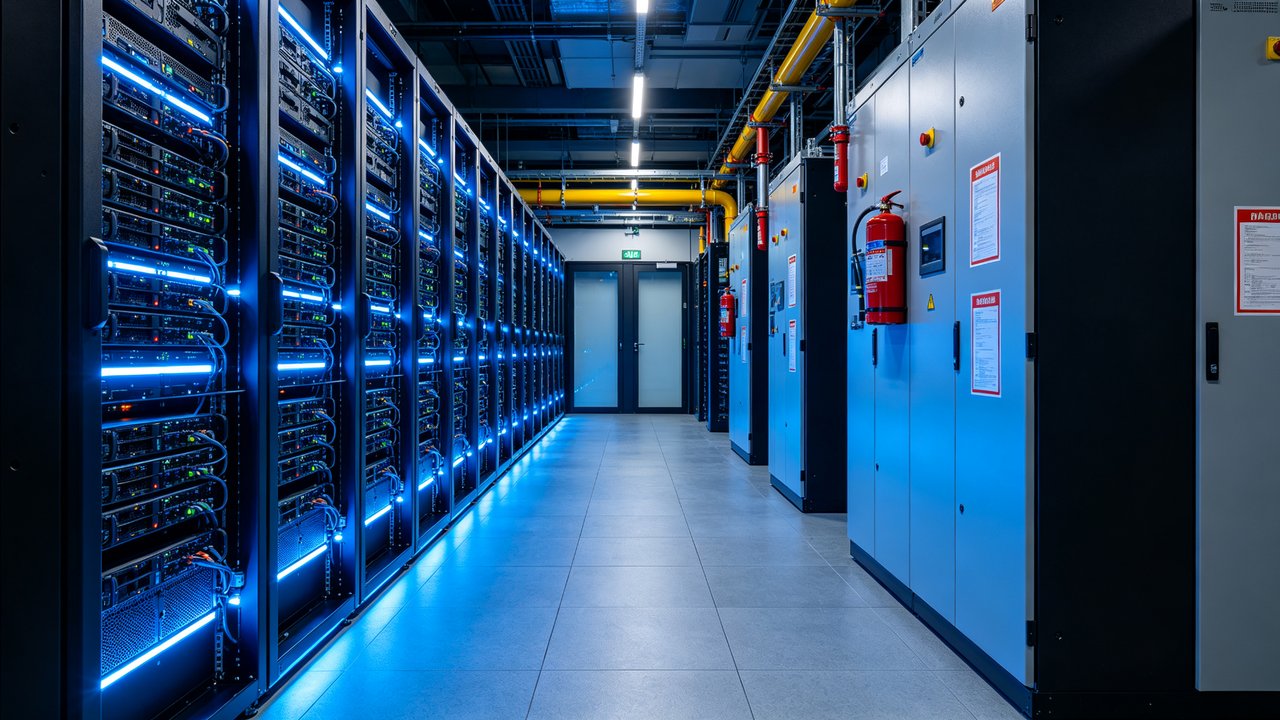
Unlike traditional facilities, data centers present a unique fire risk profile. High electrical density, continuous airflow for cooling, lithium-ion battery storage, and tightly packed server racks create conditions where a small ignition can escalate into a cascading failure within seconds. Because of this, data center operators must evaluate fire protection not as a compliance checkbox but as a core risk-management discipline.
The High Cost of Data Center Downtime
Downtime is the silent killer of data center P&L statements. The Uptime Institute consistently reports that major outages cost operators between $100,000 and over $1 million per incident, with the most severe cases crossing into eight-figure territory. Fire events are particularly damaging because they often require full rack replacement, environmental cleanup, forensic investigation, and weeks of validation before workloads can return.
This is why fire suppression architecture directly influences SLA commitments. A protection strategy that isolates a single compromised server without discharging across the entire white space preserves uptime for every other tenant, workload, and customer on the floor.
Active Suppression: Room-Level Gaseous Systems
Active suppression systems are the traditional default for data center fire protection. These include clean agent gases such as FM-200, Novec 1230, and inert gas blends like Inergen or Argonite, all designed to flood an entire room and suppress fire by displacing oxygen or interrupting the chemical chain reaction.
While effective at containing widespread fire, room-level gaseous suppression carries significant operational trade-offs:
- Total area discharge – The entire data hall is flooded, regardless of the fire's actual location.
- Operational shutdown – HVAC is typically isolated, and personnel evacuation is mandatory.
- Refill cost and downtime – After discharge, the room must be inspected, sealed, and refilled before operations resume.
- No component-level intelligence – The system cannot identify which rack or device originated the event.
For many operators, the cost of an unnecessary room-level discharge rivals the cost of the fire itself.
Passive Suppression: Granular Rack-Level Protection
Passive fire suppression takes a fundamentally different approach. Instead of flooding an entire room, it places the suppression medium directly at the point of risk — inside the server rack, the cabinet, or the individual enclosure where a fire is most likely to originate.
This category includes condensed aerosol generators, encapsulated chemical patches, and pre-engineered automatic units that activate based on localized heat detection. Because they do not require room evacuation, do not displace breathable air, and do not interrupt HVAC, they offer several operational advantages:
- Targeted response – Only the affected rack or device is treated, leaving the rest of the facility operational.
- No personnel evacuation – Safe for occupied spaces, supporting 24/7 staffing models.
- Minimal cleanup – No gas venting, no pressure balancing, no multi-day room recommissioning.
- Lower total cost of ownership – No cylinder banks, no piped distribution, no extensive room integrity testing.
FIREQUELL QuellPatch: Engineered for the Data Center Environment
The FIREQUELL QuellPatch represents a new generation of passive suppression purpose-built for data center and server room applications. It is a compact, self-contained condensed aerosol patch that mounts directly inside a server rack, on a PDU, above a battery bank, or within a network cabinet.
When the patch senses abnormal heat — well before a sustained flame or full-cabinet fire develops — it automatically discharges a potassium-based aerosol that chemically interrupts combustion at the molecular level. The discharge is electrically non-conductive, leaves no corrosive residue that would damage adjacent servers, and requires no external power source or mechanical trigger.
For data center operators, the operational benefits translate directly into uptime protection:
- Granular containment – A single QuellPatch addresses the incident at the rack of origin, preventing cross-rack propagation.
- Continuous operation – Adjacent racks, rows, and the broader data hall remain online.
- Rapid restoration – The protected rack can be swapped and returned to service in hours, not weeks.
- Scalable deployment – Operators can protect new build-outs incrementally, aligning capex with capacity expansion.
Choosing the Right Strategy for Your Facility
Active and passive suppression are not mutually exclusive. Many high-availability data centers deploy a layered approach: room-level gaseous systems as a final safety net, combined with granular rack-level units for first-line intervention. The strategic question is no longer whether to protect a data center, but how to protect it in a way that minimizes the operational blast radius of any fire event.
For colocation providers, hyperscale operators, and enterprise IT teams evaluating their next-generation fire protection strategy, FIREQUELL QuellPatch delivers the targeted, low-impact defense that modern uptime economics demand. Speak with a FIREQUELL specialist to model deployment across your rack fleet and quantify the avoided-downtime value for your specific SLA commitments.