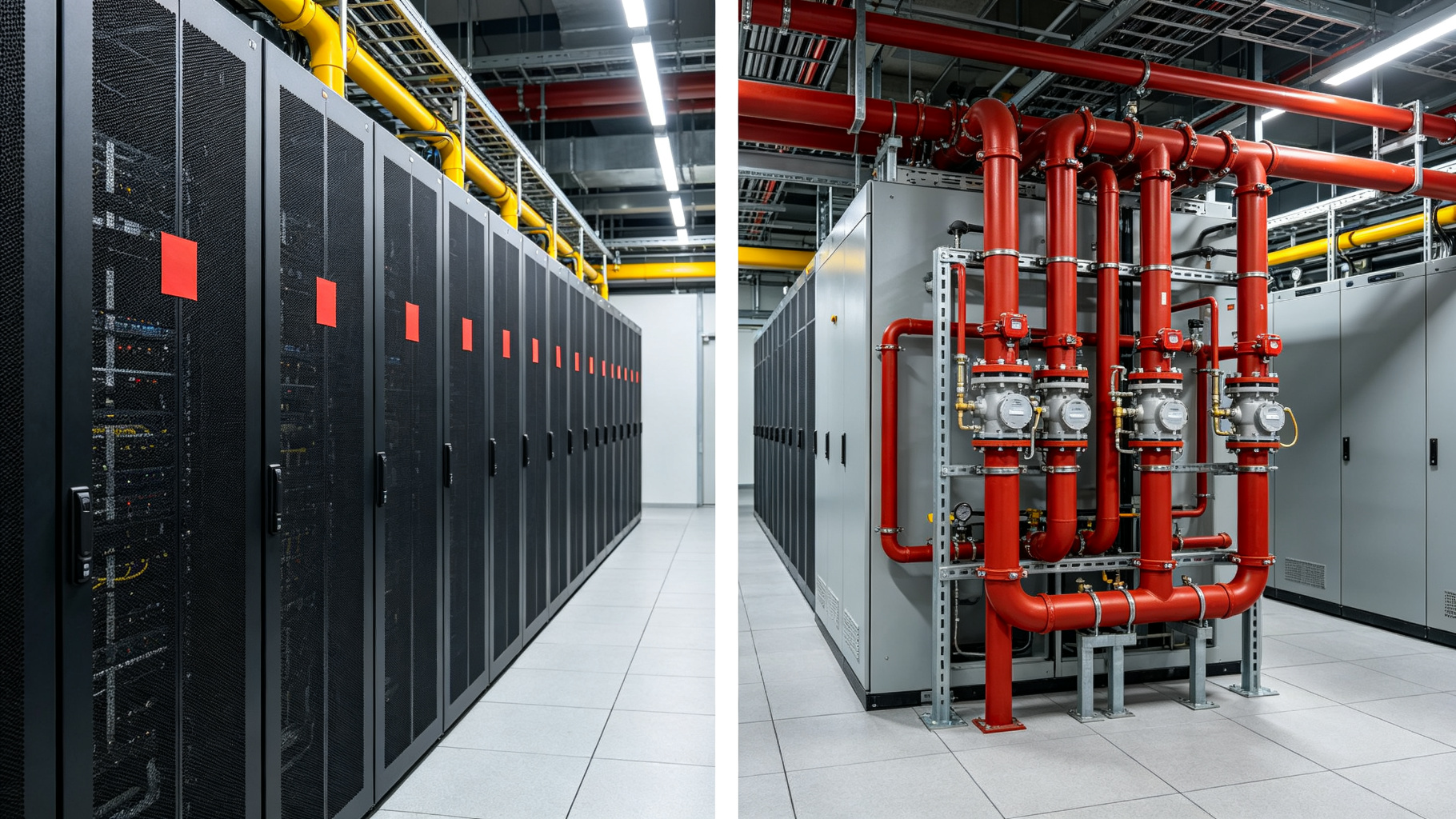
Technical guide on distributed suppression for electrical fire protection
Should you deploy individual suppression units at each hazard or rely on a single central system with a network of piping? Distributed and centralized fire suppression strategies each offer distinct trade-offs in cost, response time, and maintenance complexity. The right choice depends on facility layout, risk concentration, and the acceptable level of downtime during a fire event.
Fire system architecture for electrical infrastructure is usually framed as a choice between total-flooding protection and point-of-hazard protection. Centralized suppression relies on shared cylinders, piping, detection, and releasing controls to protect an entire enclosure or zone. Distributed suppression places self-contained devices at or near the equipment most likely to fail, reducing dependence on a common agent path. This article compares the two approaches using QuellPatch, a passive clean-agent patch product line containing microencapsulated FK-5-1-12, as the reference distributed technology. The comparison focuses on failure domains, activation timing, agent delivery, maintenance, and application fit for switchgear, motor control centers, UPS cabinets, relay panels, and similar electrical enclosures.
A centralized clean-agent system stores FK-5-1-12 in one or more pressurized cylinders located in a cylinder bank or protected space. When the detection and control panel receives an alarm condition, it activates a releasing valve, and agent flows through a manifold, piping, and nozzles to flood the protected enclosure. The architecture is well established for large, relatively tight spaces such as control rooms or electrical vaults where a uniform concentration can be maintained.
Its failure domain is also centralized. A single cylinder pressure loss, valve fault, piping obstruction, nozzle blockage, panel power issue, or detector wiring fault can affect protection for the entire zone. The system may include supervision for pressure or device trouble, but those supervisory features do not remove the shared dependencies in the agent distribution path.
Distributed suppression assigns suppression capacity to individual hazards rather than a common cylinder bank. QuellPatch products are self-contained patches mounted inside electrical enclosures, directly above or adjacent to components such as bus connections, terminal blocks, relays, capacitors, or circuit breakers. Each patch contains microencapsulated FK-5-1-12 within a polymer laminate. No external piping, detector, control panel, or power supply is required for operation.
The failure domain is therefore local. If one patch is damaged, improperly selected, or exposed to abnormal heat, the effect is generally limited to that patch or enclosure rather than an entire zone. This makes the architecture useful for dispersed assets, retrofits, and facilities where installing a central cylinder bank and pipe network would be costly or disruptive.
Centralized systems separate detection from discharge. Smoke or heat detectors must send a signal to the control panel, which may require cross-zoning, alarm verification, or a pre-discharge delay to allow personnel evacuation and door or damper closure. Once the releasing valve opens, a well-designed clean-agent system can discharge agent through the piping network in approximately 10 seconds or less, but the total event time includes detector response, panel logic, and any programmed delay. In a small electrical enclosure, an incipient arc or overheated connection can develop during that interval.
QuellPatch uses passive thermal activation. When the patch surface reaches its rated activation temperature, the microencapsulated shells rupture and release FK-5-1-12 directly at the hazard. There is no separate signal path, no software decision, and no pipe transit delay. Actual response depends on fire size, mounting location, and airflow, but the device begins discharging as soon as sufficient heat reaches the patch rather than after a panel confirms an alarm.
QuellPatch is available with activation temperatures of 80°C, 140°C, and 180°C. These ratings are selected based on the maximum normal temperature at the mounting location, not simply the room thermostat. A common engineering approach is to select an activation rating at least 20–30°C above the highest expected surface or air temperature at the patch location under worst-case load and ventilation conditions.
Because activation is thermal, placement is critical. Patches should be located where hot gases from a likely ignition source will impinge on the patch, while avoiding direct contact with normal hot surfaces that could cause premature discharge.
Centralized FK-5-1-12 systems are generally designed as total-flooding systems. For Class C electrical hazards, design concentrations commonly fall in the range of 4.5–6.0% by volume, depending on the hazard, enclosure geometry, and applicable design standard. The piping and nozzle layout must achieve that concentration throughout the enclosure and maintain it for a code-defined retention period, often 10 minutes, to prevent reflash.
Distributed patches do not attempt to create a uniform room concentration. Instead, they deliver FK-5-1-12 directly to the incipient fire location. The local concentration near the discharge point can be high enough to interrupt combustion before the fire spreads beyond the component of origin. QuellPatch is therefore described as local protection rather than total-flooding protection. Sizing is based on enclosure volume, internal airflow, and hazard severity using published application guidance; a single patch is not intended to protect an entire room.
Centralized systems depend on enclosure integrity. Open doors, unsealed cable penetrations, ventilation dampers, and missing panels can allow agent to escape before the required concentration is maintained. Room integrity testing and automatic door or damper closure are often part of the design. Internal obstructions can also create nozzle shadowing, leaving some compartments under-protected.
Distributed patches are less sensitive to overall enclosure leakage because agent is released inside the target compartment. They can be installed behind panels, above buswork, or in tight compartments where pipe nozzles cannot be aimed effectively. However, high forced-airflow can dilute or carry agent away from the hazard, so patches should be positioned with attention to cooling fan patterns and airflow paths. Open or naturally ventilated racks may require multiple units to cover separate ignition zones.
Centralized systems require structured maintenance: pressure or weight checks, control panel testing, detector sensitivity checks, battery replacement, and periodic cylinder inspection or hydrostatic testing according to the applicable standard and authority having jurisdiction. Cylinder service intervals vary, but internal and external inspections or hydrostatic tests may fall on 5- to 12-year cycles depending on cylinder type and local requirements.
QuellPatch has no pressure vessel, electrical circuit, or moving part. Routine maintenance consists primarily of visual inspection for physical damage, adhesion loss, contamination, or indication that the patch has discharged. The product has a 5-year service life from installation, after which replacement is recommended. This can reduce per-asset inspection time, but facilities must track installation dates because a patch that has exceeded its service life may not perform as intended.
A centralized system can be cost-effective for a large, sealed enclosure because one cylinder bank protects a substantial volume. Its disadvantages include space for cylinders and piping, coordination with shutdowns, and the possibility that a single system fault disables protection for a broad zone. Retrofits may also require ceiling or wall penetrations and enclosure sealing work.
Distributed patches can be added incrementally to individual enclosures, making them suitable for edge sites, older facilities, and equipment located in spaces not originally designed for fire suppression piping. Because each patch operates independently, protection can be scaled one cabinet at a time. The tradeoff is that passive patches do not inherently provide remote trouble or discharge signaling; unless separate monitoring is added, a discharged or damaged patch may be identified only during inspection.
Centralized and distributed suppression represent different approaches to fire system architecture rather than interchangeable products. Centralized FK-5-1-12 systems provide uniform total-flooding protection for large, tight enclosures but rely on detection, controls, piping, and enclosure integrity. Distributed QuellPatch devices provide local protection at the point of hazard using microencapsulated FK-5-1-12, passive thermal activation at 80°C, 140°C, or 180°C, and a 5-year service life.
For electrical infrastructure, the choice depends on enclosure size, leakage, ambient temperature, maintenance resources, retrofit constraints, and AHJ requirements. In many facilities, a hybrid architecture is appropriate: a centralized system for large zones or rooms, with QuellPatch added inside high-value or difficult-to-protect compartments where early, local suppression can reduce damage and downtime.
A: Distributed suppression is often practical for individual electrical enclosures, retrofits, edge sites, or compartments where piping runs, cylinder storage, or enclosure sealing would be disruptive. It is especially useful when adding protection to isolated cabinets, remote equipment rooms, or high-value electrical assets without modifying an existing centralized gaseous system.
A: Select the activation temperature based on the highest normal operating temperature at the mounting location, with a safety margin above that temperature. The 80°C variant is generally used in controlled, low-ambient electronics areas, 140°C for typical electrical cabinets with moderate heat rise, and 180°C for higher-temperature equipment or locations close to normal heat sources.
A: QuellPatch does not require pressure cylinders, periodic discharge testing, agent refills, or piping inspections common to centralized clean-agent systems. Maintenance is primarily visual: confirm the patch is securely mounted, inspect for damage or contamination, verify labels and replacement dates, and document the inspection during routine electrical PM cycles.
A: A centralized system must detect the fire, process the alarm, release cylinders, and distribute agent through piping and nozzles, which can take several seconds or longer depending on enclosure conditions. QuellPatch activates directly at the heat source when its rated 80°C, 140°C, or 180°C threshold is reached, reducing dependence on detection zoning, pipe routing, and enclosure flooding time.
A: No, because QuellPatch is a local point-protection device rather than a total-flooding system relying on a maintained enclosure concentration. This removes the need for room door-seal checks, enclosure pressure venting, and routine room integrity testing associated with centralized NFPA 2001 gaseous systems, although applicable building and fire codes still apply.
FIREQUELL QuellPatch delivers automatic, maintenance-free clean-agent protection for electrical panels, battery cabinets and control rooms — designed to meet FM Approved, UL Listed, CE and UKCA requirements.
Request a Site Assessment