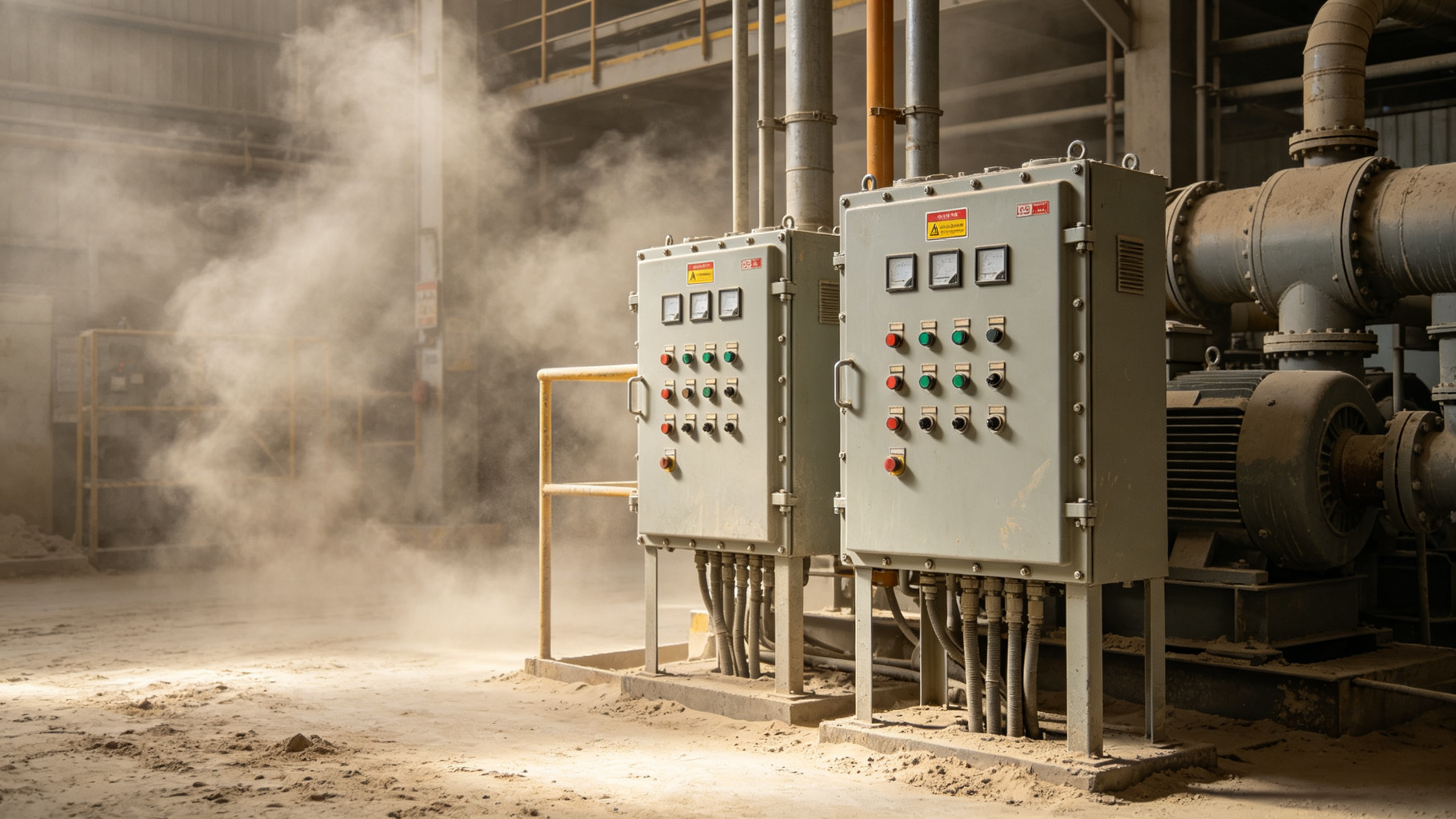
Technical guide on dust explosion for electrical fire protection
In facilities handling combustible dust, a minor spark can trigger a devastating explosion that propagates through ductwork and equipment. Electrical fire protection in these environments demands specialized suppression systems that can detect and extinguish flames before they escalate. Understanding the unique hazards of dust-laden atmospheres is the first step toward implementing a compliant safety solution.
Combustible dust environments convert ordinary electrical faults into coupled fire and explosion risks. In food, wood, pharmaceutical, metal-powder, recycling, and chemical processing facilities, fine dust accumulates on motor control centers, terminal blocks, variable-frequency drives, lighting circuits, and instrument enclosures. A loose lug, failing capacitor, or tracking arc can first ignite a thin dust layer; the resulting pressure wave or airflow can then loft accumulated dust into a suspended cloud, producing a secondary dust explosion. Electrical fire protection in these hazardous environments must therefore address both the incipient electrical ignition and the surrounding combustible dust atmosphere.
This article discusses how passive, clean-agent suppression patches fit into a dust hazard analysis, with emphasis on the QuellArmor product line. It covers ignition pathways, limitations of active systems, patch materials and activation, and engineering considerations for placement and service life.
A dust explosion requires combustible dust, dispersion in air within the explosible range, confinement, oxidant, and an ignition source of sufficient energy. Many combustible dusts have minimum ignition energies in the range of 1–500 mJ, and minimum explosible concentrations can be as low as tens of grams per cubic meter for fine materials. In normal operation, dust is often present as a deposited layer rather than a cloud, but layers are not benign: they can smolder, ignite, and be lofted by a first event or by process airflow.
Dust layer thickness matters because a layer insulates the surface beneath it and can reduce the temperature required for ignition. Housekeeping programs commonly target layer thicknesses below 0.8 mm (1/32 in) to limit flash-fire and secondary explosion fuel load. Even where equipment is rated for dusty locations, long-term dust accumulation can alter thermal behavior and cooling performance.
Electrical enclosures contain several potential ignition sources:
Dust worsens these conditions by blocking ventilation filters, coating heat sinks, and retaining heat around connections. Ingress protection ratings reduce dust entry but do not eliminate fine-particle accumulation over years of service. The result can be a localized hot spot inside an enclosure that is not visible from outside until a fire or pressure event has already developed.
Total-flooding clean-agent systems are designed to achieve a uniform concentration throughout an enclosure. In dusty facilities, that model can be challenged by several factors. Dust coatings on smoke or heat detectors can delay response or increase nuisance alarm rates. Nozzles and piping can become obstructed, and cable glands, ventilation openings, and poorly sealed doors allow agent to escape. By the time a detector signals a release and the agent reaches the far side of an enclosure, an incipient electrical fault may already have ignited a nearby dust layer.
Active systems also require electrical detection and control hardware. In classified hazardous environments, such equipment may need additional certification, periodic functional testing, and careful management of changes to enclosure integrity. Water-based suppression can cause prolonged electrical downtime, while dry-chemical residues can damage contacts and electronics. Manual extinguishers depend on rapid human response and may not be suitable for live electrical hazards until the equipment is de-energized. These limitations create a role for local, passive protection at the most probable ignition points.
QuellArmor patches use a flexible polymer matrix containing microencapsulated FK-5-1-12 clean agent. Microencapsulation isolates the agent in small polymeric shells until thermal activation occurs. The patch contains no pressurized cylinder, piping, nozzle, or electrical release circuit, which reduces the number of components that must be inspected and certified in a hazardous environment.
FK-5-1-12 is a non-conductive clean agent that vaporizes after discharge and leaves little or no residue on electrical contacts or circuit boards. It has zero ozone-depletion potential and a short atmospheric lifetime. In total-flood systems, FK-5-1-12 is commonly used at design concentrations of roughly 4–6% by volume for many electrical and flammable-liquid hazards. A patch does not create a total-flood concentration by itself; instead, it delivers agent directly at the point where an incipient fire is most likely to begin, reducing the time between overheating and agent application.
QuellArmor patches activate passively when local heat raises the patch to its rated temperature. The polymer shells soften or rupture, releasing the microencapsulated FK-5-1-12, which then vaporizes and interacts with the developing flame. Because activation depends on surface temperature rather than an external detector, the patch is not blinded by dust in the same way as an optical or smoke sensor, although heavy dust accumulation can still slow heat transfer and should be controlled.
The product line is available in three activation ratings: 80°C, 140°C, and 180°C. Selection should be based on the maximum normal surface temperature of the protected component, not on room ambient temperature alone.
An engineering margin of approximately 20–40°C above the highest expected normal surface temperature is a reasonable starting point for selection. Thermographic surveys under load can help identify whether a proposed patch location will remain below the chosen activation threshold during normal operation.
QuellArmor patches are point-of-use devices, not area explosion-suppression systems. Their value is highest when placed close to probable ignition sources identified in a dust hazard analysis. Typical locations include terminal blocks, contactor coils, relay bases, bus connections, VFD capacitors, power supplies, and the interiors of sealed junction boxes. Placement should follow heat-source mapping rather than uniform spacing alone.
Patches should not block ventilation openings, impede moving parts, or cover access points required for maintenance. In large or leaky enclosures, multiple patches may be needed to address separate high-risk components. The installed assembly should be evaluated with the authority having jurisdiction, especially where electrical equipment is marked for hazardous location use.
QuellArmor patches have a 5-year service life under specified indoor service conditions. They should be inspected periodically for adhesion, physical damage, capsule integrity, and excessive dust loading. Patches that have activated, detached, or show signs of damage should be replaced promptly; otherwise, replacement should follow the 5-year service interval.
The patches are one layer in a broader combustible dust control strategy. They do not replace dust housekeeping, explosion venting, chemical or mechanical isolation, bonding and grounding, electrical preventive maintenance, or proper equipment temperature classification. Their intended role is to reduce the probability that a small electrical fault becomes the ignition source for a dust fire or explosion.
Dust explosions frequently begin with small electrical ignitions inside enclosures that are difficult to monitor continuously. In combustible dust environments, electrical fire protection should therefore combine source control, housekeeping, explosion protection, and rapid suppression at the ignition point. QuellArmor patches use microencapsulated FK-5-1-12 and passive thermal activation at 80°C, 140°C, or 180°C to provide local, non-conductive clean-agent release without external power or detectors. When selected with appropriate temperature margins, placed near known hot spots, and maintained within their 5-year service life, they can serve as a useful component of a layered dust hazard mitigation program.
A: No. QuellArmor is designed for incipient electrical fires at or near the protected component inside an enclosure. It is not a substitute for explosion venting, isolation, chemical suppression, or other deflagration-protection systems required by the dust hazard analysis and applicable codes.
A: A 140°C patch is often appropriate for general motor control centers where normal surface temperatures stay below about 100–110°C. Use an 80°C patch for sensitive electronic compartments with lower operating temperatures, and consider 180°C only for high-temperature compartments where measured normal conditions justify the higher rating.
A: Yes. FK-5-1-12 is electrically nonconductive and leaves no residue, so it will not short out energized electrical or electronic components. In dusty environments, its value is that it releases directly at the protected component without relying on nozzle networks, detectors, or piping that can become fouled.
A: Dust can foul detectors, block nozzles, coat sensors, and interfere with the mechanical or electrical components needed for active suppression to operate. Heavy dust layers can also insulate surfaces and change heat-release behavior, reducing the reliability of systems that depend on remote detection and agent distribution.
A: QuellArmor should be treated as a localized fire-control layer for electrical ignition sources identified in the Dust Hazard Analysis, not as the primary explosion-protection strategy. The DHA should still define housekeeping, equipment classification, ventilation, isolation, venting, and explosion-suppression measures where combustible dust hazards exist.
FIREQUELL QuellPatch delivers automatic, maintenance-free clean-agent protection for electrical panels, battery cabinets and control rooms — designed to meet FM Approved, UL Listed, CE and UKCA requirements.
Request a Site Assessment