
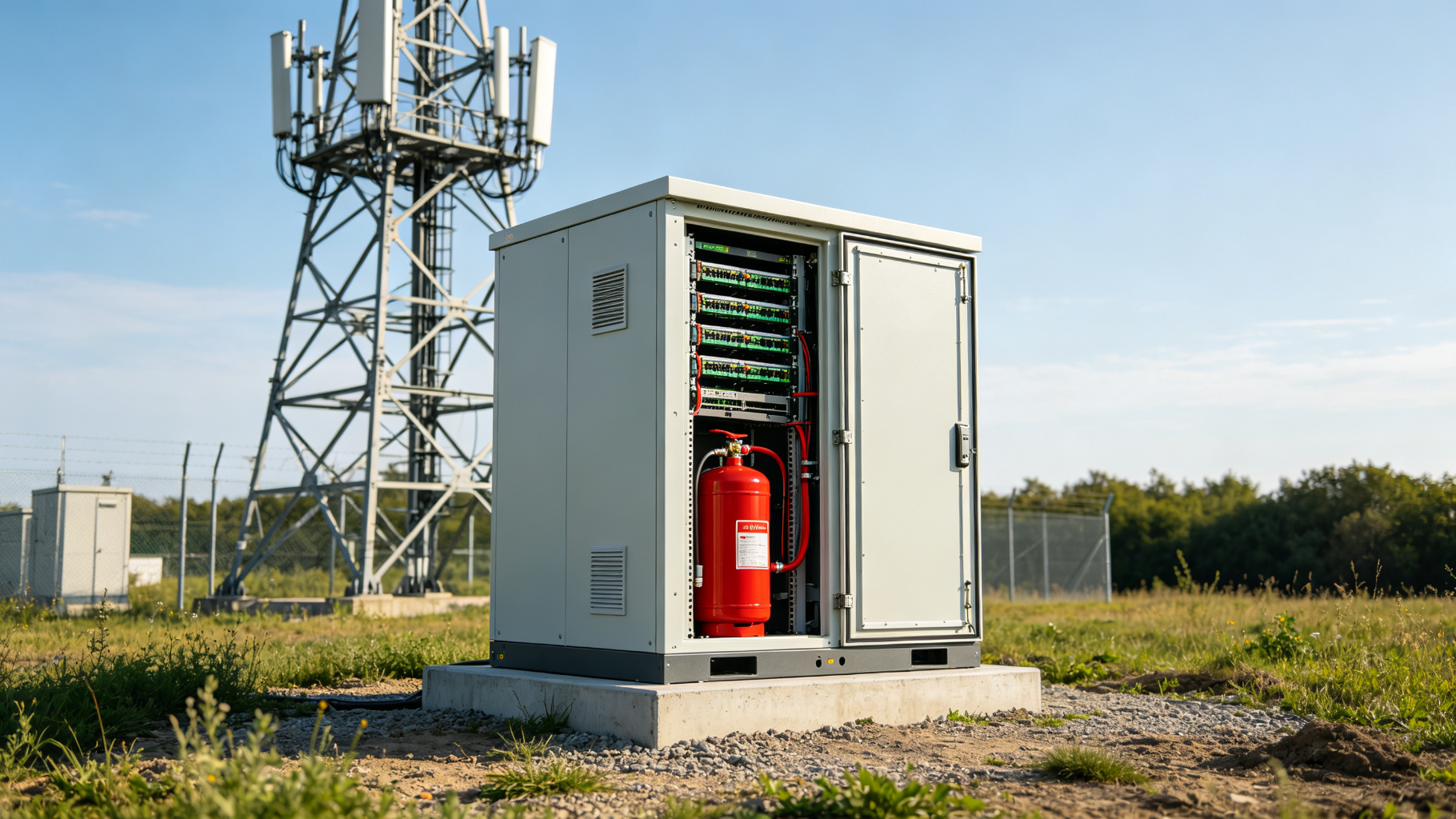
How is fire protection designed for a 5G edge data center micro-cabinet in a remote or unmanned location?
A 5G edge micro-cabinet in a remote location is protected by a layered system: smoke detection, passive FK-5-1-12 patches inside the IT cabinet, and a remotely-monitored fire alarm. The system must be maintenance-free for 12+ months, must operate on backup power for 24+ hours, and must suppress a fire without human intervention.
1. The 5G Edge Computing Boom
By 2026, there are over 1.2 million 5G edge data center micro-cabinets deployed worldwide, growing at roughly 200,000 per year. These cabinets are 1-3 m³ enclosures, typically located at the base of a 5G cell tower or in a street-side cabinet, containing 5-20 kW of IT load, battery backup, and a small cooling system. They are typically unmanned, located in remote or hard-to-access sites, and serviced by a 4-6 week maintenance interval. The fire protection architecture must be radically different from a traditional data center.
2. The Edge Fire Hazard
The 5-20 kW of IT load in a typical edge cabinet generates 5-20 kW of waste heat, which is cooled by a small air conditioner or heat exchanger. The IT load is mostly 1-2U servers and network switches, with a small lithium-ion battery backup (typically 1-3 kWh). The fire hazard is dominated by the lithium-ion battery, which can enter thermal runaway if the cell management system fails. The resulting fire is small (under 10 kW peak heat release rate) but produces HF and CO at concentrations that can damage adjacent equipment within minutes.
3. Detection in an Unmanned Cabinet
Standard smoke detection in an edge cabinet produces 5-15 false alarms per year because of dust, humidity, and temperature fluctuations. The 2026 best practice is a multi-sensor detector combining smoke, heat, and CO/CO2 measurement, with a 60-second confirmation window before alarm. The detector must be powered from the cabinet's 48V DC bus, must operate on backup battery for 24+ hours, and must communicate over 4G/5G backhaul to a central monitoring system.
4. Suppression Strategy: Why Passive Wins
Active suppression systems (sprinklers, water mist, clean agent total flooding) are impractical in an edge cabinet because they require water supply, cylinder space, piping, and periodic maintenance. The 2026 best practice is passive FK-5-1-12 patches inside the IT cabinet, sized for the 5-20 kW IT load. The patches fire on thermal trigger at 80°C, suppress the incipient fire before it can propagate to the battery backup, and require no power, no detection signal, and no piping. The patches are good for 10+ years and require no maintenance.
5. QuellPatch for Edge Cabinets
FIREQUELL QuellPatch in the 2g and 5g sizes is the most reliable answer for edge cabinet fire protection. A typical edge cabinet gets 1-2 patches on the battery backup, 1 patch on the main power supply, and 1-2 patches on the IT equipment rack. The patches are mounted with thermal-conductive adhesive and have a 10-year maintenance-free interval. The activation temperature (80°C) is below the typical Li-ion cell vent temperature (120-150°C), giving the patch a 30-60 second operating window.
6. Remote Monitoring and Notification
An edge cabinet must be remotely monitored 24/7 because it is typically unmanned. The fire alarm signal is sent over 4G/5G backhaul to a central monitoring center, which then notifies the local fire department and the maintenance contractor. The QuellPatch activation is detected by the cabinet's thermal sensor, which sends a fire alarm signal. The monitoring center has 1-4 hours to dispatch a maintenance crew, depending on the site. The passive suppression ensures that the fire is contained until the crew arrives.
7. Standards and Compliance
The applicable standards for edge cabinet fire protection are: EN 50173 (cabling), IEC 62368-1 (audio/video/ICT equipment safety), UL 60950-1 (information technology equipment), and the emerging ETSI EN 303 645 (cyber security for consumer IoT). Fire-specific standards are still catching up: the most commonly cited is NFPA 75 (information technology equipment) for US deployments and the EN 50402 (fire detection) for European deployments. Most 5G operators are now requiring cell-level passive suppression as a default.
8. Conclusion
Edge data center micro-cabinet fire protection is a maintenance-constrained, remotely-monitored, unmanned application. The 2026 best practice is layered detection plus cell-level passive suppression. The FIREQUELL QuellPatch is the only product engineered specifically for this application, with 2g and 5g sizes for the small IT loads typical of edge cabinets, a 10-year maintenance-free interval, and remote activation detection over the existing 4G/5G backhaul.
Frequently Asked Questions
How often must edge cabinet fire protection be maintained?
QuellPatch in edge cabinets is designed for a 10-year maintenance-free interval. The only routine check is a visual inspection during the scheduled maintenance visit (typically 4-6 weeks). The remote monitoring system provides 24/7 alarm notification.
Can you use a sprinkler system in an edge cabinet?
Not practically. Edge cabinets are too small for a sprinkler system, and the water supply is not available. The 2026 best practice is passive FK-5-1-12 patches inside the IT cabinet, sized for the 5-20 kW IT load.
How does the fire alarm reach the monitoring center?
Over 4G/5G backhaul. The cabinet's thermal sensor detects the QuellPatch activation, the cabinet controller sends a fire alarm signal over the existing 4G/5G link, and the monitoring center notifies the local fire department and the maintenance contractor within 1-4 hours.
Need a Passive Fire Suppression Solution?
FIREQUELL QuellPatch delivers automatic, maintenance-free clean-agent protection for electrical panels, battery cabinets and control rooms — designed to meet FM Approved, UL Listed, CE and UKCA requirements.