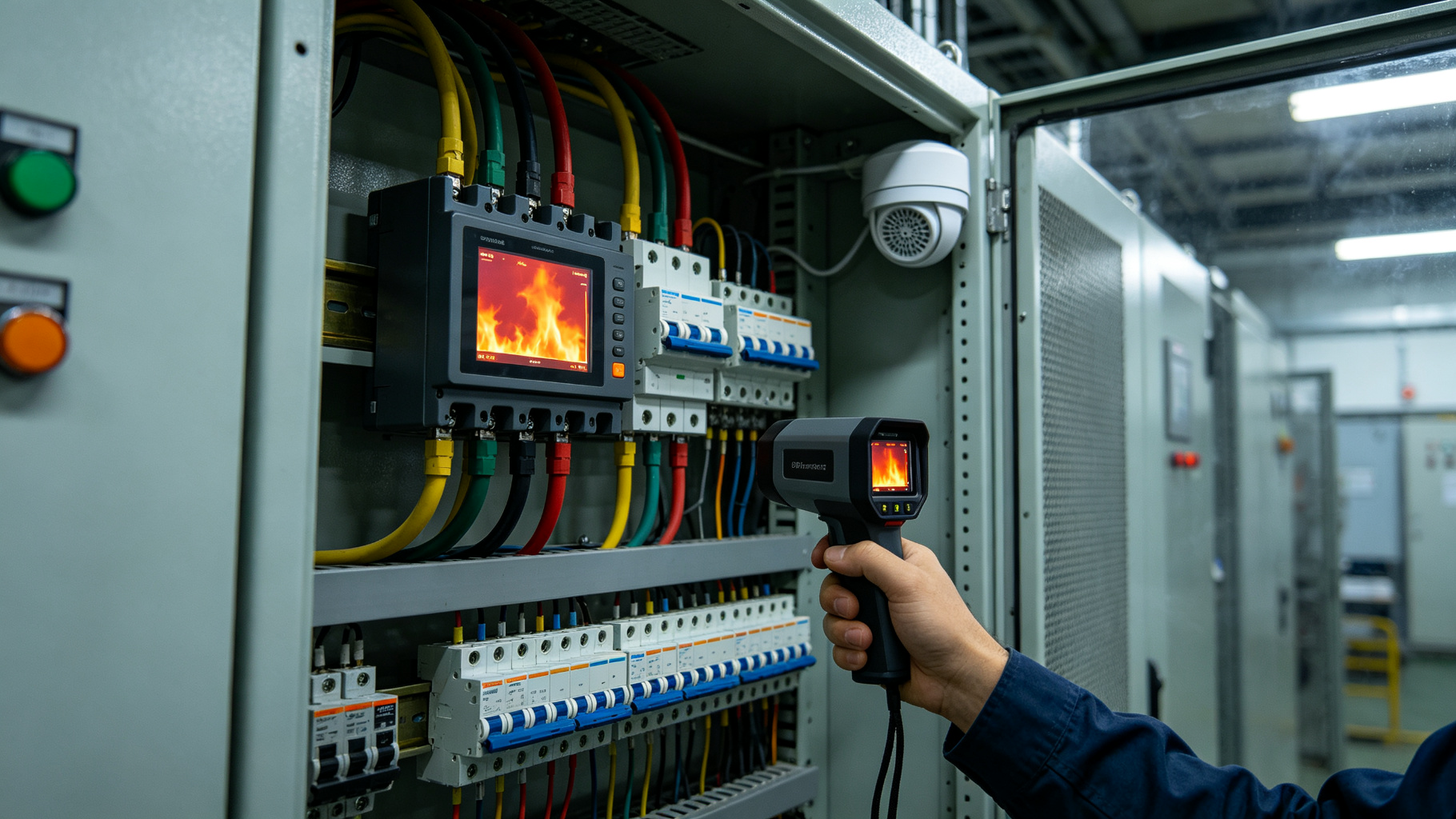
Technical guide on early fire detection for electrical fire protection
The difference between a minor electrical fault and a catastrophic fire often comes down to how quickly it is detected. Early detection systems, such as aspirating smoke detectors and linear heat sensing cables, can identify overheating components before visible flames appear. This proactive approach enables intervention during incipient stages, protecting both assets and business continuity.
Electrical fires frequently begin as localized thermal faults: a loosened busbar joint, an overloaded terminal, a failing contactor, or degraded insulation. In many incidents, smoke and flame appear only after minutes or months of resistive heating. By the time a ceiling smoke detector or room heat sensor responds, the fault may have already spread through a motor control center, switchgear cubicle, or cable compartment. Early fire detection therefore depends on identifying abnormal heat close to its source, before the transition to open flame.
For electrical infrastructure, detection is complicated by enclosure geometry. Metal housings retain heat, dilute smoke, and block line-of-sight thermal cameras. Dust, airflow, and normal load cycling can further mask incipient signals. A practical approach uses layered sensing: electronic or linear thermal detection for broad coverage, fire alarm inputs for notification, and compact passive devices inside compartments where powered sensors are difficult to install or maintain. The QuellPatch product line is designed for this last role, using fixed-temperature passive thermal activation to release microencapsulated FK-5-1-12 clean agent directly at the point of overheating.
Most electrical faults follow a recognizable thermal sequence. Increased resistance at a connection produces I²R heating, which raises conductor and insulation temperatures. Polyvinyl chloride, cross-linked polyethylene, thermoset composites, and phenolic circuit boards begin pyrolysis at temperatures that can range from roughly 100°C to more than 200°C, depending on material formulation and duration. Early signatures include local temperature rise, volatile organic compounds, discoloration, and subtle odor before visible smoke or flame develops.
Enclosures alter these signatures. A sealed cubicle may contain hot gases until a gasket fails or a door is opened, while a ventilated cabinet may exhaust smoke before it reaches a ceiling detector. Heat, by contrast, remains concentrated near the fault and is often the most reliable early indicator inside the compartment.
A fixed-temperature detector must balance two conditions. It must activate below the temperature at which adjacent materials ignite or sustain thermal damage, but it must remain inactive during normal operating temperatures, including temporary overloads and high ambient conditions. A threshold set too low increases nuisance discharges; one set too high delays response. For electrical compartments, engineering selection typically considers maximum measured surface temperature, expected ambient temperature, equipment insulation class, and the ignition temperature of nearby combustible materials.
Resistance temperature detectors, thermocouples, thermistors, and continuous thermal cameras provide quantitative temperature data. Point sensors can achieve accuracies in the range of ±0.5°C to ±2°C under controlled conditions, making them useful for critical busbar joints and transformer connections. Thermal cameras can scan multiple components, but they require line of sight and are affected by emissivity, reflective metal surfaces, and enclosure doors.
These systems require power, communication wiring or wireless infrastructure, calibration, and cybersecurity consideration for network-connected devices. They are valuable for condition monitoring, but they may not be cost-effective or practical in every low-voltage compartment, junction box, or remote cable pit.
Linear heat detection cable is commonly used in cable trays, bus ducts, and ceiling voids. Analog or digital cables can report a heat condition along their length and connect to addressable fire alarm panels. Response depends on cable proximity to the hot surface, contact pressure, ambient temperature, and the selected alarm temperature. Linear heat is effective for spreading hazards but may not pinpoint a small terminal fault if the cable is routed more than a few hundred millimeters away.
Photoelectric smoke detectors and aspirating smoke detection systems can identify particles from overheated insulation. They are often applied in electrical rooms and data halls, but their response inside closed equipment depends on smoke transport. Dust, fiber debris, and airflow from cooling fans can produce delayed or ambiguous signals.
Arc-fault monitors, leakage current sensors, and power-quality analyzers detect abnormal electrical behavior rather than heat. They can identify series arcs or insulation degradation that thermal sensors may miss if the fault is intermittent. Gas and VOC detectors can also sense pyrolysis products at very early stages. These technologies generally require baseline commissioning and signal interpretation; they may produce false or ambiguous alarms from normal switching, load changes, or background contaminants.
QuellPatch patches use a polymer matrix containing microencapsulated FK-5-1-12 clean agent. Each microcapsule is engineered to respond to temperature: when the local surface or surrounding air reaches the patch’s rated activation temperature, the capsule material softens or ruptures and releases the agent. FK-5-1-12 is electrically non-conductive and vaporizes after discharge, which reduces residue concerns on switchgear, circuit boards, terminals, and control components.
The product line offers fixed activation temperatures of 80°C, 140°C, and 180°C. Because activation is purely thermal, the patch requires no external power, battery, control circuit, or software. It functions as a distributed, point-type thermal release device: detection and agent discharge occur at the same location, reducing the transport delay that affects smoke and heat detectors mounted outside an enclosure.
The 80°C variant is suited to confined electronic compartments, control panels, or low-voltage spaces where normal ambient and component temperatures remain well below the threshold. The 140°C variant is commonly considered for general switchgear, motor control centers, and terminal compartments where surfaces may run warm under load but should not approach pyrolysis temperatures. The 180°C variant is intended for higher-ambient industrial locations, heavy busway connections, or areas near heat-generating equipment where lower thresholds could produce nuisance activation.
As a design guide, the selected threshold should sit above the maximum expected operating temperature at the mounting location with a practical margin, while remaining below the temperature at which adjacent insulation or structural materials could ignite. Thermographic surveys under load can help establish that baseline.
QuellPatch products have a specified 5-year service life under intended ambient and mounting conditions. They do not require field calibration, but they should be visually inspected during routine electrical maintenance and replaced if damaged, dislodged, exposed to incompatible chemicals, or after discharge. The replacement date should be recorded in the asset maintenance log.
Passive thermal activation does not by itself transmit a signal to a fire alarm panel. Where notification is required, patches should be used with addressable heat detectors, linear heat modules, enclosure-mounted smoke detectors, or other listed initiating devices connected to the fire alarm system. This combination provides local suppression with building-wide notification and emergency response.
Early response requires proximity. Patches should be installed near high-resistance or high-current locations such as terminal blocks, circuit breaker lugs, busbar joints, contactor coils, fuse holders, and cable splice compartments. Mounting on an interior wall or bracket within 100–300 mm of the target surface is generally preferable to mounting on the outer door, where thermal lag can be significant. Installation must maintain required electrical clearances and avoid contact with moving parts or live conductors unless the device is explicitly rated for that use.
No single sensor addresses every electrical fire signature. A layered program may include:
Each layer should be zoned and identified at the fire alarm panel so maintenance staff can locate the affected compartment quickly.
Before setting thresholds, conduct a baseline thermographic inspection under representative load. Record normal temperatures, hotspot locations, ambient conditions, and patch placement. Inspect patches during scheduled shutdowns, verify that labels and replacement dates are legible, and confirm that adjacent detectors have not been obstructed by wiring or equipment changes. Connected fire alarm devices should be tested in accordance with applicable standards and local code requirements.
Electrical fire early detection is most effective when sensing is placed close to the fault and matched to the thermal environment of the equipment. Electronic monitoring, linear heat, smoke detection, and electrical signature analysis each provide useful information, but they may be delayed by enclosures, distance, or environmental conditions. QuellPatch adds a passive thermal response inside the compartment: microencapsulated FK-5-1-12 activates at 80°C, 140°C, or 180°C without external power and discharges directly at the overheating location. With a 5-year service life and minimal maintenance requirements, it can be integrated into a layered detection program alongside conventional fire alarm devices. Proper threshold selection, placement, inspection, and documentation remain essential for reliable performance.
A: No. QuellPatch is a passive thermal activation and local FK-5-1-12 discharge device; it does not by itself transmit an alarm signal to a fire panel or monitoring station. A code-compliant building fire alarm system with listed initiating devices is still required for general notification, emergency response, and code compliance.
A: Select the setpoint based on the maximum expected temperature at the mounting location and the ignition or damage temperature of nearby materials. The 80°C variant is typically used in cooler electronic compartments, 140°C for higher-ambient electrical enclosures, and 180°C for hot engine or industrial compartments where normal operating temperatures are elevated.
A: No. FK-5-1-12 is a clean agent that vaporizes during discharge and leaves no powder, liquid residue, or corrosive byproduct on energized electrical equipment. It is electrically non-conductive and suitable for protecting sensitive electronics, switchgear, and control panels when discharged at listed design concentrations.
A: Overheated wiring, terminations, breakers, and busbars can show abnormal heating well below open-flame temperatures; QuellPatch uses 80°C, 140°C, or 180°C activation thresholds depending on the compartment. For comparison, common PVC insulation can begin degrading around 100–120°C, while sustained arcing and ignition can produce far higher localized temperatures.
A: Detection alone provides warning but does not stop a fire inside a closed electrical compartment, where flames can spread before personnel respond. A layered approach combines listed detection or alarm coverage with local suppression such as QuellPatch, which activates thermally and discharges FK-5-1-12 directly at the protected risk.
FIREQUELL QuellPatch delivers automatic, maintenance-free clean-agent protection for electrical panels, battery cabinets and control rooms — designed to meet FM Approved, UL Listed, CE and UKCA requirements.
Request a Site Assessment