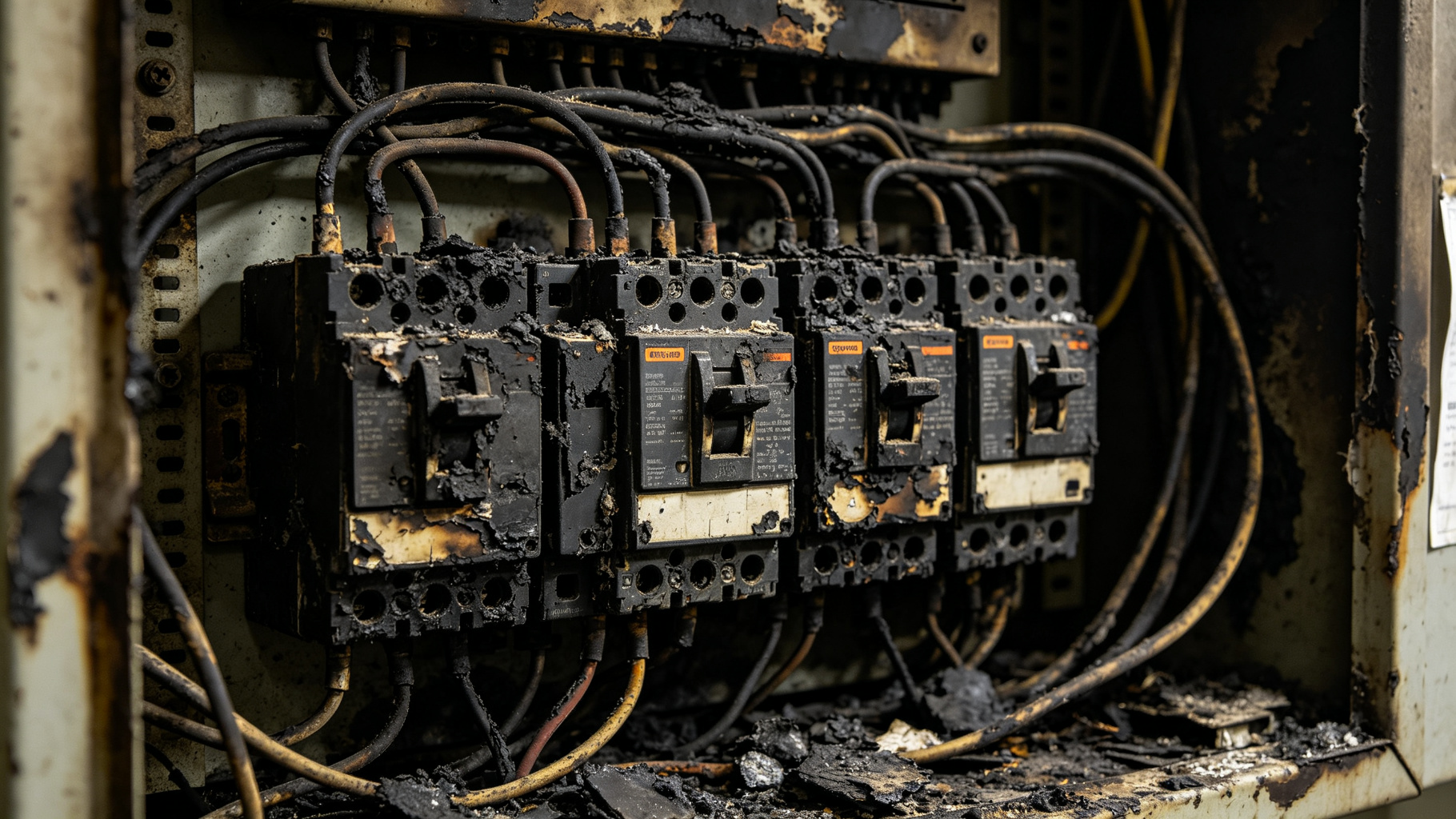
Technical guide on electrical fire incident for electrical fire protection
When an electrical fire breaks out, the aftermath is often a maze of investigation, liability, and costly downtime. Real-world incident reports reveal that most of these fires stem from arc faults, overloaded circuits, or faulty equipment—not random chance. Analyzing these cases shows why targeted electrical fire protection is critical for preventing repeat incidents and minimizing operational disruption.
Electrical fire incident reviews consistently show that major losses rarely begin as dramatic, whole-room events. They begin as localized failures: a loosened busway joint, an aging contactor, a partially degraded insulator, or a cable termination operating just outside its thermal design limit. By the time building smoke detectors respond, the ignition source may already be shielded inside metal-enclosed equipment, where standard suppression discharge can be delayed or diluted.
This article examines representative electrical fire case analysis findings from enclosed electrical infrastructure and translates them into engineering lessons for passive protection. The discussion focuses on failure modes that are difficult for conventional detection to catch early, and on how the QuellPatch product line uses microencapsulated FK-5-1-12 clean agent and passive thermal activation to address the fire at its point of origin. The cases below are composites drawn from common investigation patterns; specific values are used to illustrate thermal and electrical behavior rather than to describe a single public report.
The first case involved a 1,200 A busway run in a colocation facility. Monitoring showed a gradual 14% increase in phase current over six months following additional server load. No immediate alarm was generated. During a routine thermal scan, an inaccessible joint behind a solid cover was not measured. Approximately three weeks later, smoke was observed exiting a busway plug-in box.
Fire investigation found that the likely origin was a bolted busway joint where contact force had decreased over time. The joint resistance had increased from an expected range near 45 µΩ to approximately 320 µΩ. At 1,000 A, the local I²R heating was therefore on the order of:
P = I²R = (1,000)² × 320 × 10⁻⁶ ≈ 320 W
That heat was concentrated in a small contact area rather than distributed along the busbar. Internal temperatures were estimated to have exceeded 220°C before ignition of adjacent insulation and cable materials. The room gaseous suppression system discharged, but post-incident modeling suggested the metal busway housing slowed agent penetration to the exact joint surface.
The key lesson was not that detection was absent, but that the fire started in a concealed, energized compartment with limited air exchange. Conventional spot smoke detection saw products of combustion only after they left the housing. Infrared inspection also missed the fault because the energized cover could not be opened safely during load conditions and the external surface temperature did not reflect the internal hot spot.
For this type of failure, local protection inside the enclosure is valuable. A QuellPatch unit rated for 80°C activation could be placed near the joint plane, where busbar surface temperatures under normal conditions typically remain below 60–65°C. If the joint enters a thermal runaway condition, passive thermal activation can release FK-5-1-12 directly at the source before the fault develops into a larger enclosure fire.
The second case involved a 150 kW DC electric vehicle charging cabinet. Investigation focused on the main DC contactor and surrounding cable terminations. Repeated cycling had caused contact erosion and increased resistance at one pole. Thermal aging of the contactor housing and nearby insulation followed.
Data logs showed intermittent load imbalance before the event, but no temperature signal was available at the contactor itself. The cabinet smoke detector alarmed after visible flame had already spread to a wiring harness. The local fire service used a dry-chemical extinguisher. The fire was contained, but cleanup required replacement of multiple power modules because of residue and corrosion concerns.
This case illustrates two recurring failure lessons. First, electrical enclosures often contain both high-current switching devices and densely packed control wiring. A small arc or overheated contact can ignite wiring insulation long before cabinet-level smoke detection reaches alarm thresholds. Second, after fire control, residue from conventional extinguishers can increase downtime and repair cost in electronic equipment.
FK-5-1-12 is electrically nonconductive and vaporizes after discharge, leaving little to no residue. In a QuellPatch assembly, the agent is held in microencapsulated form and released only when the capsules reach their rated temperature. For charging cabinets with high normal ambient temperatures around power electronics, a 140°C or 180°C variant may be more appropriate than an 80°C variant, depending on measured surface temperatures and thermal margins.
Across investigations, several common conditions appear:
These patterns explain why fire case analysis should look beyond the first fuel and examine the thermal path from component failure to detection. A connection that reaches 180°C internally may produce only a modest exterior temperature rise while still degrading nearby polymer insulation.
Total-flood clean-agent systems are designed for protected volumes, but their effectiveness depends on agent reaching the flame at sufficient concentration. In electrical enclosures, internal partitions, cable bundles, and equipment subcompartments can create local zones where concentration builds more slowly. A passive device located near the probable failure point can reduce that delay.
QuellPatch uses microencapsulation to store FK-5-1-12 until thermal exposure activates the capsules. The mechanism does not require external power, control panels, or pneumatic piping. When the local temperature reaches 80°C, 140°C, or 180°C, depending on the selected variant, the capsule shells soften and release agent directly into the compartment. This approach is best understood as point-of-origin protection rather than a replacement for room-scale suppression.
The engineering choice in QuellPatch is matching the activation threshold to the equipment’s normal thermal profile. The 80°C variant is suitable for compartments where normal surface temperatures remain well below the threshold, such as accessible busway joints or low-voltage distribution sections. The 140°C variant provides a wider margin for cable compartments and control cabinets with elevated ambient conditions. The 180°C variant is intended for higher-temperature environments near power conversion equipment, transformers, or heat-producing assemblies where a lower threshold could produce unwanted activation.
Because activation is thermal, response depends on heat flux and proximity to the hot surface. Mounting the patch inside the enclosure, close to known high-risk terminations or contactors, improves the likelihood of early release. It should not be applied in a way that reduces electrical clearance or creates a path to energized parts. Installation should maintain required creepage and clearance distances and follow the manufacturer’s mounting instructions.
QuellPatch units have a 5-year service life from installation under specified service conditions. Unlike pressurized cylinders, they do not require pressure gauges or hydrostatic testing. However, they should be included in periodic visual inspections for physical damage, detachment, capsule weeping, or exposure to temperatures outside the intended range.
After a known electrical fire incident or activation event, affected patches should be replaced. Fire investigation teams may also note the location and condition of activated units as evidence of thermal exposure, although such evidence should be interpreted alongside other data such as arc marks, melting patterns, and electrical logs.
Electrical fire incident analysis repeatedly points to the same gap: the most dangerous faults often begin inside energized, enclosed equipment where detection and suppression are slow to reach. The busway and charging-cabinet cases show how localized heating, shielded compartments, and changing loads can combine to produce avoidable damage. The failure lessons are practical: inspect for high-resistance connections, reassess thermal margins after load changes, and protect probable ignition points directly.
QuellPatch addresses these failure modes by combining FK-5-1-12 clean agent, microencapsulation, and passive thermal activation in 80°C, 140°C, and 180°C variants. When selected and placed according to equipment temperature profiles, it can provide local suppression at the earliest stage of an electrical fire. It remains one layer within a broader fire-protection program that should include code-compliant detection, building suppression, maintenance, and emergency response procedures.
A: Choose the activation temperature based on the maximum normal surface or air temperature in the compartment, plus an engineering margin. The 80°C variant is commonly used for cooler distribution or electronic compartments, 140°C for general electrical panels and moderate-temperature equipment, and 180°C for high-load compartments where normal operating temperatures are significantly higher.
A: No. QuellPatch provides localized, point-of-origin protection inside electrical enclosures and is not a replacement for code-required total-flood gaseous systems, sprinklers, smoke detection, or fire-service response. It is intended to suppress an incipient fire at the source while the building-level fire protection strategy remains in place.
A: No. FK-5-1-12 is a clean agent that vaporizes and leaves no powder, oil, or sticky residue on electrical or electronic components. Because it is electrically nonconductive, it is suitable for use around energized equipment when applied according to the listed product design and enclosure conditions.
A: The busway incident involved concealed joint degradation that produced localized overheating before developing into an electrical fire. The failure pattern highlights the risk that poor connections, thermal cycling, and inaccessible joints can create hot spots not easily detected by visual inspection alone.
A: EV charging contactors can degrade from repeated high-current switching, thermal cycling, contact wear, and loose or resistive connections. As resistance increases, localized temperatures rise and can ignite nearby insulation or plastic components, making point-of-origin suppression near the contactor a useful layer of protection.
FIREQUELL QuellPatch delivers automatic, maintenance-free clean-agent protection for electrical panels, battery cabinets and control rooms — designed to meet FM Approved, UL Listed, CE and UKCA requirements.
Request a Site Assessment