Technical guide on electrical panel fire risk for electrical fire protection
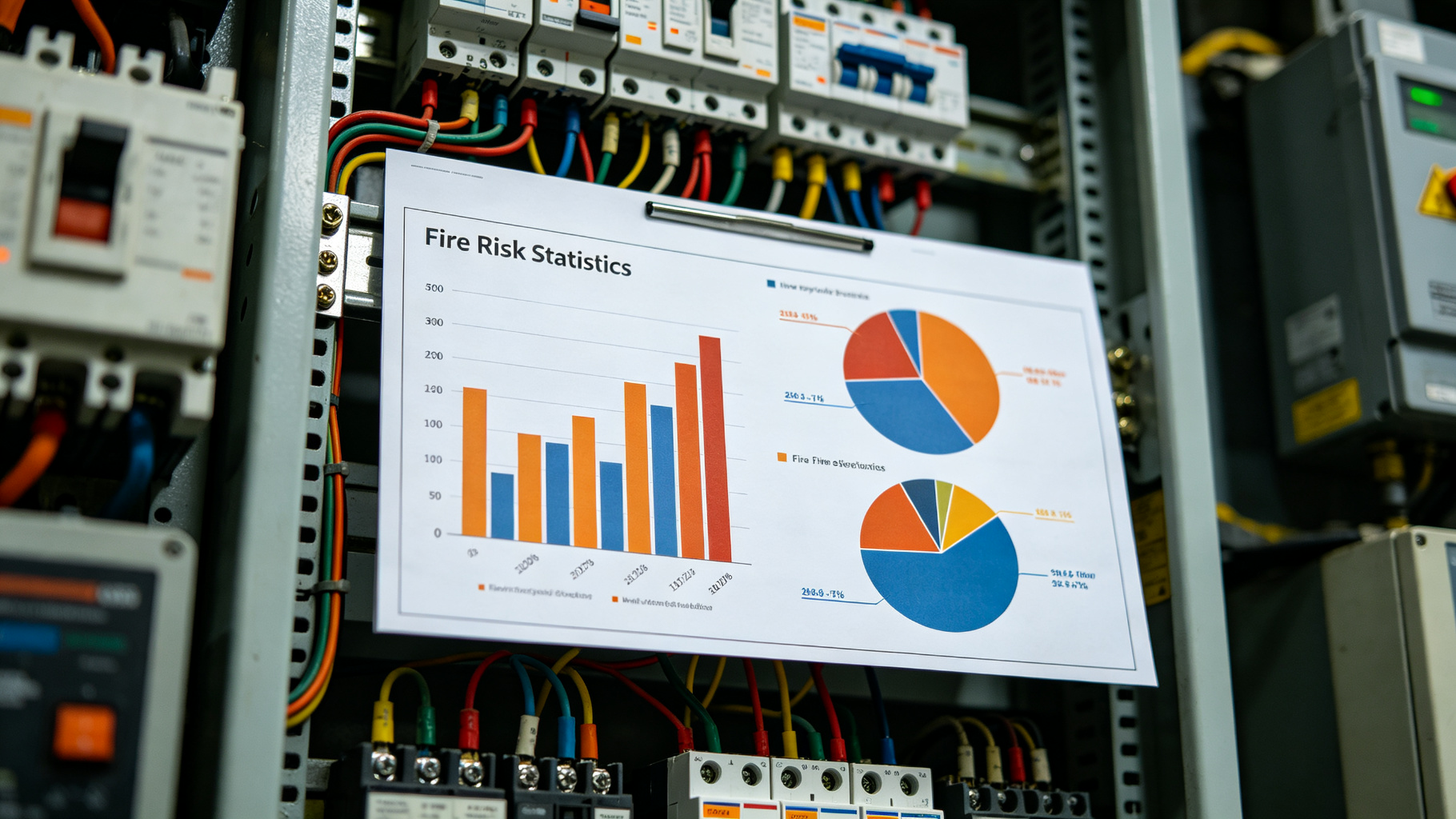
Electrical panels are a leading source of industrial fires, yet many facilities underestimate the risk. According to recent data, electrical distribution equipment accounts for nearly 6% of all non-residential fires, with panel failures often triggered by loose connections or insulation breakdown. These statistics highlight why proactive electrical fire protection must prioritize panel maintenance and monitoring.
Low-voltage electrical panelboards are the nodal distribution points for nearly all commercial, industrial, and multi-residential power systems, but their closed, often out-of-sight installation makes developing electrical panel fire risk hard to identify during routine walkthroughs. Incipient panel fires often smolder behind closed steel doors for 30 minutes or more before spreading to adjacent wall cavities or equipment, leading to extended downtime and costly property damage. This analysis breaks down verified fire statistics, documented panel fire causes, gaps in common mitigation approaches, and layered fire prevention strategies, with a focus on how passive clean-agent suppression technology integrates into holistic panel protection programs.
Data from the U.S. National Fire Protection Association (NFPA) shows that between 2017 and 2021, local fire departments responded to an average of 23,900 structure fires annually involving electrical distribution or lighting equipment, resulting in an estimated 290 civilian injuries and $1.1 billion in direct property damage per year. Approximately 32% of these incidents originated in panelboards, load centers, or associated overcurrent protection devices, per NFPA’s 2023 Electrical Structure Fires report.
An analysis of 2018–2022 EU Fire Statistics Report data suggests 28% of commercial electrical fires trace to low-voltage panels, with a disproportionate share occurring after business hours, when detection delays extend fire growth. FM Global loss data indicates panel fires in manufacturing facilities have a 47% likelihood of causing downtime exceeding 8 hours, as hidden heat damage to busbars is often not visible in initial post-incident checks. Residential settings account for 58% of reported panel fire incidents, but non-residential incidents carry 3.2x higher per-incident loss due to higher load densities and mission-critical equipment ties.
Resistive heating at loose or degraded terminal lugs is a dominant precursor to panel fires, governed by the Joule-Lenz law (P = I²R). For a 200A main lug with a contact resistance rise of just 0.005 ohms above factory baseline, heat generation at the connection reaches 200W during full load, sufficient to raise local lug temperatures to 180°C or higher under sustained load before arcing even occurs. Thermal cycling over decades of service loosens torque values, while aluminum conductor terminations are particularly susceptible to creep and oxide formation; field studies show 62% of connection-related panel failures occur at aluminum lugs installed before 1990.
When circuit breakers experience repeated nuisance tripping, facility teams may occasionally bypass or shunt overcurrent protection, leading to sustained overcurrent that heats conductor insulation beyond its 75°C or 90°C temperature rating. After 10,000 operational cycles, breaker contact erosion can increase internal resistance enough to generate localized hot spots of 140°C during rated load. Arc faults from insulation breakdown reach core temperatures of 6000°C, but most begin as small smoldering hot spots at insulation breach points that persist for 20–40 minutes before open flame develops.
Conductive metal dust, lint, or corrosive vapors accumulating on busbar supports create surface tracking paths that reduce dielectric strength and trigger arcing. In food processing or wastewater facilities, corrosive vapors can degrade PVC conductor insulation by 0.1mm per year, reducing dielectric strength by 40% within 10 years. Rooftop or basement panels exposed to seasonal moisture also face elevated arcing risk.
Standard building smoke detectors are almost always mounted outside panel enclosures, so smoldering fires inside closed panels can take 10+ minutes to trigger an alarm, by which time flames may have spread to adjacent wiring. Area-wide total-flood clean agent systems require regular enclosure integrity testing, carry high upfront costs for individual panel protection, and can discharge accidentally if pressure sensors drift. ABC dry chemical extinguishers require immediate human response, unfeasible for unoccupied sites, and residual powder can cause permanent busbar corrosion, with cleaning costs often exceeding direct fire damage.
Annual thermographic inspections only capture anomalies at the exact time of the scan, and require near-peak load to detect resistive heating. Data from the InterNational Electrical Testing Association (NETA) suggests thermographic surveys miss approximately 30% of developing hot spots, either because load levels are too low during inspection or the hot spot is hidden behind a busbar barrier blocking infrared signatures. Internal visual inspections require de-energization, carrying arc flash risk and scheduled downtime.
QuellPatch, FIREQUELL’s passive suppression patch line for electrical infrastructure, uses microencapsulated FK-5-1-12, a fluorinated ketone clean agent rated for Class A, B, and C electrical fires that leaves no post-discharge residue. The process embeds 10–50 micrometer FK-5-1-12 droplets in a heat-sensitive polymer shell, coated onto a non-conductive pressure-sensitive adhesive backing that mounts directly to interior panel surfaces. Unlike pressurized canisters, the microencapsulated format requires no pressure vessel, reducing slow leak risk over service life.
QuellPatch operates via passive thermal activation, with no external power, wiring, or detection panel required. The line offers three activation temperature ratings matched to standard panel conditions: 80°C for low-voltage control panels with operating temps below 60°C; 140°C for standard commercial panelboards with 75°C rated conductor insulation; and 180°C for high-load industrial panels with 90°C conductors or elevated ambient temps. When local surface temperatures reach the rated threshold, polymer shells rupture, releasing FK-5-1-12 directly into the enclosure to disrupt combustion chain reactions. Third-party testing shows incipient fire suppression within 12 seconds of activation for appropriately sized enclosures, at 4–6% agent concentration with no oxygen displacement.
QuellPatch has a 5-year service life from installation, with no required pressure checks, functional testing, or routine maintenance during that window. Sizing is based on net internal enclosure volume: standard 100mm x 150mm patches are rated for 0.07m³ (2.5 ft³) enclosures, with larger units available for 0.21m³ (7.5 ft³) main lug panels. Patches mount to non-current-carrying interior side walls or door backs, and can be installed in energized panels by qualified personnel wearing appropriate arc flash PPE.
Reduction of electrical panel fire risk starts with alignment to NETA maintenance standards, which address the root causes of most panel failures before hot spots develop. Core program tasks include:
QuellPatch units should be selected to provide a minimum 20°C buffer between the panel’s maximum measured peak-load operating temperature and activation temperature, to reduce risk of non-fire discharge. Patches should be distributed evenly across the enclosure, with additional units placed within 30cm of high-risk zones: main lugs, branch breaker connections, and busbar splices. For multi-section switchgear, one patch per vertical section ensures uniform agent distribution.
After a QuellPatch activation, de-energize the affected panel and follow lockout/tagout procedures before opening the enclosure. Ventilate the space for 10–15 minutes, then inspect all terminations and components for heat damage. As FK-5-1-12 evaporates completely at room temperature, no specialized residue cleaning is needed for undamaged components; install a new patch once the overheating root cause is corrected.
Electrical panel fire risk remains a persistent source of property loss and operational downtime across all facility types, driven by hidden resistive heating, component wear, and contamination that often evades standard inspection schedules. Aggregated fire statistics confirm that a large share of these fires originate inside closed enclosures, where early detection is difficult and response delays allow rapid fire growth. While regular torque checks, thermographic inspections, and enclosure upgrades form the foundation of fire prevention, passive suppression solutions like QuellPatch provide a redundant final layer of protection that activates without external power or human intervention. When selected to match panel operating temperatures and installed as part of a layered risk reduction program, microencapsulated FK-5-1-12 patches can suppress incipient fires before they spread, with a 5-year service life that minimizes long-term maintenance overhead for facility teams.
A: NFPA data consistently identify electrical distribution or lighting equipment as a leading cause of structure fires, with panels, breakers, transformers, and related wiring involved in a substantial share of electrical-fire incidents. The exact percentage varies by occupancy and reporting category, but panel-level failures such as arcing, loose connections, overloaded circuits, and insulation breakdown are common ignition sources.
A: Common causes include loose or corroded connections, overloaded circuits, breaker failure, damaged insulation, improper modifications, and sustained arcing or overheating at busbars and terminations. NFPA statistics also show that many incidents involve heat buildup that remains hidden inside the enclosure until ignition occurs, making local suppression inside the panel valuable.
A: QuellPatch can be installed in energized panels by qualified electrical personnel wearing appropriate arc-flash PPE and following NFPA 70E practices, because the adhesive backing is non-conductive and the patch is mounted only on non-current-carrying metal surfaces. However, site safety procedures may still require lockout/tagout depending on panel condition, available clearances, arc-flash ratings, or maintenance policy. The patch does not require power, control wiring, or panel penetration.
A: Select a rating with at least a 20°C buffer above the highest measured peak-load internal or surface temperature at the mounting location. The 80°C version is typical for commercial and control panels operating below 60°C, while 140°C and 180°C versions are used for hotter power compartments, busways, or equipment near heat sources. Temperature logging under load is recommended before final selection.
A: FK-5-1-12 is a clean agent that vaporizes and leaves no powdery or sticky residue on electrical components, reducing cleanup compared with dry-chemical systems. It is electrically non-conductive and has a zero ozone-depletion potential, making it suitable for enclosed electrical spaces. Proper sizing and placement are still required so the agent reaches the incipient fire zone inside the panel.
FIREQUELL QuellPatch delivers automatic, maintenance-free clean-agent protection for electrical panels, battery cabinets and control rooms — designed to meet FM Approved, UL Listed, CE and UKCA requirements.
Request a Site Assessment