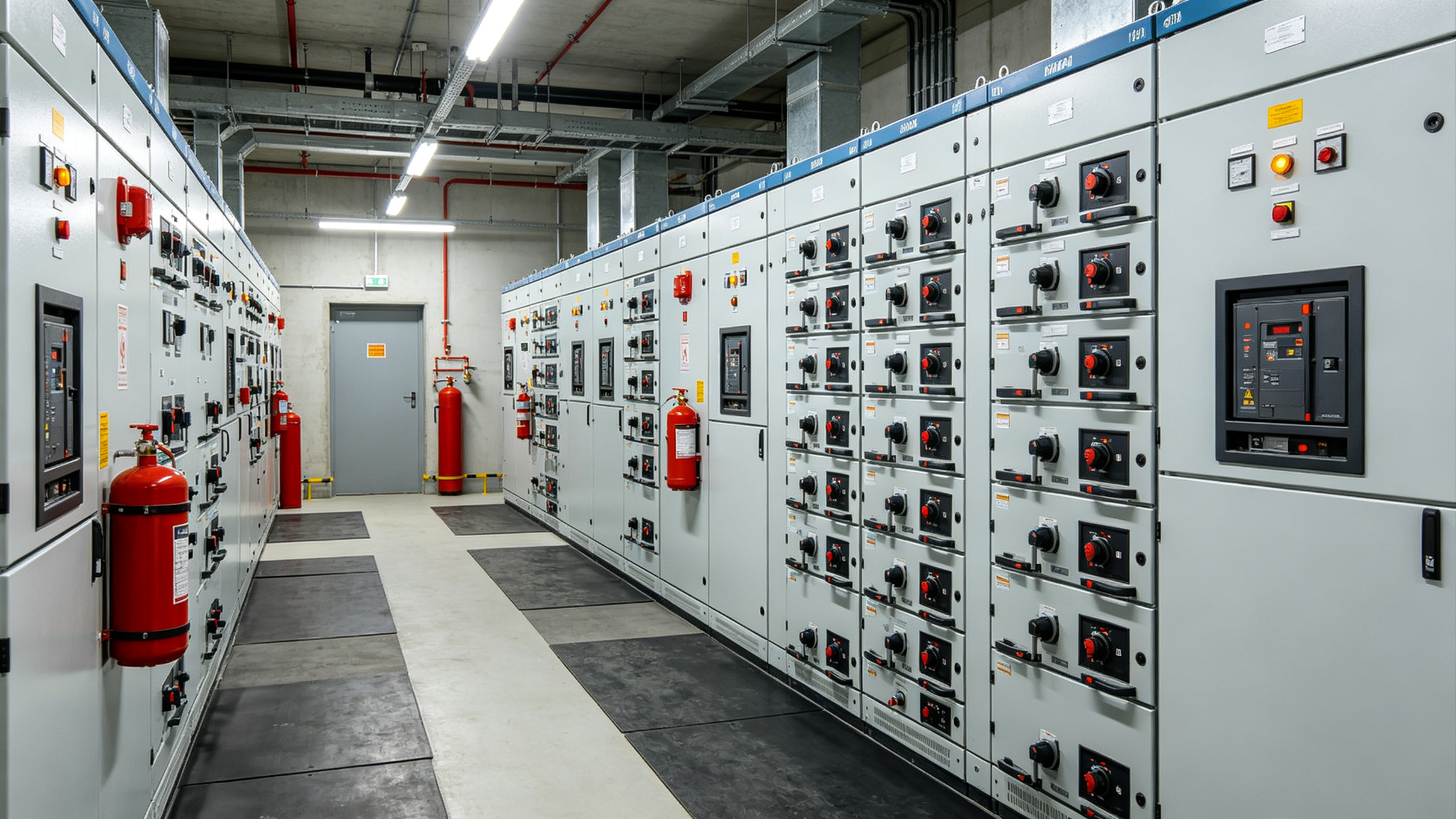
Technical guide on electrical panel fire for electrical fire protection
Choosing the right fire suppression system for electrical panels can mean the difference between a minor disruption and a catastrophic shutdown. With options ranging from clean agents to water mist, the selection depends on factors like panel size, voltage, and surrounding hazards. A wrong choice can damage sensitive electronics or fail to extinguish the fire effectively, so careful evaluation is essential.
LV and MV switchgear compartments present a difficult fire-protection challenge: high available fault energy, dense cable and busbar arrangements, limited access, and ignition sources that may remain hidden until an electrical panel fire develops. A loose lug, tracking insulator, failed contact, or damaged cable can generate localized heating long before smoke or flame is visible. Once ignition occurs, the enclosure can trap hot gases, accelerate insulation pyrolysis, and spread products of combustion to adjacent compartments.
Effective switchgear suppression therefore requires a point-of-source strategy rather than reliance only on room-level detection or total-flooding systems. QuellPatch passive clean-agent patches are designed for this role: they are installed inside electrical compartments and release FK-5-1-12 clean agent when heated to a rated activation temperature. This guide explains the technical selection criteria for LV MV protection, including failure modes, activation-temperature selection, placement, service life, and coordination with electrical protection.
LV switchgear, generally rated up to 1,000 V AC, commonly contains high-current busbars, molded-case or air circuit breakers, distribution terminals, and control wiring. Electrical panel fires in LV equipment often begin at connection points where cyclic loading, vibration, or improper torque produce elevated contact resistance. Other sources include insulation tracking in humid or contaminated environments, cable damage during maintenance, and overload of undersized conductors.
Because LV compartments may contain many outgoing ways, a single small ignition can involve thermoplastic insulation, cable ties, labeling materials, and control wiring. The objective of panel fire suppression is to interrupt the incipient flame before it spreads to adjacent cable sections or reaches the main bus compartment.
MV switchgear, typically from 1 kV to 52 kV, has different energy and geometry characteristics. Failures may occur at cable terminations, current or voltage transformers, bushings, insulating barriers, or withdrawable breaker contacts. An arcing fault in MV equipment can rapidly produce high temperatures, pressure rise, and ionized gases. In metal-clad gear, segregated compartments can limit flame spread, but they also make manual detection and suppression difficult.
Passive suppression patches are intended for air-insulated, non-pressurized MV compartments. They are not suitable for SF6-filled or oil-filled equipment, and they should not be installed where they could block pressure-relief vents or reduce electrical clearances.
The engineering goal is not to replace overcurrent protection or arc-resistant switchgear. It is to provide localized, automatic suppression at the earliest stage of an electrical panel fire, reduce the probability of flashover within a compartment, and limit thermal damage to adjacent equipment. This can improve post-event recoverability while maintaining compatibility with energized electrical infrastructure.
FK-5-1-12 is a fluorinated ketone clean agent with a boiling point near 49°C. At panel temperatures above its boiling point, it vaporizes readily and can reach the flame zone as a gas. It is electrically nonconductive, leaves no measurable residue under normal discharge conditions, and has an ozone-depletion potential of zero. Its atmospheric lifetime is short, measured in days, and its global warming potential is approximately 1.
Fire suppression occurs mainly through chemical interruption of the combustion chain reaction, with a smaller cooling contribution. In conventional total-flooding systems, FK-5-1-12 is applied at design concentrations commonly around 4–6% for Class A and Class C hazards. In a patch-based local application, concentration uniformity across the entire compartment cannot be assumed; performance depends on placing the agent close to the likely ignition source and retaining enough vapor within the enclosure.
QuellPatch uses microencapsulation to store FK-5-1-12 without a pressure cylinder, piping network, or electronic control. The agent is contained within polymer microcapsules embedded in the patch material. When the capsules reach their rated activation temperature, the shell material loses strength and ruptures, releasing agent directly into the hot compartment.
Passive thermal activation means the device responds to heat from the developing fire rather than to a separate detector. This can reduce detection-to-discharge delay, but it also makes placement critical. The patch must be located where hot gases or radiant heat will reach it early. It is a one-shot device; after discharge, the patch must be replaced.
QuellPatch variants are available with activation temperatures of 80°C, 140°C, and 180°C. Selection should be based on the maximum normal compartment temperature, expected hotspot temperatures, and the response needed for the protected equipment. A practical design rule is to select an activation temperature at least 20–30 K above the highest normal operating temperature at the patch location, while remaining below the temperature at which significant insulation damage or rapid fire growth is expected.
Temperature selection should be verified using thermal imaging or temperature sensors during peak load conditions, not estimated from room temperature alone.
Each switchgear compartment should be treated as a separate hazard. Open doors, ventilation openings, cable penetrations, and unsealed gaps allow agent vapor to escape, so coverage must be adjusted for leakage. The manufacturer’s listed volume-per-patch data should be used for sizing; patches should not be extrapolated to cover large, open, or strongly ventilated spaces.
For most LV and MV applications, patches should be mounted on the upper interior surface or sidewall within approximately 100–300 mm of the likely ignition source. Typical locations include:
Because hot gases rise, top-of-compartment mounting often improves thermal response. The patch must not contact moving parts, busbars, or primary insulation, and it must not reduce creepage or clearance distances.
In LV switchgear, the main challenge is often the number of small compartments. A single patch in the main bus compartment does not protect distribution boards or control sections separated by metal barriers. Each enclosed section should be assessed separately.
In MV switchgear, electrical clearances and pressure-relief paths are more restrictive. Patches should be mounted on grounded metal surfaces or approved insulating locations, and they should not obstruct arc vents, breaker racking mechanisms, or insulating barriers. Compatibility with the switchgear manufacturer’s instructions should be confirmed before installation.
Mounting surfaces should be clean, dry, and free of grease or loose paint. Adhesive mounting is common, but mechanical retention may be appropriate in high-vibration areas. Patches should be installed only by qualified electrical workers following lockout/tagout procedures. In energized-work situations, appropriate PPE and minimum-approach distances must be maintained.
The patch should not be folded, punctured, or compressed, because damage to the microcapsules can cause premature agent loss. It should also be positioned so that future infrared inspection or thermography is not blocked.
QuellPatch has a specified service life of 5 years under normal indoor conditions. Annual visual inspections are recommended to verify adhesion, capsule integrity, cleanliness, and absence of physical damage or paint overspray. Unlike stored-pressure systems, the patch has no pressure gauge; inspection is primarily visual and documentary.
Patches should be replaced after activation, after significant physical or thermal damage, or at the end of the 5-year service period. Replacement should be recorded in the facility’s fire-system log with compartment location, activation temperature, lot number, and installation date.
Passive switchgear suppression does not interrupt current or detect arcing faults. Circuit breakers, fuses, protective relays, and arc-flash mitigation systems remain essential. After a patch discharges, the equipment should be de-energized before inspection. The cause of the electrical panel fire should be investigated, damaged components replaced, and the compartment cleaned and ventilated before returning the gear to service.
Selecting panel fire suppression for LV and MV switchgear requires more than choosing a clean agent. It requires matching the suppression device to compartment geometry, normal operating temperature, leakage, ignition location, and electrical clearance requirements. QuellPatch, using microencapsulated FK-5-1-12 and passive thermal activation, offers a localized option for protecting high-risk compartments when the 80°C, 140°C, or 180°C variant is selected and placed correctly.
For LV MV protection, the most reliable approach is compartment-by-compartment engineering: identify likely heat sources, measure operating temperatures, size patches to the protected volume, and maintain a 5-year replacement cycle. When integrated with proper electrical protection and inspection practices, switchgear suppression patches can reduce the extent of damage from an incipient electrical panel fire and support faster, safer restoration.
A: It can be applied to both LV and MV equipment when the compartment is air-insulated, non-pressurized, and within the manufacturer’s stated limits. MV installations require special attention to electrical clearances, creepage distances, arc-flash hazards, and equipment-warranty conditions, so placement should be reviewed against the OEM instructions and applicable IEC or IEEE requirements.
A: Base the choice on measured peak ambient and component surface temperatures at the mounting location, leaving margin to avoid nuisance activation. Use 80°C for cooler compartments with sensitive electronics, 140°C for general-purpose LV and MV compartments, and 180°C where high normal operating temperatures make lower ratings unsuitable.
A: The specified service life is 10 years from installation when the device is kept within the manufacturer’s environmental and application limits. Inspection should follow the installed maintenance schedule, and devices should be replaced if damaged, discharged, expired, or outside the approved operating conditions.
A: FK-5-1-12 is widely used for electrical hazards because it is electrically non-conductive, leaves no residue, and has a zero ozone-depletion potential. In a properly sized and sealed compartment, it can suppress Class A, B, and C-type fires without the post-discharge cleanup associated with water or powder agents.
A: Sizing is based on the protected compartment volume, enclosure leakage, location of high-risk components, and the manufacturer’s listed application data. It is not selected by panel nameplate ampacity alone; the compartment must remain within the approved volume and sealing limits for the patch model to deliver the intended FK-5-1-12 concentration.
FIREQUELL QuellPatch delivers automatic, maintenance-free clean-agent protection for electrical panels, battery cabinets and control rooms — designed to meet FM Approved, UL Listed, CE and UKCA requirements.
Request a Site Assessment