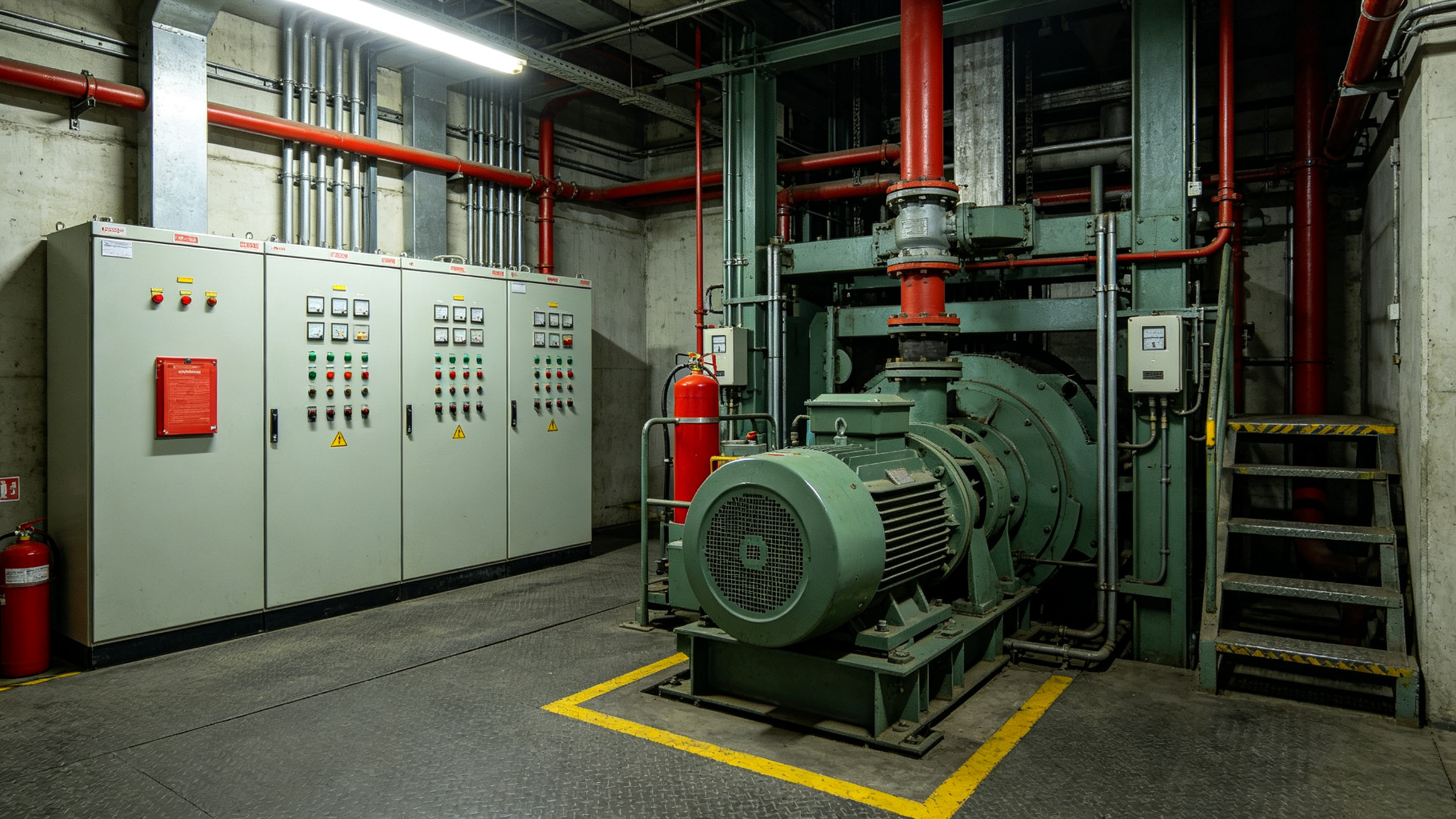
Technical guide on elevator fire for electrical fire protection
Elevator machine rooms house critical electrical equipment that, if ignited, can trap passengers and halt building operations. Fires here often start in motor controllers or brake resistors, generating intense heat and toxic smoke. Effective electrical fire protection in these spaces requires suppression systems that activate quickly without endangering people or damaging the elevator's control systems.
Elevator machine rooms concentrate several high-energy electrical loads in a relatively small space: traction drives, motor controllers, emergency power interfaces, braking resistors, and the lift control cabinet. An elevator fire in this area can interrupt service, expose technicians to arc and shock hazards, and generate smoke that migrates into hoistways and lobbies. Machine room protection therefore requires more than room-level detection; it requires a response that reaches the fire while it is still confined inside electrical enclosures.
Clean-agent suppression is well suited to these risks because it can suppress electrical fires without leaving conductive residue. The QuellTag product line applies this principle at the component level using passive, microencapsulated FK-5-1-12 patches installed directly inside or near high-risk equipment. This article examines the fire dynamics specific to elevator machine rooms, explains how localized clean-agent release differs from total-flooding systems, and provides engineering guidance for applying QuellTag units as part of a coordinated elevator suppression strategy.
Most elevator machine room fires involve electrical equipment rather than the traction machine itself. Common ignition sources include:
The lift control cabinet is particularly important because it contains low-voltage logic, relay boards, and power conductors in close proximity. A small fault there can damage control circuits, cause unintended elevator behavior, or disable recall functions before a room-level detector responds.
Fire growth in a closed control cabinet differs from open-room fire growth. The cabinet restricts oxygen, which can slow flaming combustion, but it also traps hot gases and directs the plume toward the top interior surface. Smoke detectors mounted above the cabinet may not receive a concentrated smoke sample until gaps around doors or cable glands allow leakage. By that time, internal temperatures may already be high enough to damage multiple circuit boards.
Thermal lag is also significant. A detector on the ceiling sees average room temperature, while the fire plume heats local surfaces and wiring much faster. Effective machine room protection should therefore address the incipient fire at its point of origin, not only after smoke or heat enters the room volume.
A lift control cabinet may have an internal volume of only 0.2–1.5 m³, with leakage around doors, ventilation filters, and cable entries. Total-flooding gaseous systems rely on maintaining a uniform design concentration throughout an enclosure. In small cabinets with fans, filters, or unsealed openings, achieving and holding that concentration can be difficult without modifying ventilation.
Localized suppression takes a different approach. By releasing agent directly above the probable fire location, it exploits the natural plume to carry agent into the combustion zone. This reduces dependence on room integrity and allows protection to be targeted at drives, capacitor banks, resistor compartments, or terminal sections. The approach is compatible with passive thermal activation because the same heat that produces the plume also triggers the device.
FK-5-1-12 is a fluorinated ketone clean agent with a boiling point near 49°C, low electrical conductivity, and no residual particulate after discharge. Published property data indicate a global warming potential near 1 and an atmospheric lifetime measured in days, characteristics that support its use in occupied or sensitive infrastructure areas. It suppresses fire through a combination of heat absorption and interruption of the combustion chain reaction.
For elevator suppression, these properties matter because the agent can be discharged near live electronics without creating a shock path or requiring post-discharge cleanup of powder or water residue. In QuellTag patches, FK-5-1-12 is held in microencapsulated form. The polymer capsules separate the agent from the environment, eliminate the need for a pressurized cylinder, and allow the patch to be installed on interior cabinet surfaces.
QuellTag patches are available with activation temperatures of 80°C, 140°C, and 180°C. Selection should be based on measured operating temperatures in the specific compartment, with a margin between normal maximum temperature and activation rating.
The rated temperature refers to the thermal response of the microcapsule shells, not the bulk room temperature. For this reason, installation should follow a temperature survey: measure surface and air temperatures at the proposed patch location under peak load, then select the rating that provides adequate margin without delaying response to an actual fire.
QuellTag patches are mounted with pressure-sensitive adhesive or mechanical clips on interior cabinet surfaces, usually above the highest-risk components. Typical mounting positions include the upper interior panel above VFD heatsinks, the ceiling of a resistor compartment, and side panels adjacent to capacitor banks. Patches should not be installed directly on moving parts, service access covers, or surfaces that exceed the selected activation rating during normal operation.
Selection tables relate patch model to protected volume and leakage; a common lift control cabinet may use one or more units covering approximately 0.5–1.0 m³ of enclosure volume, depending on cabinet geometry and ventilation. The product has a 5-year service life under specified indoor conditions. Because the agent is microencapsulated and the device is passive, there is no pressure gauge to monitor and no periodic hydrostatic testing requirement. Visual inspection should confirm that the patch is intact, uncontaminated by dust or oil, and within its replacement date.
QuellTag patches act directly through passive thermal activation and do not require external power, a control panel, or an interlock to discharge. They should, however, be coordinated with the building fire alarm and elevator control sequence. Machine room smoke detectors commonly initiate elevator recall; sprinkler systems may require shunt-trip disconnects before water discharge. A local clean-agent patch can reduce fire involvement during the early stages, but it does not replace these code-required functions.
Because elevator suppression must not create an entrapment hazard, shutdown sequences should be reviewed by a qualified elevator contractor. Any discharge event should trigger maintenance inspection before the elevator is returned to service. The fire alarm system should remain the primary source of occupant notification and fire service response, while QuellTag provides localized agent application within the protected enclosure.
Routine inspection can be combined with quarterly elevator maintenance walkthroughs. Technicians should verify that patches have not been displaced by cabinet work, covered by dust or cable debris, or exposed to unauthorized modifications. Labels showing installation date and replacement interval should remain legible.
After a confirmed or suspected activation, all patches in the affected enclosure should be replaced. The discharged agent should not present a residue problem, but the fire may have produced smoke, soot, or heat damage. Affected drives, wiring, and control boards should be evaluated by qualified personnel before energization. This inspection is especially important in lift control cabinet applications because damaged insulation or semiconductor components can fail after the initial incident.
Elevator machine room protection is most effective when it addresses the specific fire behavior of drives, resistors, and control cabinets. Room-level detection and sprinkler systems remain important, but they may respond after a fire has already damaged critical electronics. Localized clean-agent protection using QuellTag patches provides an additional layer of elevator suppression by placing microencapsulated FK-5-1-12 close to the most likely ignition points.
Engineering selection should focus on three factors: choosing the correct 80°C, 140°C, or 180°C activation rating from measured temperatures, locating patches where the plume will carry agent into the fire zone, and integrating the installation with elevator recall, shutdown, and inspection procedures. With proper placement and replacement at the 5-year service interval, QuellTag can serve as a passive component of a comprehensive machine room protection strategy.
A: No. QuellTag patches provide localized, point-of-origin protection inside electrical enclosures and are intended to supplement code-required sprinkler, detection, and alarm systems. They do not provide whole-room fire control or satisfy the building-level sprinkler requirements typically found in NFPA 13 or the local building code.
A: Select the patch rating based on measured peak temperatures at the mounting location. An 80°C patch is commonly used for low-voltage control sections with normal ambient temperatures below about 50–60°C, 140°C is more appropriate near drives or braking resistors, and 180°C is used only where high operating temperatures make lower ratings prone to nuisance activation.
A: No. QuellTag is a passive device that activates thermally at its rated temperature, so it does not require external power, a detector circuit, or a network connection to discharge. For monitoring, optional supervisory or alarm contacts can be integrated with the elevator or building fire alarm system, but activation itself remains independent of those controls.
A: The principal hazards are electrical failures in the controller, drive, relays, contactors, power supplies, and braking or regenerative resistors. These components can produce overheating, arcing, or ignition in enclosed cabinets even when the room itself is relatively clean and unoccupied.
A: They address different objectives: total-flooding systems protect the entire room volume, while localized QuellTag protection targets fires inside specific electrical enclosures at the point of origin. For elevator machine rooms, localized patches can be a useful supplement because they discharge directly in the cabinet where most electrical fires start, but they do not replace sprinklers or an engineered clean-agent system where required by code or insurer.
FIREQUELL QuellPatch delivers automatic, maintenance-free clean-agent protection for electrical panels, battery cabinets and control rooms — designed to meet FM Approved, UL Listed, CE and UKCA requirements.
Request a Site Assessment