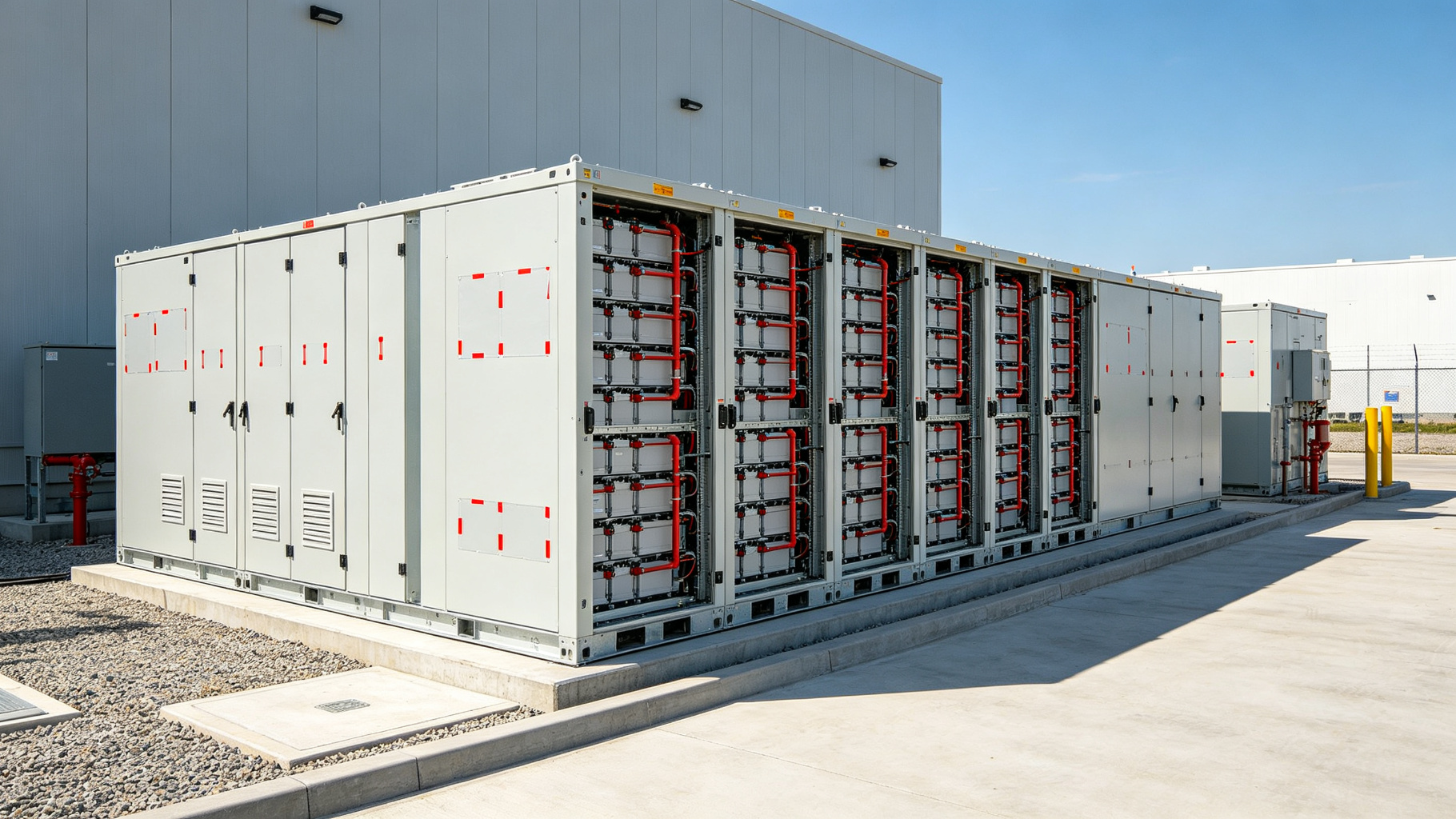
Technical guide on energy storage case for electrical fire protection
A single thermal runaway in an energy storage system can escalate into a catastrophic fire within minutes, as several real-world incidents have shown. One notable case involved a utility-scale battery facility where a faulty cell ignited, releasing flammable gases and causing extensive damage. This case study underscores the urgent need for robust electrical fire protection tailored to the unique risks of energy storage.
This energy storage case describes a fire implementation at a 12 MW/24 MWh utility-connected battery energy storage system (BESS) in the southwestern United States. The facility uses six outdoor walk-in enclosures, each rated at 2 MW/4 MWh, with lithium iron phosphate (LFP) modules arranged in two rows along a central service aisle. Although the site already had addressable smoke detection, a gaseous total-flood system, and a battery management system (BMS), the project team identified a protection gap at the module and busbar level, where incipient electrical faults can develop before room-level detection or total-flood agent distribution occurs.
This BESS case study focuses on the use of QuellArmor passive clean-agent patches as a local, source-mounted layer within the storage fire protection strategy. The objective was not to replace building-level detection or suppression, but to reduce the likelihood that a small connection or terminal fire would grow into a module-to-module propagation event. The following sections summarize the hazard assessment, product selection, installation approach, and observed performance during an incipient thermal event.
Each enclosure contains 192 LFP modules rated at approximately 20.8 kWh, for a total of 1,152 modules across the site. Modules are connected in series strings to DC combiners and outdoor inverters. The principal fire scenarios considered were:
The existing total-flood system was designed to achieve a uniform clean-agent concentration in the enclosure after cross-zone detection. However, sealed module cases, cable routing, and HVAC airflow can delay agent entry into the exact compartment where a fault begins. The engineering team therefore evaluated local suppression that could activate directly at the heat source without relying on panel-based releasing logic.
Passive patches were selected because they require no external power, no piping, and no detector cross-counting delay. They can be installed inside modules, busbar compartments, and electrical cabinets, placing agent close to potential ignition sources. The team also considered aerosol generators and water mist, but those options required additional mounting space, electrical supervision, or drainage considerations. QuellArmor patches were judged suitable for retrofit during scheduled outages because they could be bonded to interior surfaces without modifying enclosure structural members.
QuellArmor patches contain microencapsulated FK-5-1-12 clean agent. The agent is held within small thermoplastic polymer shells distributed on a flexible patch substrate. Under passive thermal activation, the shells soften and rupture when the local temperature reaches the rated set point, releasing FK-5-1-12 directly into the compartment. The agent is electrically nonconductive and typically leaves little or no residue, which is advantageous for electrical insulation and post-event equipment cleanup.
Because the patches are pressureless, they do not require hydrostatic testing, weighing, or supervised release circuits. The specified service life is 5 years from manufacture under the published storage and operating conditions, subject to visual inspection and replacement if damaged or activated.
The supplier offers activation temperatures of 80°C, 140°C, and 180°C. Selection was based on 90 days of BMS and temporary thermocouple data collected during peak summer operation:
The 80°C rating was selected for module interiors, providing a margin above normal cycling temperatures while responding early to connection overheating. The 140°C rating was used in busbar compartments, where higher transient temperatures are possible but nuisance release from normal operation remained unlikely. The 180°C rating was reserved for combiner and inverter compartments exposed to elevated solar and power-electronic temperatures. This staged approach allowed lower-temperature patches near cell terminals and higher-temperature patches near heat-generating equipment.
Approximately 9,300 QuellArmor patches were installed across the six enclosures. Placement and density were determined by compartment volume, expected leakage, and the location of energized connections:
Patches were mounted on upper interior surfaces directly above terminals, busbars, and contactors, where released agent could disperse across the hazard. Adhesive mounting was supplemented with mechanical clips in areas subject to vibration from door operation and HVAC cycling. Installers verified that patches did not block vent paths, service handles, BMS sensors, or airflow through heat sinks.
The QuellArmor patches did not require electronic integration, but the fire implementation was coordinated with the site’s active systems. BMS thermocouples continued to monitor module temperatures, and the enclosure-level gaseous system remained in service. On confirmed smoke or thermal alarm, the sequence shut down the HVAC, opened DC contactors, and sent alarms to the operations center. Patch activation was treated as a physical finding during post-event inspection: ruptured shells, discoloration, or missing agent indicated that a compartment had reached its release temperature and required investigation.
Fourteen months after commissioning, the BMS generated a high-temperature alarm for one module. Data logs showed the following sequence:
Maintenance personnel found soot and localized pitting at a loose busbar connection. The FK-5-1-12 had vaporized, with only minimal residual staining. There was no sustained flame spread to adjacent cell tops, wiring, or neighboring modules. The highest temperature recorded on an adjacent module was 52°C.
All six patches in the affected module were replaced because the microencapsulated agent had discharged. The remaining patches in the enclosure were visually inspected and showed no signs of unintended activation. The bolted connection was re-torqued, and infrared scanning was performed across the affected string before re-energization.
The project team noted that this event involved an incipient electrical fire at a connection, not a fully developed internal cell thermal runaway. The observed data suggest that early passive thermal activation contributed to limiting fire growth, but the results should not be extrapolated to all BESS fire scenarios. Mature lithium-ion fires can involve self-heating, gas production, and re-ignition that exceed the capability of local suppression alone.
This energy storage case demonstrates a layered storage fire protection approach in which QuellArmor patches were installed at the module, busbar, and inverter levels to complement existing detection and total-flood suppression. The fire implementation used 80°C, 140°C, and 180°C activation temperatures selected from measured operating conditions, with patch densities based on compartment volume and hazard location. During the reported incipient event, the 80°C patches activated near the rated temperature, and the fault was isolated without module-to-module propagation.
For similar BESS facilities, the engineering process should include thermal mapping, leakage consideration, coordination with BMS shutdown sequences, and a clear replacement plan. Patches should be inspected periodically and replaced after activation or at the end of the 5-year service life. Passive clean-agent patches can be a useful component of a BESS fire protection scheme, but they should be applied as part of a site-specific design that also addresses detection, ventilation, emergency response, and authority having jurisdiction requirements.
A: QuellArmor uses microencapsulated FK-5-1-12 in polymer shells engineered to soften and rupture at rated temperatures. When local heating reaches 80°C, 140°C, or 180°C, the patch releases agent directly at the hazard without requiring power, detectors, or a fire alarm control panel.
A: They are intended for incipient-stage suppression at electrical connections, terminals, busbars, and nearby combustibles and may reduce propagation before a larger event develops. A mature cell thermal runaway involving sustained cell venting, high gas production, and multi-cell propagation is beyond the intended scope of a localized patch and requires the full BESS safety design and emergency response plan.
A: Activation temperatures are selected by comparing the patch rating with the compartment’s normal operating temperature, expected hot spots, and the temperature at which cables or components could fail. In BESS applications, 80°C may suit cooler control compartments, 140°C is often used near higher-load electrical connections, and 180°C is selected only where elevated ambient or operating temperatures make lower ratings susceptible to premature discharge.
A: The case study covered a BESS site where a hazard review identified unprotected electrical connection risks and QuellArmor patches were installed at specific high-risk locations. During an observed incipient event, the patches released FK-5-1-12 locally, helping suppress the early-stage fire and supporting post-incident review of the installation and response sequence.
A: Install patches at identified ignition risks such as terminal blocks, busbars, contactors, disconnects, and cable junctions, using the tested spacing and mounting orientation for the enclosure volume and ventilation. The implementation should follow the site hazard assessment, manufacturer coverage limits, and applicable BESS safety requirements rather than placing patches generically inside cabinets.
FIREQUELL QuellPatch delivers automatic, maintenance-free clean-agent protection for electrical panels, battery cabinets and control rooms — designed to meet FM Approved, UL Listed, CE and UKCA requirements.
Request a Site Assessment