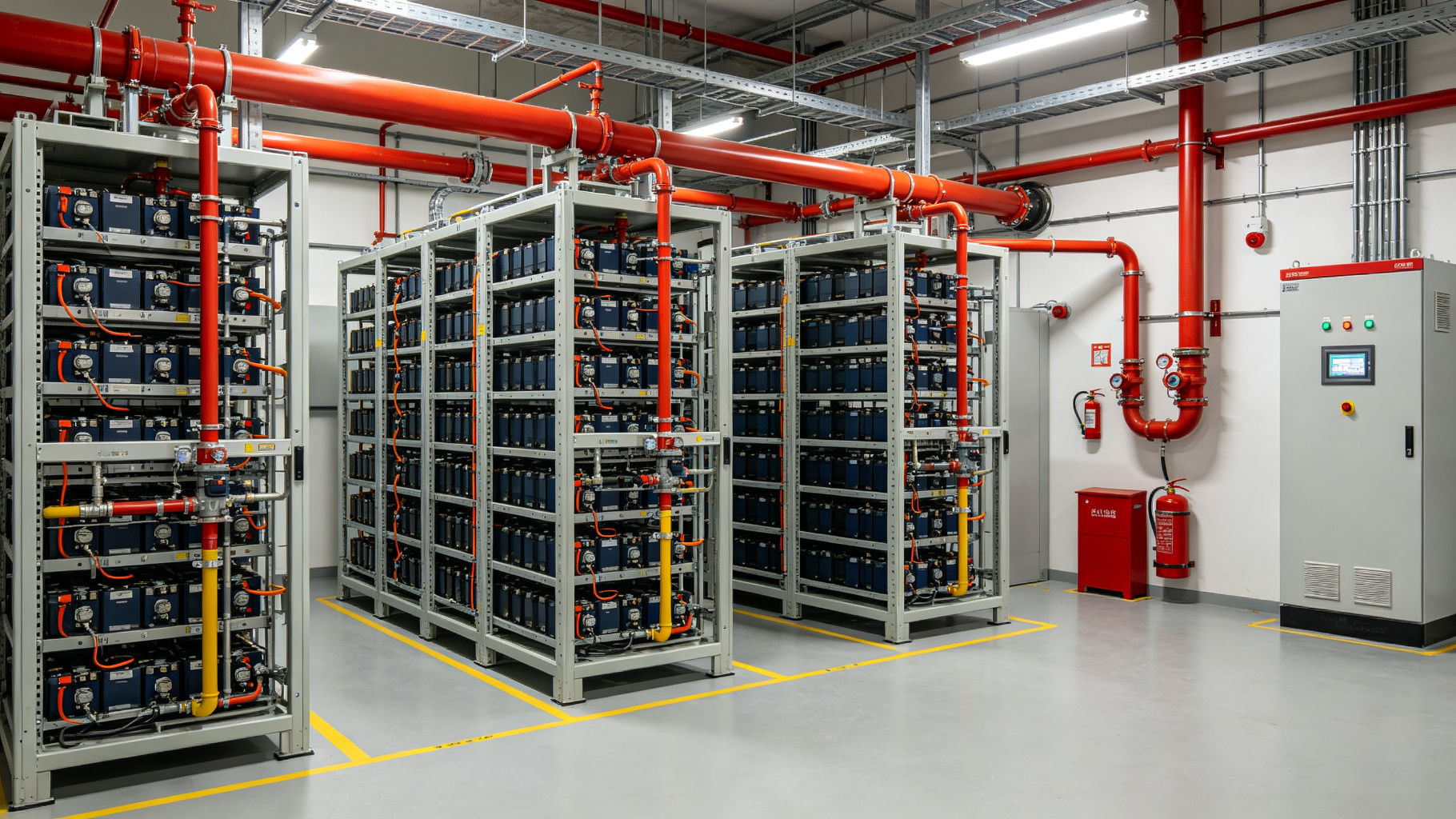
Technical guide on energy storage fire for electrical fire protection
Energy storage systems are transforming power grids, but they also introduce new fire hazards that traditional suppression methods often fail to address. Lithium-ion batteries can undergo thermal runaway, producing intense heat and toxic fumes that require specialized detection and extinguishing agents. Implementing effective electrical fire protection for these systems demands a deep understanding of battery chemistry and fire dynamics.
Battery energy storage systems (BESS) present a distinctive fire protection challenge because the fuel package carries both electrical energy and chemically stored energy. A lithium-ion cell can enter thermal runaway after an internal short, overcharge, mechanical damage, or external heating, and the resulting event may produce flammable vent gas, jet flames, projectile cell parts, and sustained re-ignition risk. These hazards make energy storage fire protection different from conventional electrical-room protection: the event can begin inside a sealed module, propagate cell-to-cell before smoke reaches a ceiling detector, and continue after visible flames are suppressed.
Passive, local suppression is therefore increasingly used as one layer of a BESS protection strategy. FIREQUELL’s QuellArmor patches use microencapsulated FK-5-1-12 clean agent and passive thermal activation to deliver agent directly at the cell, busbar, or module surface where heating begins. This article discusses technical design considerations for applying QuellArmor within ESS/BESS installations, including failure modes, patch architecture, placement engineering, validation, and compliance boundaries.
Thermal runaway usually begins at a single cell. For common lithium-ion chemistries, onset may occur in a range of approximately 130–200°C, depending on state of charge, aging, and cell construction. Once venting starts, adjacent cells can be heated by hot gases, direct flame contact, and conduction through module structures. In densely packed modules, propagation can occur within tens of seconds to several minutes.
A protection system must therefore act close to the source. Total-flood gaseous systems can be effective at enclosure scale, but they may not deliver sufficient agent concentration inside a closed module before propagation begins. QuellArmor patches are installed inside or on the module so that activation occurs before heat spreads to neighboring cells.
During thermal runaway, cells vent gases that may include carbon monoxide, methane, hydrogen, ethylene, and other flammable products. If these gases accumulate in a module or cabinet and ignite, pressure rise can rupture equipment and spread flame. Suppression patches do not replace explosion venting, gas detection, or purge ventilation; rather, they target incipient flames while the vent-gas hazard is still developing.
BESS faults can remain energized until isolation devices operate. DC arcs, hot busbars, and heated cell terminals can re-ignite combustible materials even after an initial flame is knocked down. FK-5-1-12 is electrically nonconductive and leaves little or no residue, making it suitable for use near busbars, battery management system (BMS) boards, and contactor compartments. However, patches should be coordinated with overcurrent protection, disconnects, and maintenance lockout procedures.
QuellArmor patches contain FK-5-1-12 clean agent held in microencapsulated form within a flexible polymer matrix. The matrix is bonded to a pressure-sensitive backing for installation on cell lids, module walls, busbar covers, and cabinet surfaces. When the patch reaches its rated temperature, the microcapsules respond by releasing agent directly into the heated zone. Because FK-5-1-12 has a boiling point near 49°C, it vaporizes rapidly on contact with hot surfaces and forms a local vapor mixture that absorbs heat and reduces flame availability.
FK-5-1-12 is used in clean-agent systems because it is electrically nonconductive, has low global warming potential, and has an atmospheric lifetime measured in days rather than decades. It does not leave powder or aqueous residue that can corrode contacts or short printed circuit boards. This is particularly relevant in BESS modules where residue could interfere with BMS connectors, voltage taps, or thermal sensors.
QuellArmor patches are offered with activation ratings of 80°C, 140°C, and 180°C. These ratings allow designers to match patch response to specific hazard zones:
Passive thermal activation means the patch does not require external power, addressable loops, or control-panel logic. This can be valuable in BESS installations where detector placement, network latency, or loss of control power could delay agent release.
QuellArmor patches have a 5-year service life under specified indoor storage and operating conditions. Unlike pressurized cylinders, they do not require hydrostatic testing or pressure weighing, but they should be visually inspected during scheduled BESS maintenance for damage, detachment, edge lifting, or exposure to temperatures above their rating. Patches that have activated or show physical degradation should be replaced. Designers should also include replacement intervals in the asset maintenance plan because end-of-life is not always apparent from external appearance alone.
Patch layout should be based on module geometry, cell form factor, free volume, and manufacturer agent-mass data. A typical starting point for prismatic or pouch modules is one 140°C patch per cell or per two adjacent cells, supplemented by 80°C patches along vent paths and 180°C patches near electrical connections. For cylindrical-cell modules, patches may be arranged across the top plastic holder and between module groups where heat can accumulate.
The engineering calculation should estimate local agent concentration in the protected volume rather than simply counting patches per rack. FK-5-1-12 local application designs commonly target flame-zone concentrations of roughly 4–6% by volume for short durations, although the required concentration depends on fuel type, leakage area, and ventilation. Because modules are not perfectly sealed, agent retention is improved by placing patches close to the likely ignition source rather than relying on long vapor travel.
BESS fires often involve not only cells but also high-current connections. Loose busbar bolts, failed contactors, insulation damage, and connector corrosion can produce localized heating and arcs. QuellArmor 180°C patches can be installed on busbar covers, inside contactor boxes, and near fuse holders. Sufficient electrical clearance and creepage distance must be maintained; patches should not be applied across exposed live parts unless the installation meets the manufacturer’s voltage and spacing requirements.
Passive patches are most effective when integrated with active BESS safety systems. The BMS should continue to monitor cell voltage, temperature, and gas detectors where provided. On alarm, designers may interlock HVAC shutdown, close fire dampers, open explosion vents, and trigger remote disconnects. Gas detectors can identify off-gas before flame appears, while QuellArmor provides a local physical response if heating reaches the patch threshold. This layered approach addresses both the pre-ignition vent-gas stage and the early flame stage.
Manufacturer and laboratory testing of QuellArmor has focused on cell-level and module-level scenarios. In reported tests, patches activated within seconds of reaching their rated surface temperature, reduced visible flame duration, and increased the time between first venting and heating of adjacent cells. Results vary with cell chemistry, state of charge, module sealing, and patch density, so data from one BESS product should not be extrapolated to another without engineering review.
It is important to distinguish flame suppression from thermal-runaway termination. A patch can suppress incipient flame and reduce local heat, but it may not stop a fully developed runaway involving multiple cells or sustained electrical energy. Designers should therefore present patches as part of a mitigation system, not as a standalone control for all BESS fire scenarios.
UL 9540A provides a test method for evaluating thermal runaway in battery cells, modules, units, and installation levels. NFPA 855 uses such information to determine whether a system requires spacing, fire barriers, detection, suppression, or other mitigation. QuellArmor can be documented as part of the suppression strategy when test data or engineering analysis supports its use. Authorities having jurisdiction may require third-party verification, site-specific calculations, or explicit listing for the intended enclosure.
After any activation, affected modules should be treated as potentially hazardous. Even if flames are no longer visible, cells can retain heat and re-ignite. Emergency response procedures should include isolation, cooling where appropriate, gas monitoring, and qualified personnel review. Activated patches must be replaced, and surrounding patches should be inspected for heat exposure. The 5-year service clock should also be checked for unaffected patches during post-incident restoration.
Energy storage fire protection requires an approach that follows the hazard from cell heating through venting, ignition, propagation, and re-ignition. QuellArmor patches address a specific point in that sequence: they provide passive, local clean-agent release at 80°C, 140°C, or 180°C using microencapsulated FK-5-1-12. Their value lies in close placement to cells and electrical connections, no dependence on external power, and minimal residue. They should be designed using module-specific coverage calculations, coordinated with BMS interlocks and ventilation, and validated against UL 9540A/NFPA 855 documentation. When applied as one layer in a broader BESS protection strategy, QuellArmor can help reduce early flame development and slow propagation, but it does not eliminate the need for detection, electrical isolation, explosion venting, and emergency response planning.
A: NFPA 855 sets requirements for siting, fire hazard analysis, emergency response, and mitigation of battery energy storage system hazards, including thermal runaway and gas/explosion risks. It references testing such as UL 9540A and requires protection appropriate to the ESS technology, enclosure size, and hazard level. QuellArmor is intended as a local passive suppression layer for incipient-stage electrical and cell-level fire risks, not as a substitute for required ventilation, gas detection, or larger system-level protection.
A: No. QuellArmor is designed to suppress incipient flames and reduce local heat exposure near cells, busbars, connectors, and electrical components before a fire becomes established. It is not intended to stop a fully propagated thermal runaway involving multiple cells, modules, or racks, which can release large amounts of heat and flammable gas. For BESS applications, it should be treated as part of a layered NFPA 855 protection strategy that includes detection, ventilation, emergency procedures, and appropriate system-level suppression.
A: The patches use passive thermal activation. Microencapsulated FK-5-1-12 is released when the patch reaches its rated activation temperature of 80°C, 140°C, or 180°C. No external detector, control circuit, pressurized cylinder, or fire alarm panel is required, so the device can provide local suppression even if control power is lost.
A: Yes. FK-5-1-12 is a non-conductive clean agent that leaves no residue and is suitable for use near energized electrical and electronic equipment. The patch itself contains no pressurized vessel and can be installed close to high-risk components such as BMS boards, contactors, fuses, busbars, and module connectors. Installation should still maintain required electrical clearances and follow the equipment manufacturer’s and applicable code requirements.
A: Patches should be positioned close to the most probable ignition and heat sources, such as cell terminals, BMS electronics, contactors, fuse blocks, wiring junctions, and busbar connections. Layout should be based on the cabinet geometry, airflow, maximum normal operating temperatures, and the expected fire scenario rather than using a generic square-footage rule. Activation temperature should be selected with a margin above normal service temperature to avoid nuisance release.
FIREQUELL QuellPatch delivers automatic, maintenance-free clean-agent protection for electrical panels, battery cabinets and control rooms — designed to meet FM Approved, UL Listed, CE and UKCA requirements.
Request a Site Assessment