
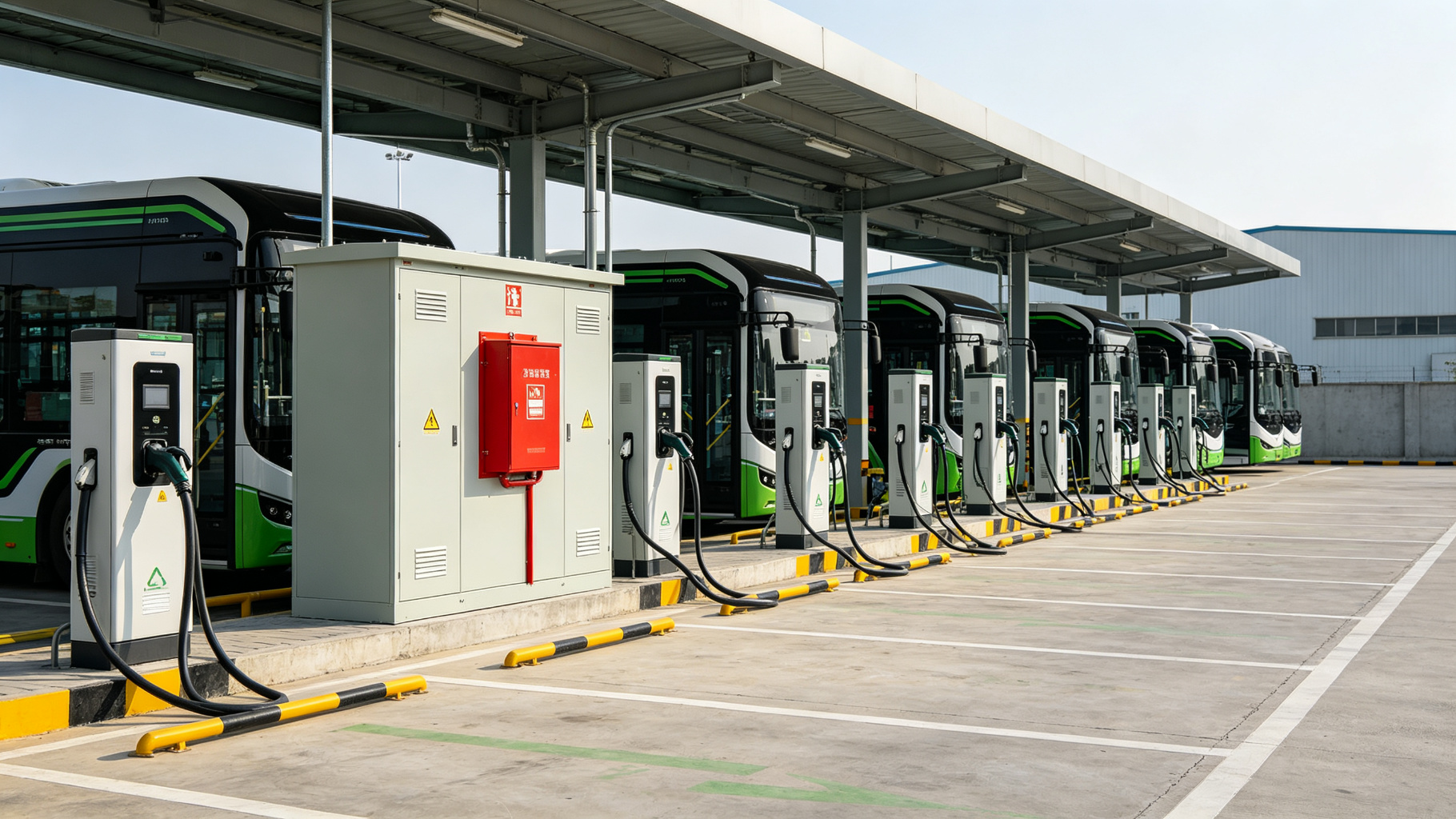
What is the recommended fire protection architecture for an EV bus depot with 50+ chargers and 200+ buses?
An EV bus depot with 50+ chargers should have (1) VESDA detection in the charging hall, (2) water-mist deluge systems covering the chargers, (3) passive FK-5-1-12 patches inside each bus battery enclosure and each charger cabinet, and (4) a 10-meter spacing between charger groups to prevent propagation.
1. The EV Bus Depot Hazard Profile
A 200-bus EV depot is a 10,000-30,000 m² facility that combines indoor bus storage, 50-200 fast-charging stations, battery inventory storage, maintenance workshops, and office space. The largest fire hazard is the charging hall, where 50+ buses may be charging simultaneously at 150-350 kW each. A single bus fire during charging can involve 200-400 kWh of stored energy, can propagate to adjacent buses within 5-10 minutes, and can produce HF, CO, and soot in concentrations that exceed IDLH limits within 60 seconds.
2. Fire Risk Modeling
Modern fire risk models for EV bus depots give a probability of a thermal runaway event at one charger in any given year of roughly 0.5-1.5% per charger. For a depot with 100 chargers, the expected number of events per year is 0.5-1.5. The expected loss given an event ranges from US$500k (single bus fire, contained) to US$50M (depot-wide fire, total loss). The expected annual loss is therefore US$2.5k-750k, which is the basis for insurance premium and the business case for fire protection.
3. Detection Strategy
Standard smoke detection in a charging hall produces 10-30 false alarms per year because of dust, vehicle exhaust during cold starts, and humidity. The 2026 best practice is dual-criteria detection: optical smoke + heat, with a 30-second confirmation window. For the charging stations themselves, off-gas detection (sensors that detect electrolyte vapors) is increasingly common. The 2026 detection-to-suppression time target is under 15 seconds, which is achievable with dual-criteria detection and pre-action water-mist.
4. Active Suppression: Water Mist
Water mist is the most common active suppression for EV bus depots because it is cheap, effective at cooling, and readily available. The design density is 10-15 mm/min over the fire envelope for 30 minutes, which requires a 200 m³ water reservoir for a typical charging hall. Pre-action systems (which hold the pipes dry until the detection signal arrives) are the standard, eliminating the false-discharge risk. The water-mist design must include floor drainage capable of handling 200-500 L/min of contaminated runoff.
5. Passive Suppression Inside the Bus
The most reliable suppression for an EV bus is a set of FIREQUELL QuellPatch patches inside the battery enclosure, sized to the bus's specific battery pack. A typical 400 kWh bus battery has 6-12 modules; each module gets 1-2 QuellPatch units. The patches activate at 80°C and suppress the cell vent before it can propagate to the rest of the module. Independent testing (2024, EU-funded EV fire project) showed that buses equipped with QuellPatch had 70% lower peak heat release rate and 80% lower HF production than buses without.
6. Charger Cabinet Protection
The 50-200 charging stations in a depot are themselves a fire hazard. Each charger contains 50-150 kW of power electronics, cooling fans, and a 200-500 kWh intermediate buffer in the newer designs. A single charger fire can produce 50-100 kW of heat and propagate to adjacent chargers within 5 minutes. The recommended protection is one QuellPatch inside each charger cabinet, mounted on the IGBT heat sink, plus a 5-meter spacing between charger groups. The spacing prevents propagation even if the QuellPatch fails to fire.
7. Battery Inventory Storage
Many bus depots also store 5-20 spare battery packs for rapid swap operations. These packs are typically stored in a separate room with 2-hour fire-rated walls, 4-meter spacing between packs, and dedicated clean agent suppression. The most common suppression is FK-5-1-12 total flooding at 5.5-6.0% design concentration, with a 10-minute hold time. QuellPatch inside each pack is an additional layer that protects the packs even if the room-level system fails or is delayed.
8. Conclusion
EV bus depot fire protection is a layered system: detection, room-level water mist, charger-level passive patches, and bus-level passive patches. The FIREQUELL QuellPatch product line is the only one engineered specifically for both the bus battery enclosure and the charger cabinet, with documented 70% reduction in peak heat release rate and 80% reduction in HF production. The 5-meter charger spacing is a simple but effective design measure that prevents propagation even if all suppression systems fail.
Frequently Asked Questions
What is the recommended spacing between EV bus chargers?
A 5-meter spacing between charger groups is the 2026 best practice. This prevents thermal propagation even if a single charger catches fire and all suppression systems fail. The spacing also allows emergency vehicle access to the fire zone.
How effective is water mist for EV bus depot fires?
Water mist at 10-15 mm/min for 30 minutes is the most common active suppression. It is cheap, effective at cooling, and readily available. The main drawback is the 200-500 L/min contaminated runoff, which must be drained to a hazardous waste system.
Can QuellPatch be installed inside a bus battery enclosure?
Yes. QuellPatch in 5g and 10g sizes is sized for typical 18650, 21700, and prismatic cell formats. A 400 kWh bus battery typically gets 6-12 QuellPatch units, one per module. Independent testing showed 70% lower peak heat release rate and 80% lower HF production.
Need a Passive Fire Suppression Solution?
FIREQUELL QuellPatch delivers automatic, maintenance-free clean-agent protection for electrical panels, battery cabinets and control rooms — designed to meet FM Approved, UL Listed, CE and UKCA requirements.