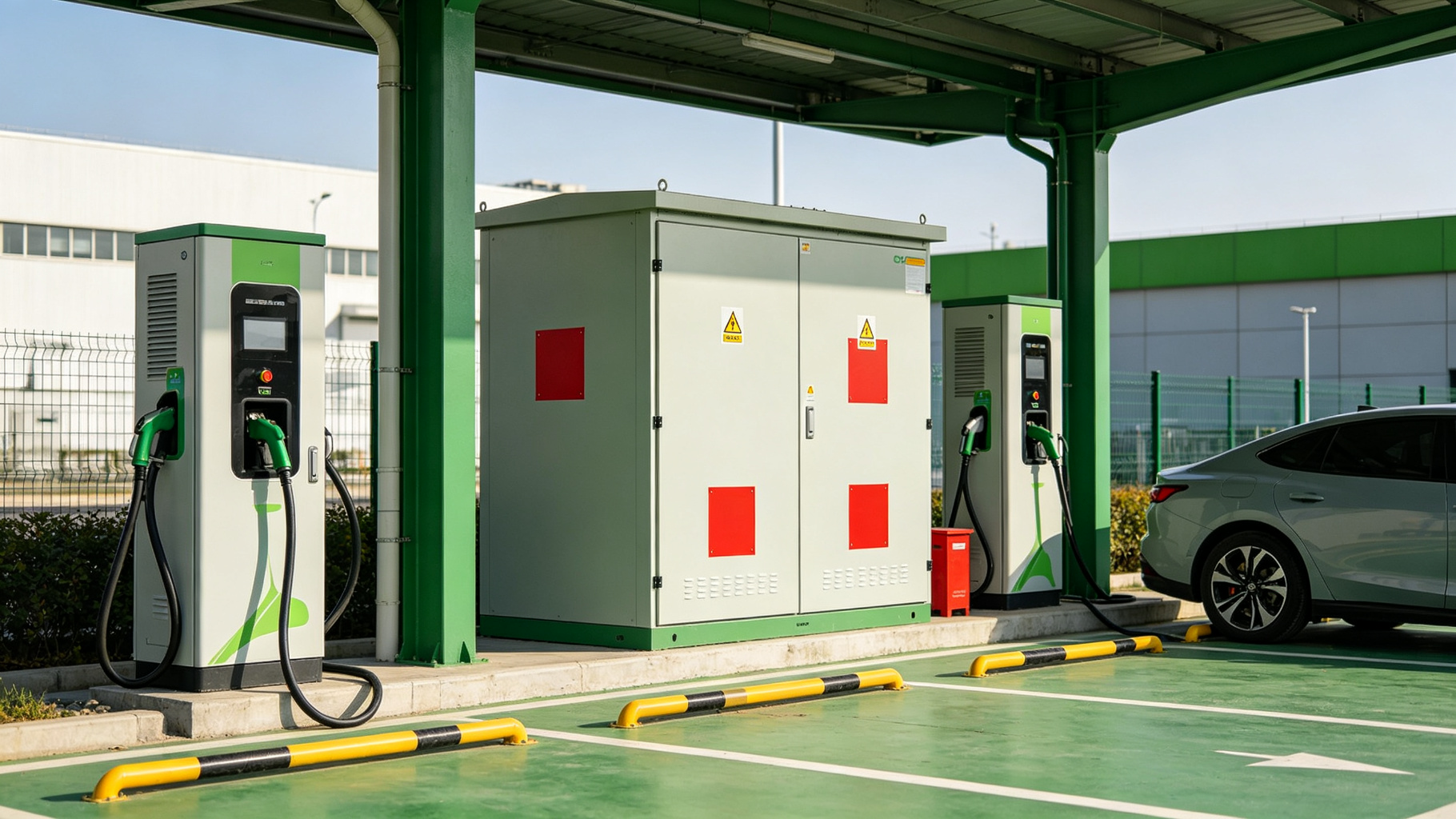
Technical guide on EV charging fire for electrical fire protection
As electric vehicle adoption surges, charging stations are becoming a common fire risk in parking garages, commercial lots, and residential areas. Faulty connectors, overloaded circuits, or battery malfunctions can spark fires that spread rapidly, endangering lives and property. Proper electrical fire protection for EV charging infrastructure must include early detection and suppression designed for high-voltage equipment.
As public and fleet DC fast-charging sites increase in power density, EV charging fire risk has become a central issue for owners, operators, and electrical designers. Most charging events occur without incident, but a fault inside an electric vehicle supply equipment (EVSE) cabinet can develop quickly, especially in high-current DC chargers operating at 400–1000 V. Effective charging station protection therefore requires more than emergency response planning; it requires local, reliable suppression at the component most likely to ignite.
The QuellPatch product line is a passive, clean-agent fire suppression solution intended for enclosure-level charger suppression. Rather than relying on a pressurized cylinder, piping, or external control logic, QuellPatch uses microencapsulated FK-5-1-12 agent that activates thermally when exposed to heat from an incipient EV charging fire. This guide explains the technical basis for using QuellPatch in EVSE applications, including hazard locations, activation-temperature selection, installation rules, inspection, and coordination with active safety systems.
Modern EVSE enclosures contain several energy-dense subsystems. A 50–350 kW DC fast charger typically includes AC input protection, rectifiers or power modules, DC-link capacitors, busbars, output contactors, filters, cooling components, and communication electronics. Failure modes associated with EV charging fires include loose busbar connections, degraded capacitor insulation, semiconductor failure, contactor welding, surge-related damage, moisture or dust ingress, and insulation breakdown on high-voltage DC cables.
These faults can produce arcing at temperatures far above the ignition point of common enclosure materials such as printed circuit boards, potting compounds, cable insulation, and connector plastics. During normal operation, internal air and surface temperatures may range from approximately 40–70°C, with heat sinks and power-module surfaces sometimes reaching 80–110°C. A fault can rapidly elevate local temperatures beyond those ranges, making early local suppression important for EVSE fire safety.
Outdoor and industrial chargers are often built to IP54, IP55, or similar ingress-protection ratings. Sealed cabinets limit water and dust entry, but they also confine smoke and hot gases. Forced-air cooling can move smoke away from ceiling-mounted detectors, while thermal lag may delay point-type heat detectors until the fire has grown beyond its incipient stage.
Because flames may not be visible through a closed cabinet, the first external indication is often smoke from ventilation openings or an EVSE fault alarm. Local suppression placed directly above high-risk components can reduce the time between fault heating and agent application, limiting damage to adjacent modules and reducing the chance of spread to cable management systems or neighboring chargers.
QuellPatch patches contain FK-5-1-12 clean agent held within polymer microcapsules coated onto a flexible backing. The microcapsules eliminate the need for a stored-pressure vessel, nozzles, or piping, which is useful in compact EVSE compartments where space is limited. When a capsule is exposed to sufficient heat, its shell ruptures and releases FK-5-1-12 directly onto or near the heated surface.
FK-5-1-12 is electrically nonconductive and vaporizes after discharge, leaving no powdery or sticky residue on contacts, circuit boards, or heat sinks. This is relevant for charger suppression because post-fire restoration can focus on electrical damage rather than cleaning suppression residue from precision electronics. The agent acts primarily through heat absorption and local interruption of the combustion process; QuellPatch is designed as a local-application passive device, not as a total-flooding system for large rooms or battery systems.
QuellPatch uses passive thermal activation: no external power, detector, or control panel is required for the patch to function. The product line is available with activation temperatures of 80°C, 140°C, and 180°C. Selection should be based on measured or manufacturer-stated maximum normal surface temperatures in the specific compartment, with an appropriate margin above operating temperature and below expected ignition temperatures.
Activation response depends on heat flux, distance from the heat source, and cabinet airflow. The goal is to select the lowest threshold that will not activate during normal operation or solar loading, while still responding early to an abnormal EV charging fire.
Installation should be component-based rather than based only on cabinet volume. A practical EVSE fire safety layout identifies high-risk zones and places patches so the released agent can reach the potential ignition source without obstruction.
Each compartment should be treated separately. Patches should be mounted in close proximity and, where possible, in the direct line of sight of the protected component. Designers should follow the manufacturer’s listed coverage recommendations and avoid treating one patch as protection for an entire multi-bay charger cabinet.
Horizontal mounting on an interior top surface, with the agent-coated side facing downward, is often effective because heat rises and the released agent can fall or diffuse toward the hot component. Vertical side mounting can also be used adjacent to capacitors, contactors, or terminal blocks. Cable bundles, metal partitions, and large heat sinks can block agent distribution, so overlapping patches may be needed on both sides of an obstruction.
Forced-air cooling affects performance. Patches should not be placed directly in front of exhaust fans where the agent could be immediately expelled. Instead, they should be located near the heat source or on the downstream side of airflow where released agent can remain in contact with the fault zone. Outdoor chargers may require weather-resistant QuellPatch variants suitable for UV exposure, humidity, and temperature cycling.
QuellPatch is a passive suppression device and does not by itself de-energize the charger or transmit an alarm. It should be integrated with code-required active systems, including overcurrent protection, ground-fault sensing, residual-current devices, contactor monitoring, and weld-detection logic where provided. If separate heat or smoke detection is installed, it can be used to send an alert, shut down the EVSE, unlock doors, or notify operations personnel.
Ventilation requires careful coordination. Smoke exhaust can improve visibility and reduce gas accumulation, but high airflow during an incipient event can also dilute local clean-agent concentration. A common engineering approach is to maintain normal cooling airflow during operation, then use the fire-alarm or EVSE fault signal to stop charging and, where appropriate, control fans based on the site fire response strategy. Emergency responders should always be given access to the charger and the connected vehicle.
QuellPatch has a 5-year service life under specified indoor and outdoor environmental conditions. Sites should maintain an installation record showing location, activation-temperature variant, date of installation, and inspection history. Annual visual inspections are recommended to check adhesion, capsule integrity, discoloration, dust or oil contamination, and physical damage.
Patches should be replaced if they have activated, show capsule rupture, become detached, or reach the end of their service life. Because the system is not pressurized, periodic hydrostatic testing is not required. After any EV charging fire event, the affected cabinet should be de-energized, ventilated, inspected by qualified personnel, and repaired before returning to service.
EV charging fire protection is most effective when suppression is located close to the components most likely to fail. In EVSE cabinets, those components include power modules, DC-link capacitors, busbars, contactors, and high-voltage terminations. QuellPatch addresses these hazards through microencapsulated FK-5-1-12, passive thermal activation, and a choice of 80°C, 140°C, and 180°C activation thresholds suited to different compartment temperatures.
For charging station protection, the technology offers a residue-free, electrically nonconductive suppression layer that operates without external power. It should be specified as part of a broader EVSE fire safety strategy that includes proper electrical protection, detection, shutdown logic, ventilation planning, inspection, and emergency coordination. When selected and installed according to the manufacturer’s guidance, QuellPatch can provide local charger suppression during the critical early stage of an enclosure fire.
A: No. QuellPatch is designed for incipient fires inside EVSE cabinets, charger compartments, contactors, relays, busbars, and wiring—not for in-vehicle battery packs or BESS units. If a vehicle battery enters thermal runaway, emergency response procedures and station-level safety controls must be followed.
A: No. QuellPatch activates passively when its rated temperature is reached and does not require external power, wiring, or a fire alarm control panel to discharge. If remote notification is required, separate heat or smoke detection can be coordinated with the installation.
A: For DC fast chargers, select the activation rating above the cabinet’s maximum normal operating temperature but below the point where cables, plastics, or electrical insulation could ignite. The 140°C patch is commonly used for high-load EVSE compartments, while 80°C may suit cooler electronics sections and 180°C should be reserved only for unusually high-temperature locations where lower ratings could activate prematurely.
A: Install QuellPatch directly above or adjacent to high-risk EVSE components such as contactors, relays, fuses, terminal blocks, busbars, charging modules, and cable connection points. Placement should follow the tested coverage limits for enclosure volume, ventilation, and mounting distance so the FK-5-1-12 agent reaches the incipient fire zone.
A: UL 9540 addresses energy storage systems and is not a product approval for every EVSE component; QuellPatch should be specified based on its own tested certifications and the charger manufacturer’s requirements. For EV charging stations, verify the relevant UL, NFPA, electrical code, and enclosure conditions rather than assuming UL 9540 coverage applies to charger cabinet suppression.
FIREQUELL QuellPatch delivers automatic, maintenance-free clean-agent protection for electrical panels, battery cabinets and control rooms — designed to meet FM Approved, UL Listed, CE and UKCA requirements.
Request a Site Assessment