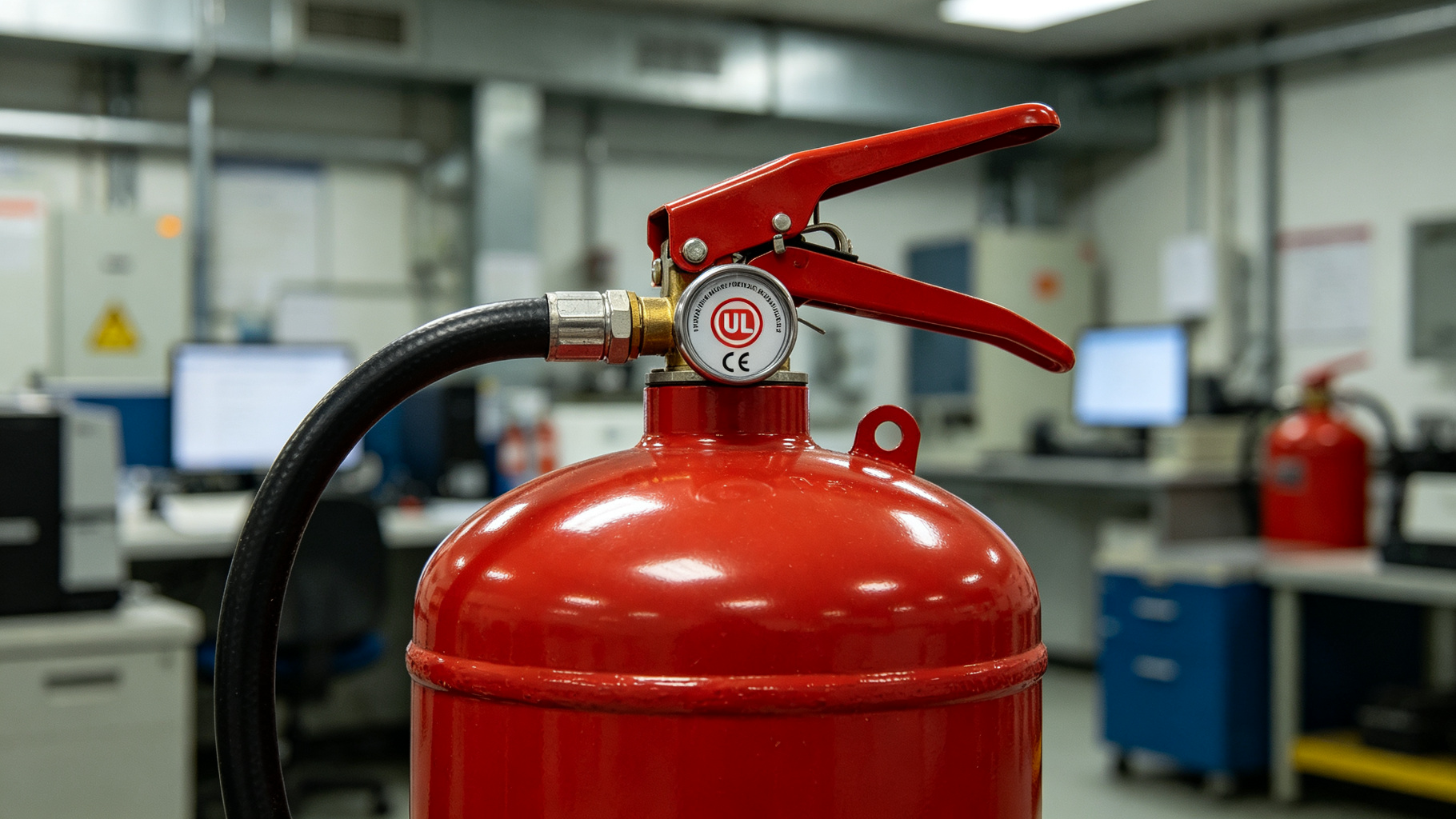
Technical guide on FM approval for electrical fire protection
When a fire breaks out in a server room, the last thing you want is a suppression system that your insurer won't back. FM approval isn't just a badge—it's a rigorous certification process that can make or break your coverage and compliance. Here's what it really takes to get electrical fire protection FM-approved.
Electrical enclosures, battery cabinets, motor control centers, and distributed IT infrastructure present difficult fire-protection challenges: the hazard is often concealed, ventilation is limited, and conventional discharge systems can be difficult to retrofit. Passive clean-agent patches such as the FIREQUELL QuellPatch product line offer a localized approach by storing agent in a thin, mounted format and releasing it only when a thermal threshold is reached. For specifying engineers, facility managers, and insurers, however, the key question is not simply how the patch works, but whether its performance has been independently verified against recognized fire product certification systems.
This article explains three commonly referenced marks—FM Approval, UL certification, and CE marking—and how they apply to QuellPatch. It also connects those certification frameworks to specific product parameters: microencapsulated FK-5-1-12 clean agent, passive thermal activation at 80°C, 140°C, or 180°C, and a 5-year service life. The objective is to treat certification as an engineering boundary, not as a marketing label.
A passive suppression patch has no detector, piping, control panel, or external power supply. Its reliability depends on material stability, adhesive durability, capsule integrity, and predictable rupture under fault heating. Without third party testing, a manufacturer could claim activation at a rated temperature while offering limited evidence that the product will survive years of thermal cycling, humidity, vibration, or electrical enclosure contamination.
Independent certification establishes a tested envelope. It defines the enclosure sizes, mounting positions, activation temperatures, aging conditions, and fire scenarios under which the product was evaluated. It also typically requires follow-up production audits, so units shipped after certification remain within the same design and quality range as the originally tested samples.
QuellPatch uses microencapsulated FK-5-1-12, a fluorinated ketone clean agent selected for electrical applications because it is electrically nonconductive, vaporizes readily, and has low residue potential. FK-5-1-12 has an atmospheric lifetime measured in days, zero ozone-depletion potential, and comparatively low global-warming potential. Its boiling point is near 49°C, so when microcapsules rupture at elevated temperatures, the released agent can vaporize quickly and interact with a developing fire.
The patch is passively thermally activated. Rated activation temperatures are 80°C, 140°C, and 180°C, allowing selection based on normal enclosure operating conditions. Microencapsulation separates the agent from the environment until activation, reduces leakage risk, and supports a 5-year service life under specified conditions. Certification programs evaluate whether these features remain functional after aging and environmental exposure.
FM Approvals is closely associated with industrial property risk and loss prevention. Its approval process is commonly requested by property insurers, risk engineers, and facility operators who want evidence that a product will perform reproducibly in an industrial setting. FM Approval is not merely a single fire test; it combines product evaluation, performance testing, and ongoing manufacturing surveillance.
For fire-suppression products, the assessment typically examines whether the product controls or suppresses a defined fire scenario, whether it remains reliable under expected service conditions, and whether production quality is sufficiently controlled. The result is an approval that applies only to the specific product configuration and use described in the approval record.
For a facility team, FM Approval is most useful when the approved drawing, product variant, and installation instructions match the actual enclosure. An approval for one activation temperature or enclosure category should not be extrapolated to substantially different applications.
UL is an independent product safety certification organization whose marks are widely recognized by authorities having jurisdiction in the United States and Canada. A UL listing indicates that representative product samples have been evaluated against applicable safety requirements and that production facilities are subject to periodic follow-up inspections.
The phrase “UL CE certification” is sometimes used in procurement documents, but it should be interpreted carefully. UL may provide testing, inspection, or notified-body services that support CE marking in Europe, but a UL listing and a CE mark are not interchangeable. UL listing primarily addresses North American safety and listing requirements, while CE marking addresses European regulatory conformity.
For QuellPatch, UL-related evaluation typically focuses on electrical safety, unintended activation, material behavior, and performance in the intended application. Because the patch may be installed near energized bus bars, terminal blocks, relays, or battery modules, reviewers examine dielectric spacing, material flammability, and the consequences of agent release on electrical clearance.
The activation temperature rating is also central. A patch rated 80°C may be appropriate for a climate-controlled cabinet but could be unsuitable for an enclosure with high normal surface temperatures. Conversely, a 180°C patch may be selected for high-ambient industrial equipment but may not respond early enough in a cooler, sensitive electronics enclosure. UL documentation therefore identifies the specific product variant and intended use, and it should be checked against the project’s electrical and environmental conditions.
CE marking is a manufacturer’s declaration that a product conforms to applicable European Union and European Economic Area requirements. It is not a single universal certification mark. The directives, regulations, and conformity-assessment modules that apply depend on the product’s intended use, construction, and placement on the market.
For a fire-protection product, CE marking may involve requirements related to construction products, electromagnetic compatibility, low-voltage equipment, or other applicable legislation. In some cases, a notified body must participate in the assessment; in others, the manufacturer may compile technical documentation and declare conformity after appropriate testing. Third party testing remains important because it provides the evidence behind the declaration.
The technical file for a CE-marked QuellPatch typically includes product descriptions, material data for FK-5-1-12, microencapsulation details, activation-temperature ratings, environmental test results, fire-performance data, labeling, and installation instructions. The 5-year service life must be supported by aging or stability evidence relevant to the rated operating environment.
CE marking allows the product to be placed on the EEA market, but it does not override site-specific requirements from insurers, fire authorities, or internal engineering standards. Multinational projects may specify both UL documentation and CE marking, especially when equipment is designed in one region and deployed across several regulatory regimes.
Choosing among the 80°C, 140°C, and 180°C variants is an engineering decision, not a preference. The selected temperature should be above the maximum normal operating temperature of the enclosure with a suitable margin, but below the temperature at which cables, insulation, or components may reach failure or ignition.
The 80°C variant is commonly considered for climate-controlled control or IT cabinets where normal surface temperatures remain relatively low. The 140°C variant is suited to general electrical enclosures, motor control centers, and similar equipment with moderate operating temperatures. The 180°C variant is intended for higher-ambient locations, such as areas near transformers, generators, or process equipment, where lower-rated patches could be exposed to nuisance heating. Site temperature measurement, enclosure airflow, solar load, and internal heaters should all be reviewed before selection.
Certification is valid only when the product is installed according to the listed or approved instructions. For QuellPatch, this generally includes mounting on a clean, sound surface; locating the patch near the most probable ignition source; avoiding obstruction by cable bundles or hardware; and respecting enclosure volume and ventilation limits. Painting, coating, or covering the patch can alter thermal response and should be avoided.
The 5-year service life applies under specified ambient conditions. Patches should be inspected periodically for dislodgement, damage, discoloration, or exposure to abnormal heat. If a unit has activated, been exposed to temperatures outside its rated range, or reached the end of its service life, it should be replaced.
For global portfolios, facility teams often encounter all three frameworks. FM Approval is frequently driven by property insurance and loss-prevention requirements. UL certification is commonly required by North American authorities having jurisdiction. CE marking is required for placement on the EEA market. These marks can complement one another, but they do not automatically substitute for one another.
Procurement specifications should identify the exact QuellPatch variant, activation temperature, enclosure category, and required certification scope. A certificate for one temperature rating or agent loading does not necessarily cover another configuration, even if the product family name is the same.
FM Approval, UL certification, and CE marking represent different approaches to fire product certification, but all three rely on independent evidence rather than manufacturer assertion alone. For QuellPatch, they provide a framework for evaluating microencapsulated FK-5-1-12, passive thermal activation at 80°C, 140°C, or 180°C, and the 5-year service life under defined conditions.
The engineering value of these marks lies in their limits. They tell a specifier what was tested, how it was tested, and which product configurations the assessment covers. Proper variant selection, correct installation, and ongoing inspection remain necessary to keep the product within its certified performance envelope.
A: No. FM Approval and UL Listing apply only to tested configurations, including activation temperature, enclosure volume, ventilation, mounting position, and fire load. Select the exact QuellPatch variant covered by the certification and verify the installation against the listed limits before relying on it for a specific enclosure.
A: Select a rating above the enclosure’s maximum normal operating temperature with a suitable margin, but below the temperature at which protected components or combustibles could fail or ignite. Common practice is to use 80°C for cooler electronics compartments, 140°C for higher-load electrical spaces, and 180°C where high ambient or operating temperatures would make lower ratings prone to nuisance activation.
A: UL Listing is a third-party certification focused on product safety and defined use, often including electrical equipment applications. FM Approval emphasizes property risk reduction and consistent performance under tested conditions, while CE marking indicates conformity with applicable European regulatory requirements; LPCB and VdS are recognized third-party certification schemes in the UK and Germany, respectively.
A: No. CE marking is a manufacturer’s declaration that a product meets relevant European Union legal requirements, whereas UL certification involves third-party testing and listing against specific UL standards. For engineered fire protection, CE alone does not provide the same product-listing evidence as UL, FM, LPCB, or VdS certification.
A: For electrical enclosures, prioritize certifications that match the product’s intended use, enclosure conditions, and local authority requirements. UL Listing is commonly specified for electrical safety and listed application, while FM Approval is frequently required for property risk assurance; both should be checked against the tested activation temperature, enclosure size, ventilation, and mounting configuration.
FIREQUELL QuellPatch delivers automatic, maintenance-free clean-agent protection for electrical panels, battery cabinets and control rooms — designed to meet FM Approved, UL Listed, CE and UKCA requirements.
Request a Site Assessment