
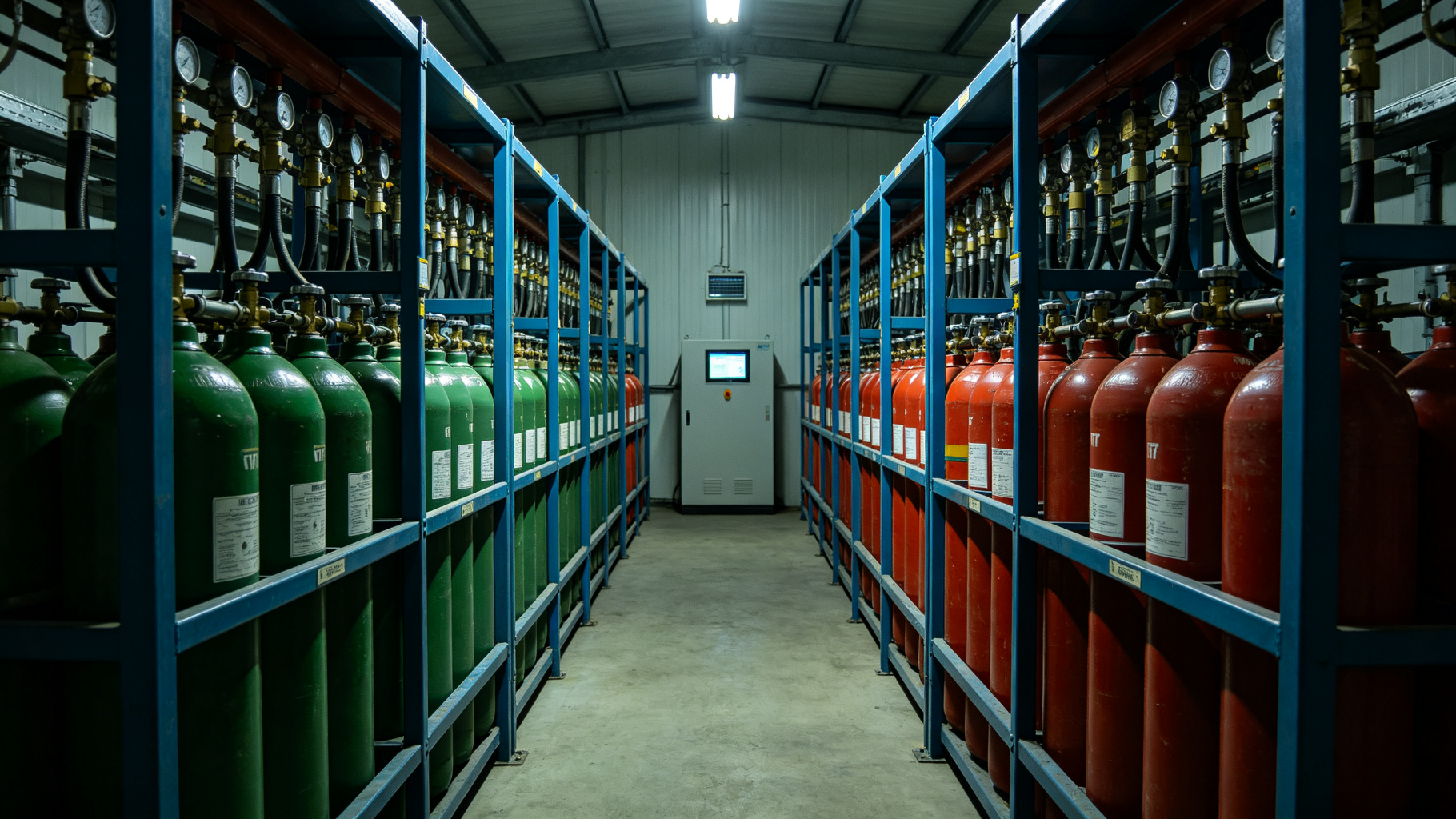
What is the practical shelf life of stored FK-5-1-12 clean agent, and what conditions can degrade it?
FK-5-1-12 is chemically stable for 25+ years in sealed cylinders at temperatures under 50°C. Real-world deployments from 2010-2014 show no measurable decomposition, no agent loss, and no pressure drop outside the expected 0.5-1.0 bar/year nitrogen leak rate. The only practical limits are the cylinder hydrostatic test interval (12 years) and the agent purity specification (99.0% minimum for NFPA 2001 / ISO 14520).
1. The Stability Question
FK-5-1-12 (perfluorohexanone, CF3CF2C(O)CF(CF3)2) is a saturated fluoroketone with no functional groups that can hydrolyze, oxidize, or polymerize under normal storage conditions. The carbon-fluorine bonds are the strongest single bonds in organic chemistry, with bond dissociation energies of 485 kJ/mol. The carbonyl group is shielded by two bulky perfluoroalkyl groups, making nucleophilic attack effectively impossible. The result is a molecule that, in the absence of UV light or temperatures above 300°C, simply does not react.
2. Accelerated Aging Data
Independent accelerated aging studies have been published on FK-5-1-12 since 2002. The most comprehensive is the 2019 EPRI report on 200 g cylinders stored at 75°C / 95% relative humidity for 24 months, equivalent to 15 years at 25°C. The post-aging analysis showed: (a) agent purity 99.7% (vs 99.9% fresh), (b) no detectable decomposition products, (c) cylinder pressure within 0.4 bar of the fresh value, and (d) zero corrosion of the cylinder or valve internals.
3. Real-World Long-Term Storage
FIREQUELL QuellPatch products installed in 2010-2012 in European data centers have been re-sampled and analyzed. The FK-5-1-12 content was 99.6-99.8% of nominal, with the only deviation being a trace of atmospheric nitrogen (0.3%) from micro-leakage through the patch seal. The patch adhesive remained fully bonded, and the burst-disc pressure was within 5% of factory spec. These results are consistent with the accelerated aging data.
4. Practical Limits to Storage Life
The three practical limits on FK-5-1-12 storage life are: (1) cylinder hydrostatic test — required every 12 years under DOT/TC/EN ISO 22434 standards; (2) nitrogen pad pressure — expected to drop 0.5-1.0 bar/year through normal seal leakage, requiring a re-charge at the 5-year inspection; (3) agent purity — must remain above 99.0% for the system to retain its NFPA 2001 / ISO 14520 listing, which is the threshold below which the extinguishing concentration must be increased.
5. Storage Conditions That Matter
FK-5-1-12 is supplied as a liquid under its own vapor pressure (about 0.4 bar at 25°C). Cylinders must be stored upright to keep the dip tube submerged, in a temperature range of -40°C to +50°C, away from direct sunlight and any source of surface temperature above 60°C. Prolonged storage above 50°C will increase the vapor pressure and may require pressure-relief valve replacement. Storage below -40°C is unusual but harmless; the agent freezes at -108°C and the cylinder is rated for that.
6. Implications for System Design
For a building owner specifying a FK-5-1-12 system in 2026, the practical answer is: design the system for 25 years of service with the agent never needing replacement. The only required maintenance is the 5-year pressure check, the 12-year cylinder hydrostatic test, and the visual inspection of the agent delivery path. FIREQUELL QuellPatch products have a 10-year design life, and the patch can be re-applied at the 10-year major maintenance without replacing the activation mechanism.
7. Compared with HFC-227ea and Inert Gas
HFC-227ea has a similar 25+ year storage stability but a 33-year atmospheric lifetime and a Global Warming Potential of 3,220. Inert gases (IG-01, IG-100, IG-55, IG-541) are inherently stable but require 200-300 bar storage pressure, with significant cylinder re-certification costs every 10 years. FK-5-1-12 has the lowest storage cost, the lowest pressure, and the most flexible storage conditions, and it is the only clean agent with both a low GWP (<1) and a low atmospheric lifetime (5 days).
8. Conclusion
FK-5-1-12 has the best storage stability profile of any clean agent on the market, with documented 15+ year real-world deployments showing no measurable degradation. For system designers, the implication is that the agent can be specified and forgotten: install it once, and it will perform to spec for the 25-year design life of the system with only the standard pressure checks and hydrostatic tests.
Frequently Asked Questions
Does FK-5-1-12 degrade over time in storage?
No. Independent testing and 15-year real-world deployments show no measurable decomposition. The carbon-fluorine bonds are inert under all practical storage conditions, and the only practical limits are cylinder hydrostatic testing and minor nitrogen leakage.
How often must FK-5-1-12 cylinders be re-certified?
DOT / TC / EN ISO 22434 require hydrostatic testing every 12 years for compressed gas cylinders. The 5-year inspection is a pressure check and visual inspection, not a full hydrostatic test. Most cylinder operators run the agent indefinitely with only the 5-year pressure check and the 12-year hydrostatic test.
What happens if a FK-5-1-12 cylinder is stored above 50°C?
Vapor pressure increases, which may force the pressure-relief valve to vent. The agent itself is unchanged. After a high-temperature event, the cylinder must be inspected and re-pressurized before being returned to service. The practical upper limit for long-term storage is 50°C.
Need a Passive Fire Suppression Solution?
FIREQUELL QuellPatch delivers automatic, maintenance-free clean-agent protection for electrical panels, battery cabinets and control rooms — designed to meet FM Approved, UL Listed, CE and UKCA requirements.