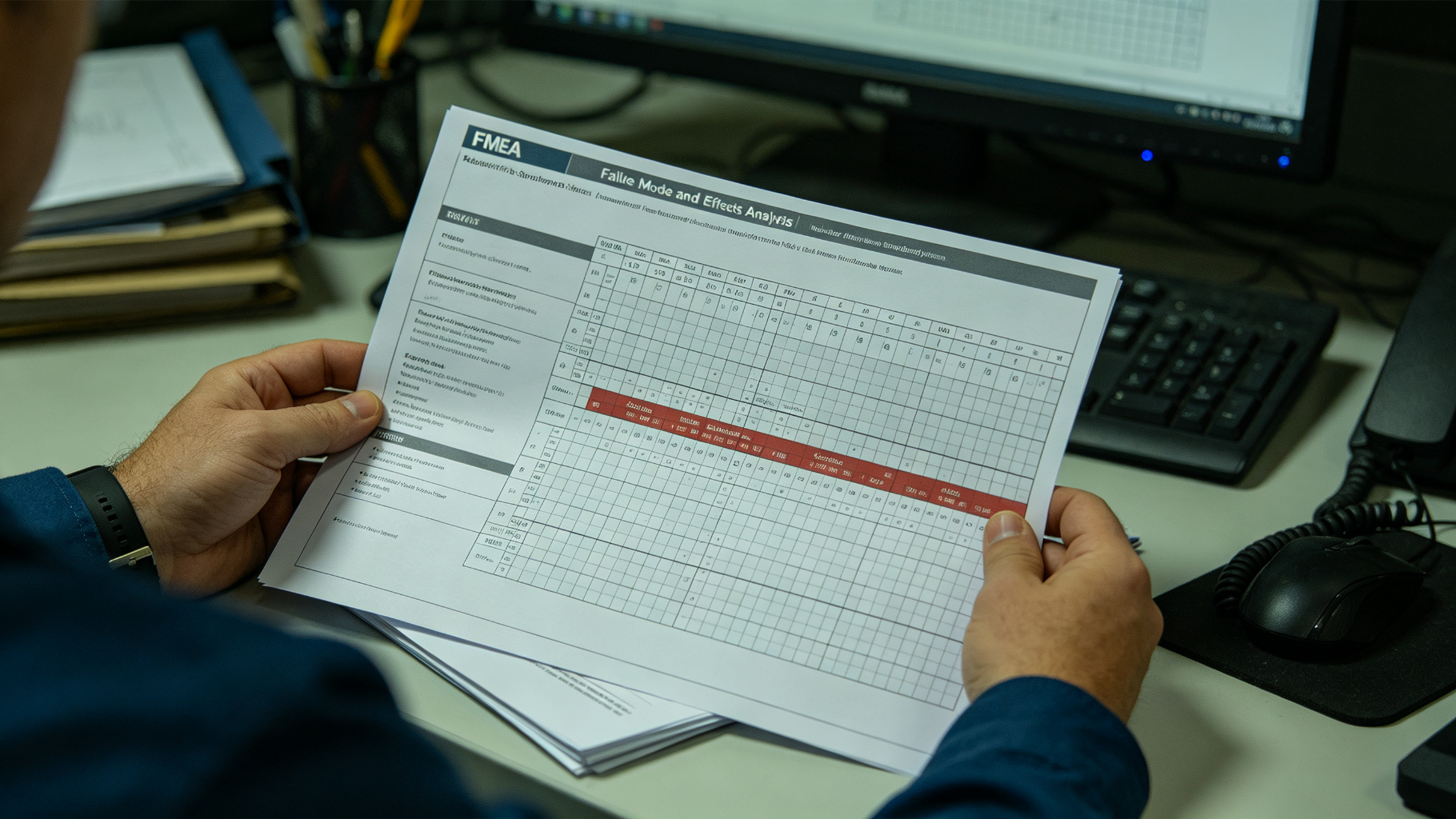
Technical guide on FMEA for electrical fire protection
When a control cabinet catches fire, the average cost of downtime in manufacturing exceeds $260,000 per hour. That's why engineers are turning to Failure Mode and Effects Analysis (FMEA) to design passive fire suppression systems that act before flames spread. This approach identifies weak points in electrical enclosures—where arcs or overheating are most likely—and deploys targeted extinguishing agents to contain the threat.
Failure Mode and Effects Analysis (FMEA) is a structured, bottom-up method for identifying how a product can fail, what causes each failure, and what consequences follow. For passive fire suppression systems used in electrical infrastructure, FMEA is especially valuable because reliability depends on material behavior, installation geometry, and fire dynamics rather than on powered detectors, control panels, or manual release. This article applies FMEA principles to the QuellPatch product line, a passive clean-agent suppression patch that uses microencapsulated FK-5-1-12 and thermal activation to release agent locally at an incipient fire.
The analysis focuses on four core topics: FMEA scope, storage and microencapsulation failure modes, thermal activation failure modes, and risk prioritization. The objective is not to imply universal performance, but to show how engineering teams evaluate passive suppression reliability during design, installation, and service-life planning. Nominal activation temperatures of 80°C, 140°C, and 180°C are considered, along with the rated 5-year service life and the role of microencapsulation in agent retention.
A useful FMEA begins with the system’s intended functions. For QuellPatch, the primary functions are to retain FK-5-1-12 during normal service, respond thermally when local temperatures reach the rated activation threshold, release agent into the fire zone, and maintain physical attachment to the protected surface. Secondary functions include providing visible condition indicators through date labels and supporting inspection without requiring equipment shutdown.
The FMEA boundary should include the patch laminate, microcapsule population, adhesive layer, release liner removed during installation, and the immediate mounting surface. It should also include installation variables such as surface preparation, patch placement, and temperature-class selection. Items outside the boundary—such as building fire alarm systems, ventilation, and emergency response procedures—still influence consequences but are analyzed as external controls rather than patch components.
QuellPatch variants are offered with nominal activation temperatures of 80°C, 140°C, and 180°C. The selected rating must exceed the maximum expected normal surface or air temperature in the protected enclosure with an appropriate engineering margin. The 80°C variant is typically considered for conditioned electronic spaces, the 140°C variant for general electrical enclosures, and the 180°C variant for higher-ambient industrial locations. These are nominal design thresholds; actual activation can be affected by heat-transfer rates, thermal mass, and airflow.
The 5-year service life assumes installation within the manufacturer’s specified ambient range, protection from persistent mechanical abrasion, and compatibility with the mounting surface. FMEA risk estimates should be revised if patches are exposed to chemical spray, oil mist, ultraviolet radiation, repeated thermal cycling, or physical damage beyond the assumed service environment.
QuellPatch stores FK-5-1-12 in a dispersed population of microcapsules within a flexible laminate. In the design analyzed here, capsule diameters are controlled to approximately 80–250 μm. This microencapsulation approach eliminates the need for a pressurized cylinder, but it introduces material-level failure modes that must be evaluated separately from conventional suppression hardware.
From a passive suppression reliability standpoint, these failure modes are important because they are gradual. A pressurized system may show a pressure loss, but a microencapsulated patch requires visual inspection, date control, and replacement discipline. The FMEA therefore assigns high detection difficulty to slow permeation that is not externally obvious.
FK-5-1-12 is selected for its electrical nonconductivity, clean discharge characteristics, and ability to interrupt combustion chemically. However, FMEA must distinguish between agent stability and package stability. The agent itself may remain chemically stable under expected storage conditions, while the capsule shell, adhesive, or laminate can age through oxidation, plasticizer migration, or environmental stress cracking.
The 5-year service life is a key control in this analysis. It limits the time during which undetected aging can accumulate. The FMEA should also consider compatibility with enclosure materials, including certain plastics, rubbers, and conformal coatings. Although FK-5-1-12 has favorable compatibility compared with some older agents, prolonged direct contact before activation, combined with elevated temperature, may affect sensitive materials. Material compatibility review is therefore recommended before installation on nonmetallic components.
Passive thermal activation is a defining feature of QuellPatch. The capsule shell is formulated to soften, rupture, or otherwise release agent when heated to the selected temperature class. Failure to activate occurs when the capsule population does not reach the threshold temperature, or when the shell response has shifted because of aging or manufacturing variation.
In FMEA terms, failure to activate usually has high severity because the patch cannot perform its primary safety function. Occurrence is reduced through coverage mapping, correct rating selection, and installation guidance, while detection depends on design review and post-installation inspection.
Premature activation is the release of agent during normal operation or non-fire conditions. Causes include selection of a temperature rating too close to normal operating temperature, localized hot surfaces, hot-work activity, steam discharge, or concentrated solar loading. A premature release does not typically present a toxicological hazard under ordinary conditions, but it removes protection until the patch is replaced and may indicate an unexpected heat source that requires investigation.
Delayed activation is different from non-activation. The patch eventually operates, but later than intended. Delay can be caused by forced cooling, high airflow, a slow-smoldering fire, or placement on a high-mass surface. The FMEA evaluates delay by comparing expected time-to-activation with fire growth in the specific enclosure. A delay of seconds may be acceptable for a small, contained component; a delay of minutes may allow flame spread to adjacent cables.
Each failure mode must be linked to a concrete effect. For electrical infrastructure, common effects include continued fire growth, damage to conductors or control boards, production outage, smoke release, and increased need for manual firefighting. Because QuellPatch is a local passive system, the FMEA should evaluate whether one failed patch leaves adjacent patches capable of responding, or whether the protected enclosure relies on a single patch.
An illustrative risk-prioritization approach uses severity, occurrence, and detection ratings on a 1–10 scale. For example, obstructed heat path leading to non-activation might be rated severity 9, occurrence 3, detection 6, giving a risk priority number of 162. Premature activation from an incorrectly selected temperature class might be severity 5, occurrence 3, detection 4, giving 60. Agent loss beyond the 5-year replacement interval might be severity 8, occurrence 4 if replacement tracking is weak, detection 5, giving 160. These values are illustrative and should be calibrated to site-specific conditions and field data.
The FMEA identifies both design and procedural controls. For QuellPatch, typical controls include:
These controls improve passive suppression reliability by addressing the highest-risk failure modes: wrong rating, poor placement, mechanical damage, and aging beyond service life. FMEA should be treated as a living document, updated after design changes, new installation experience, fire incidents, or revisions to manufacturer guidance.
FMEA of passive fire suppression systems requires attention to material behavior and fire dynamics, not just component hardware. For QuellPatch, the most significant failure modes involve agent retention through microencapsulation, thermal response at the rated 80°C, 140°C, or 180°C threshold, and installation factors that affect heat transfer and agent distribution. The 5-year service life, visual inspection, correct temperature-class selection, and proper placement are central to risk control.
The analysis also shows that passive does not mean maintenance-free. A microencapsulated FK-5-1-12 patch can provide reliable local suppression under defined conditions, but FMEA should be used to verify that the patch is matched to the enclosure, that coverage is adequate, and that replacement processes are in place. When integrated with broader risk analysis and fire-protection planning, FMEA helps facility and engineering teams understand where passive suppression contributes most effectively and where additional safeguards may be appropriate.
A: The rated service life is 5 years under the manufacturer’s specified environmental conditions. Patches should be replaced sooner if they show damage, delamination, discoloration, weeping, or if they have activated. Inspections should follow the site maintenance schedule and the manufacturer’s installation and service instructions.
A: Yes. Activation depends on the patch reaching its rated activation temperature, so thermal shielding, excessive airflow, a heat-sinking surface, or an incorrectly high temperature rating can delay or prevent release. FMEA controls include correct placement, temperature-rating selection, inspection, and avoiding installation locations where heat may be diverted away from the patch.
A: Nuisance activation can occur if the patch is exposed to temperatures above its rated threshold, such as near heaters, bus bars, transformers, or process equipment. The FK-5-1-12 clean agent discharges locally and leaves no residue, but the affected patch must be replaced and the heat source or rating selection reviewed.
A: Key failure modes include microcapsule damage or weeping, adhesive or laminate degradation, blocked or shielded heat transfer, incorrect activation-temperature selection, and physical damage during installation or maintenance. The FMEA should evaluate severity, occurrence, and detection controls for each mode, then prioritize actions such as relocation, inspection, or specification changes.
A: Risk should be prioritized by combining the severity of the fire scenario, likelihood of the failure mode, and ability to detect it before a fire. High-priority items typically include patches mounted where they cannot reach activation temperature, patches in severe thermal or vibration environments, and units showing visible degradation. Controls may include thermal mapping, periodic visual inspection, replacement intervals, and design review against NFPA and site reliability requirements.
FIREQUELL QuellPatch delivers automatic, maintenance-free clean-agent protection for electrical panels, battery cabinets and control rooms — designed to meet FM Approved, UL Listed, CE and UKCA requirements.
Request a Site Assessment