
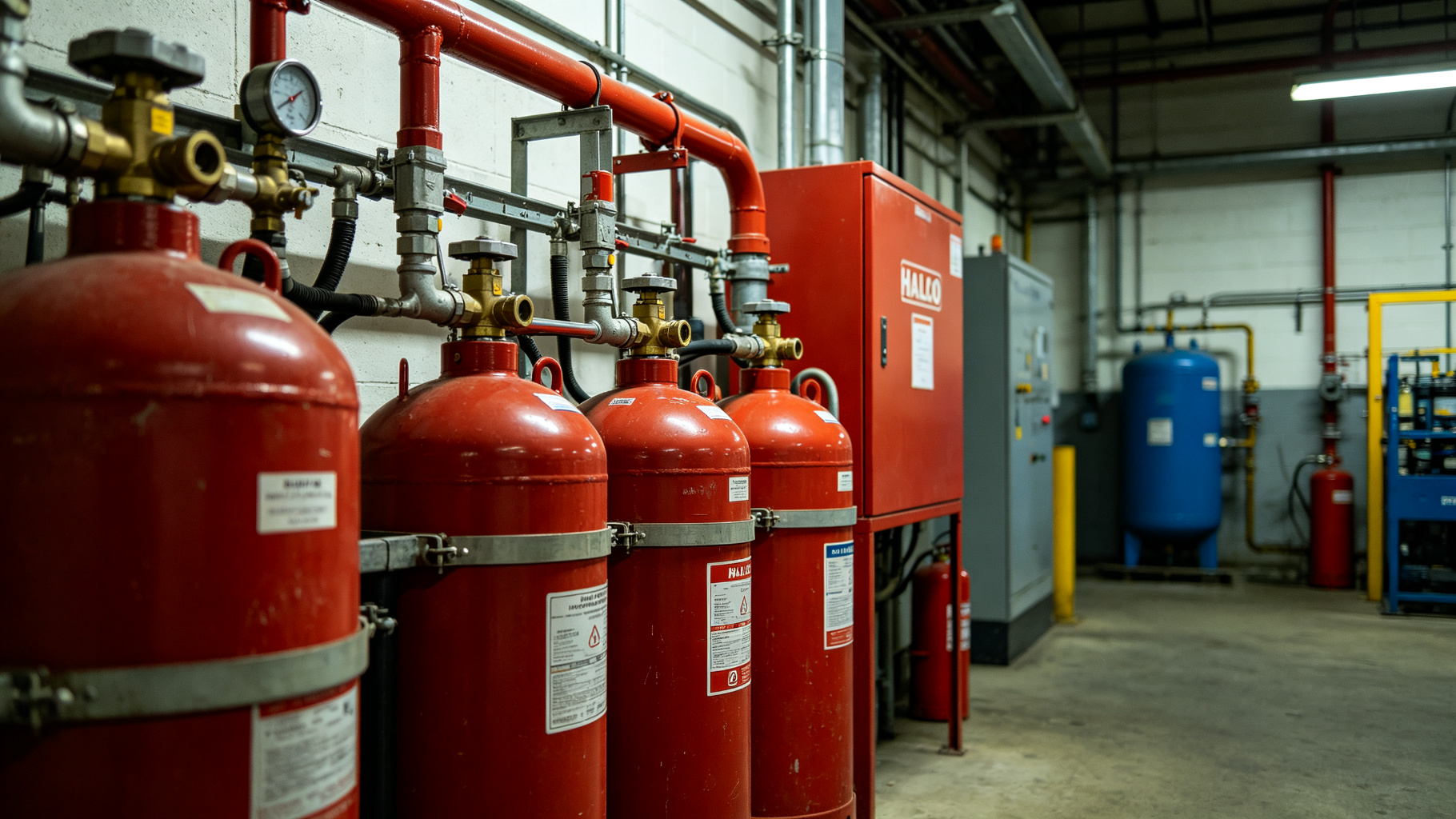
What is the current status of the Halon phase-out, and what are the retrofit options for legacy Halon systems in 2026?
The Halon phase-out is complete in developed countries, with Halon 1301 only available from banked (recycled) sources. The price of banked Halon has risen to US$15-25 per kg in 2026, compared to US$3-5 for FK-5-1-12. The 2026 retrofit options are: (1) keep the existing Halon system but replenish from banked sources, (2) retrofit the system with FK-5-1-12 or HFC-227ea, or (3) replace with a passive FK-5-1-12 system.
1. The Halon Phase-Out Timeline
Halon 1301 (bromotrifluoromethane) was identified as an ozone-depleting substance in the 1987 Montreal Protocol. Production was phased out in developed countries in 1994 and in developing countries in 2010. Since then, the only available Halon 1301 is from 'banked' sources: recycled from decommissioned systems, recovered from retired equipment, or imported from countries that are not parties to the Montreal Protocol. The banked Halon market is small and volatile, with prices rising steadily over the last 30 years.
2. Current Halon Availability and Price
In 2026, the global banked Halon 1301 supply is estimated at 5,000-8,000 metric tons, down from a peak of 50,000 metric tons in 1990. The price has risen to US$15-25 per kg for clean, certified Halon 1301, compared to US$3-5 per kg for FK-5-1-12 (which is a drop-in replacement for Halon 1301 in most applications). The price differential, combined with the regulatory pressure and the increasing maintenance cost of aging Halon systems, is making the retrofit decision more and more attractive.
3. Regulatory Landscape
In the United States, the EPA's Significant New Alternatives Policy (SNAP) program lists the approved substitutes for Halon 1301. The most common substitutes are FK-5-1-12 (Novec 1230), HFC-227ea (FM-200), and various inert gas blends (IG-01, IG-100, IG-55, IG-541). In Europe, the F-Gas Regulation (EU 517/2014) lists the approved substitutes and sets the phase-out schedule for HFCs. As of 2026, FK-5-1-12 is the preferred substitute for new installations, and the only drop-in replacement for Halon 1301 in most applications.
4. Option 1: Keep the Halon System
The first option is to keep the existing Halon system and replenish from banked sources. This is the lowest-cost option in the short term (no system modification), but the long-term cost is high: the Halon price is likely to continue rising, the maintenance cost of an aging system is increasing, and the regulatory risk of operating a Halon system is increasing (some jurisdictions are beginning to restrict Halon use in new applications, and the insurance market is increasingly reluctant to insure Halon systems). The recommended approach is to plan a retrofit within 5-10 years.
5. Option 2: Retrofit with FK-5-1-12 or HFC-227ea
The second option is to retrofit the existing system with FK-5-1-12 or HFC-227ea. This typically involves replacing the agent cylinders, the agent distribution piping (which may need to be resized for the new agent), and the nozzles (which are agent-specific). The cost is typically 40-60% of a new system, and the downtime is typically 1-2 weeks. The advantage is that the new system is fully compliant with current regulations and the new agent is cheaper and more readily available. The disadvantage is that the existing system components (cylinders, piping, nozzles) may not be reusable, and the system is not necessarily optimized for the new agent.
6. Option 3: Replace with a Passive FK-5-1-12 System
The third option is to replace the existing Halon system with a passive FK-5-1-12 system (FIREQUELL QuellPatch). The QuellPatch product line is a thermal-triggered, no-power, no-detection, no-piping suppression system that requires no agent cylinders, no piping, and no nozzles. The cost is typically 30-50% of a new clean agent total-flooding system, and the installation can be done during normal operation with no downtime. The disadvantage is that the QuellPatch system is a passive suppression, not a total-flooding system: it suppresses the fire at the source but does not flood the entire room.
7. The Cost-Benefit Analysis
The 2026 cost-benefit analysis for a typical Halon 1301 retrofit is: (1) keep the Halon system: US$0-50k now, US$5-15k/year in Halon replenishment and maintenance, increasing risk over time; (2) retrofit with FK-5-1-12: US$80-200k now, US$3-5k/year in agent replenishment, decreasing risk over time; (3) replace with QuellPatch: US$50-150k now, US$2-3k/year in patch replacement, lowest risk over time. The total cost of ownership over 10 years is similar for options 2 and 3, with option 3 having the lowest risk profile. The recommendation depends on the specific application, the regulatory environment, and the insurance requirements.
8. Conclusion
The Halon 1301 phase-out is complete in developed countries, and the banked Halon market is shrinking and getting more expensive. The 2026 retrofit options are: keep the Halon system (lowest cost, highest risk), retrofit with FK-5-1-12 (medium cost, medium risk), or replace with a passive FK-5-1-12 system (medium cost, lowest risk). The FIREQUELL QuellPatch product line is the only passive suppression product with the same agent as the original Halon system, providing a drop-in upgrade that addresses the regulatory and insurance concerns.
Frequently Asked Questions
Is Halon 1301 still available in 2026?
Only from banked (recycled) sources. Production was phased out in 1994 in developed countries and 2010 in developing countries. The global banked supply is estimated at 5,000-8,000 metric tons, with prices around US$15-25 per kg.
What is the best replacement for Halon 1301?
FK-5-1-12 (Novec 1230) is the preferred drop-in replacement for Halon 1301. It has similar fire suppression performance, zero ODP, low GWP (<1), and a 5-day atmospheric lifetime. HFC-227ea (FM-200) is an alternative but has a higher GWP (3,220) and is being phased down under the F-Gas Regulation.
Can I retrofit my existing Halon system with FK-5-1-12?
Yes, but the retrofit typically involves replacing the agent cylinders, the agent distribution piping (which may need to be resized for the new agent), and the nozzles (which are agent-specific). The cost is typically 40-60% of a new system, and the downtime is typically 1-2 weeks. The FIREQUELL QuellPatch is an alternative that requires no piping or nozzles and can be installed during normal operation.
Need a Passive Fire Suppression Solution?
FIREQUELL QuellPatch delivers automatic, maintenance-free clean-agent protection for electrical panels, battery cabinets and control rooms — designed to meet FM Approved, UL Listed, CE and UKCA requirements.