
Hyperscale Data Center Fire Protection: 50 MW Hall Architecture
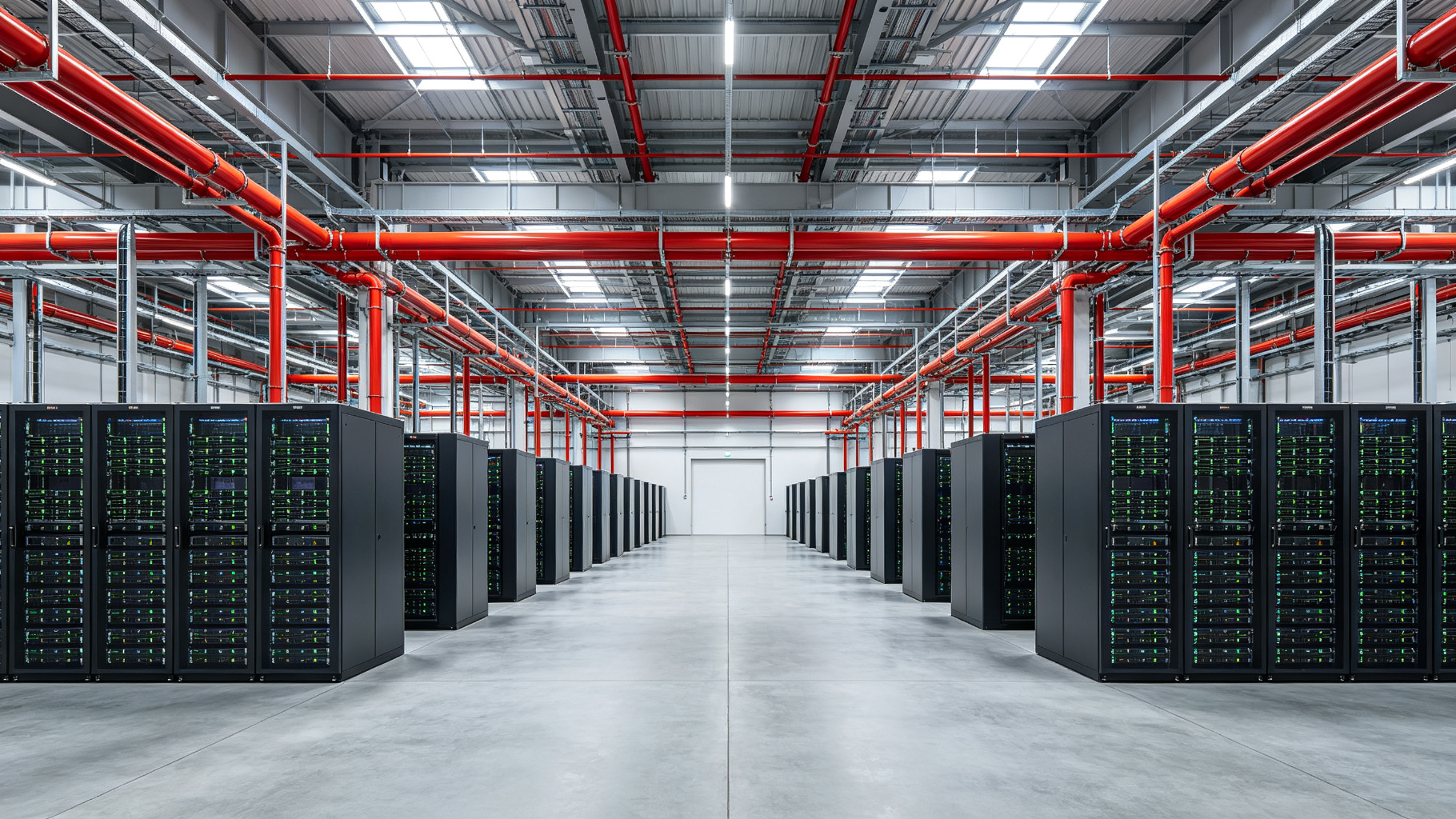
How is fire protection architected for a 50 MW hyperscale data center hall?
A 50 MW hyperscale hall is protected by layered detection (VESDA + spot heat), zoned FK-5-1-12 / inert gas total-flooding systems per row, and passive FK-5-1-12 patches inside IT cabinets for last-line defense. The architecture assumes 1 in 8 IT cabinets may be on fire at any moment and must be suppressed without disrupting the other 7.
1. Why 50 MW Halls Are Different
A 50 MW hall is not just a bigger 5 MW hall. The energy density, the redundancy model, and the speed of fault propagation all change. A single arcing fault inside a 50 kW IT cabinet can escalate to a class C fire in under 90 seconds, and in a 50 MW hall with 800+ cabinets, the same fault can propagate thermally to 4–6 neighboring cabinets before the building fire alarm triggers. The fire protection architecture must therefore be local-first, not hall-first.
2. Three-Layer Defense Model
Hyperscale operators typically deploy three concentric protection layers. Layer 1 is detection: VESDA air-sampling in cold aisles, with addressable spot heat sensors at every IT cabinet. Layer 2 is active suppression: pre-engineered FK-5-1-12 total-flooding zones sized to the worst-case 20 MW IT load, with mechanical lockout to prevent discharge during maintenance. Layer 3 is passive suppression: QuellPatch FK-5-1-12 thermal patches inside each IT cabinet for unattended, no-power, no-pipework response to incipient fires.
3. Zoning and Containment
The standard zoning for a 50 MW hall is one suppression zone per 2 MW IT load, with 4–5 zones per row. This limits the agent mass per zone to under 1,200 kg, which keeps the post-discharge atmosphere below the 10% NOAEL for FK-5-1-12 even if the entire zone is occupied. Containment is the limiting factor: NFPA 2001 requires a 10-minute hold time, which translates to envelope leakage under 1% per minute at 50 Pa.
4. Integration with Liquid Cooling
Many 50 MW halls now deploy direct-to-chip liquid cooling, which adds 2-3 liters of dielectric fluid per IT cabinet. This fluid changes the fire hazard: a leak can create a new fuel source, and a coolant pump failure can elevate IT cabinet temperatures by 8-10°C within 60 seconds. Passive FK-5-1-12 patches installed on coolant distribution units and pump enclosures add a third fire hazard zone that traditional detection cannot cover.
5. Detection-to-Suppression Timing
The detection-to-suppression window for 50 MW halls has compressed from the 30-second industry standard of 2015 to under 8 seconds in 2026 designs. This requires (a) VESDA pre-alarm at 0.05% obscuration/ft to give the suppression system 20+ seconds of decision time, (b) a fire alarm control panel that auto-triggers zone isolation and pre-discharge countdown, and (c) passive patches that operate on a totally independent thermal trigger without any electrical signal.
6. Redundancy and Single Points of Failure
Tier IV / concurrent maintainability standards require every fire protection subsystem to be N+1 redundant. In practice this means dual VESDA networks, dual agent cylinders with swing valves, and dual passive patch inventories. The single most common oversight is assuming the IT cabinet's IT-grade power supply is independent of the building fire alarm system; in most 50 MW halls the fire alarm control panel draws from the same UPS as the IT load, so a single UPS failure takes out detection. The fix is a dedicated, battery-backed fire system on a separate circuit.
7. Operating Cost
Annual operating cost for a 50 MW hall fire protection system is dominated by the agent replacement cycle and the VESDA filter maintenance. For a typical installation, budget US$0.18/W of IT load per year, of which roughly 60% is the FK-5-1-12 agent and cylinder re-certification, 25% is VESDA filter and pump replacement, and 15% is passive patch replacement after activation. Passive patches in IT cabinets that never fire are good for 10+ years and require no maintenance.
8. Conclusion
A 50 MW hyperscale hall is protected not by a single system but by three independent, overlapping systems. Detection triggers active suppression; active suppression covers the worst case; passive FK-5-1-12 patches inside each IT cabinet ensure that a fire in any single cabinet is suppressed even if both detection and active suppression fail. The FIREQUELL QuellPatch product line is engineered specifically for this last-line-of-defense role.
9. System Selection and Sizing
Sizing fire protection for a 50 MW hall starts from the IT load and the worst-case fire scenario, not from floor area. Agent mass is calculated for the full fuel volume of the largest protected zone, on the assumption of 100% fuel involvement at discharge. In practice this means a zone of 8-12 cabinets at roughly 2 MW IT load, with the passive patch layer sized to cover individual cabinets that sit outside active zones.
Selection should be driven by three questions: what fuel is present (batteries, copper, plastic, dielectric fluids), what the detection-to-suppression budget is, and whether the site needs to stay live during maintenance. Where downtime is the dominant cost, redundancy in the suppression path matters more than peak capacity — operators typically prefer multiple smaller zones over one large system, because a single-zone failure is contained and maintenance windows shrink.
10. Commissioning, Testing and Lifecycle
Commissioning a 50 MW hall means proving the chain end to end: VESDA sampling reach, valve actuation, discharge into the protected zone, and the passive patch layer's thermal activation. Acceptance testing usually includes a real discharge into an empty or representative zone, a hold-time verification, and a documented re-fill procedure so the system returns to service the same day.
Lifecycle cost is dominated by agent replenishment, cylinder inspection and detector maintenance. FK-5-1-12 has a long storage life and stable chemistry, and passive patches require no power, no cylinders and no maintenance beyond periodic visual inspection and end-of-life replacement on the five-year service cycle. That is why the passive layer is increasingly the preferred final line of defence in halls where an unplanned suppression outage can cost more than the system itself.
Frequently Asked Questions
How many IT cabinets can a single FK-5-1-12 zone cover in a 50 MW hall?
A typical zone covers 8-12 IT cabinets at 2 MW IT load, with agent mass sized for the worst-case 100% fuel involvement. Above 12 cabinets the post-discharge concentration uniformity degrades and supplemental passive patches become mandatory.
Is liquid cooling compatible with FK-5-1-12 suppression?
Yes. FK-5-1-12 is electrically non-conductive and chemically inert toward dielectric coolants. The agent will not contaminate the coolant loop, and a coolant leak does not create a fire hazard beyond the normal electrical risk. Passive patches can be installed directly on coolant manifolds and pump enclosures.
How often must VESDA detectors be recalibrated in a 50 MW hall?
VESDA detectors in hyperscale halls are typically recalibrated annually, with filter replacement every 24 months. Some operators run continuous self-calibration against a reference gas cylinder, which extends the calibration interval to 36 months. Always follow the manufacturer's published maintenance schedule.
How is agent mass calculated for a 50 MW hall?
Agent mass is sized to the largest single protected zone at 100% fuel involvement, based on the enclosure volume, the design concentration from NFPA 2001 or EN 15004, and a safety margin for leakage. In a typical 50 MW hall this works out to a zone of 8-12 IT cabinets at about 2 MW IT load. Passive patches are then sized cabinet-by-cabinet for equipment outside active zones.
Can passive protection replace VESDA detection and active suppression?
No — the three layers are complementary. VESDA gives early warning, active suppression handles the worst-case fire, and passive FK-5-1-12 patches protect individual cabinets when detection or active suppression fails. Removing any layer leaves a gap in the defence model.
What testing does a 50 MW hall fire system require before go-live?
Typical acceptance testing includes a discharge test into a representative zone, hold-time verification, valve and detector function checks, and a documented refill. After go-live, annual function tests plus detector calibration on the manufacturer's schedule keep the system compliant and audit-ready.