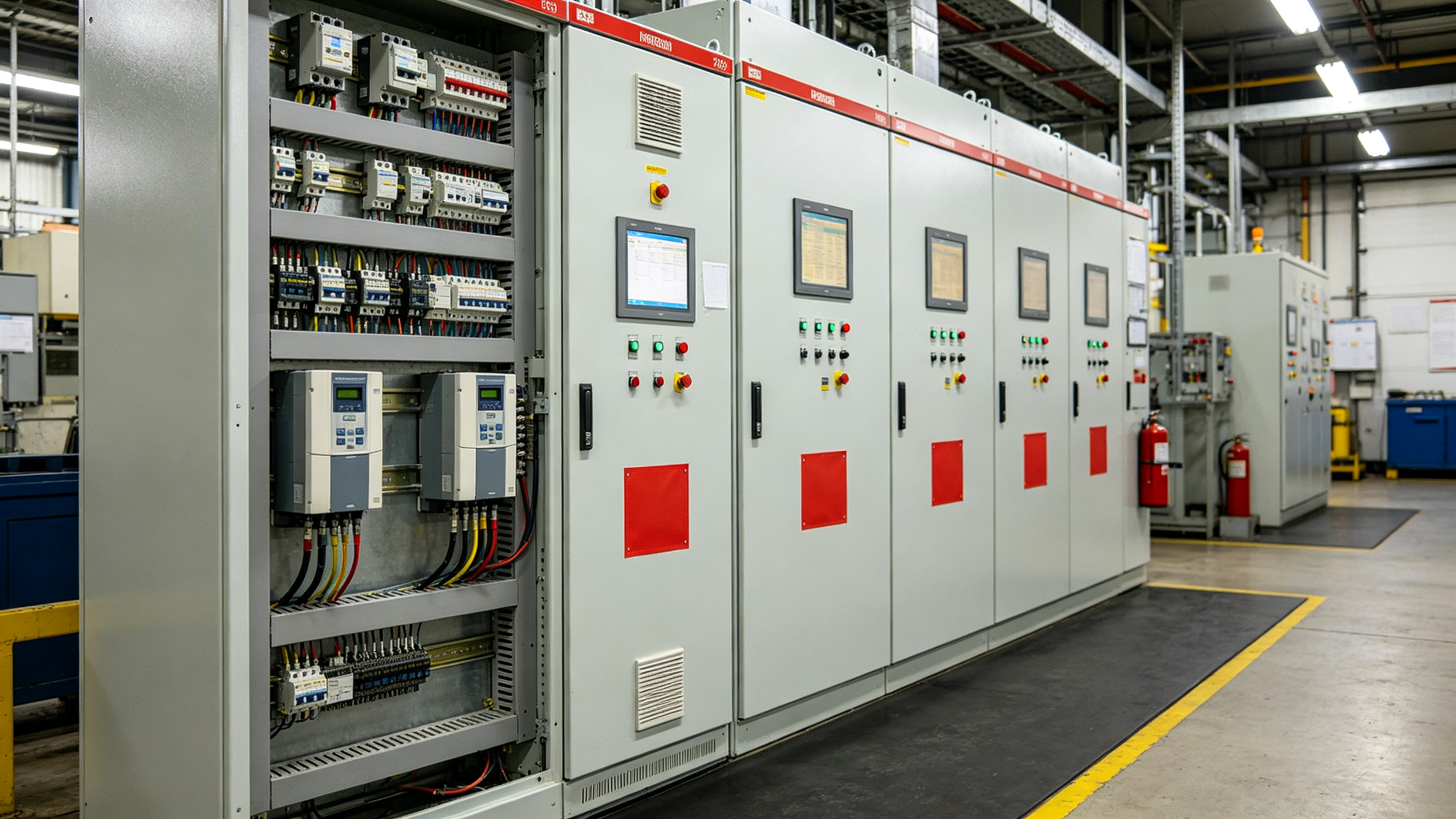
Technical guide on PLC fire for electrical fire protection
In a recent survey, 62% of industrial plants reported at least one electrical fire incident in the past five years, with control cabinets being the most common ignition point. For PLC and automation systems, a fire can mean more than equipment loss—it halts production lines and compromises safety. This is why industrial control cabinet fire protection now focuses on early, localized suppression that fits within the compact confines of modern enclosures.
PLC and DCS cabinets are the operational nodes of modern process plants, manufacturing lines, and power infrastructure. A single industrial control cabinet may concentrate 24 V DC I/O cards, 120/230 V AC power feeds, contactors, relays, terminal blocks, communication modules, and battery-backed controllers in a volume of less than one cubic meter. When a PLC fire or DCS protection failure occurs, the initial fuel load is often small—PVC insulation, phenolic circuit boards, connector housings, and capacitor wraps—but the business interruption can be substantial because production logic, safety interlocks, and historian data depend on that enclosure.
Conventional room-level clean-agent systems are designed for total flooding, but many cabinet fires start in localized hot spots that may not generate enough smoke or heat to trigger ceiling detection quickly. Cabinet doors, cable glands, cooling fans, and ventilation slots also make it difficult to maintain the agent concentration needed for total flooding. QuellPatch is a passive, clean-agent fire suppression patch intended for point-of-origin protection inside electrical enclosures. This guide explains its technical basis, application to PLC/DCS cabinets, temperature selection, service life, and engineering limitations.
Automation fire events rarely begin with an open arc. They more commonly develop from thermal runaway at a component or connection. Typical mechanisms include:
Because many PLC and DCS components are continuously energized, a degraded connection can progress over hours or days before flaming combustion occurs. That makes local, heat-responsive suppression valuable.
A floor-standing PLC cabinet commonly measures approximately 2,000 × 800 × 600 mm, but after accounting for wire duct, DIN rails, power supplies, and card cages, the free air volume may be only 0.5–0.8 m³. DCS marshalling cabinets can contain dense vertical cable bundles that create concealed flue spaces. Heat and smoke may travel within cableways before reaching a detector outside the enclosure.
Total-flooding systems require an enclosure to retain agent at a design concentration for a specified hold time. Control cabinets frequently violate that assumption because of filtered ventilation fans, unsealed cable penetrations, and doors opened during maintenance. A product that releases agent directly at the heated surface can reduce dependence on cabinet sealing while the fire is still small.
QuellPatch uses FK-5-1-12, a fluorinated ketone clean agent with a boiling point near 49°C. The agent is electrically nonconductive, leaves no measurable residue on typical electronic surfaces, and is selected for use around energized equipment because it does not conduct short-circuit current during discharge. In a fire, it acts primarily by absorbing heat and interfering with combustion radicals.
The agent is held in microencapsulated form within the patch. Each microscopic polymer shell separates the agent from the environment and removes the need for a pressurized cylinder, piping, or nozzle network. This pressureless construction is relevant to control cabinets because it avoids discharge shock, pipe routing constraints, and the mass of a stored-pressure vessel mounted on the enclosure.
QuellPatch is activated by temperature, not by an external fire panel. When the local surface or air temperature reaches the patch rating, the polymer shell softens and ruptures, releasing FK-5-1-12 directly above the hazard. Because FK-5-1-12 boils below the activation temperature, the released liquid rapidly flashes into vapor and dispersed droplets, which helps it reach the flame zone around the originating component.
The product line is available in three activation temperatures:
Temperature selection should be based on measured maximum normal surface and air temperatures at the proposed mounting location, not on cabinet nameplate data alone. An engineering margin between normal operating temperature and activation temperature helps reduce the potential for unintended discharge.
For a typical industrial control cabinet with limited ventilation, engineering guidance often starts at approximately one patch per 0.2–0.3 m³ of protected free volume, with additional units placed directly above high-fire-load components. Coverage is not equivalent to a room total-flood concentration; it is point-of-origin protection. Patches are commonly mounted on interior roof panels or side walls within line of sight of terminal blocks, power supplies, contactors, and I/O card groups. In cabinets with deep cable ducts, additional patches may be considered at the top of vertical cable risers where heat can accumulate.
Effective installation begins with a fire hazard map of the cabinet. High-risk zones include:
For redundant DCS controllers, protection should be applied consistently across primary and backup cabinets. A fire in an unprotected backup cabinet can defeat redundancy even if the primary controller remains undamaged. Patches should be positioned so they do not obstruct indicator lights, maintenance access, or airflow, and so that released agent is not blocked by large components such as drives or transformer cores.
The 80°C patch may be appropriate in climate-controlled PLC rooms where cabinet ambient typically stays below 40–50°C and where sensitive electronics justify a lower response threshold. The 140°C patch is commonly selected for general industrial control cabinet environments where normal internal temperatures may reach 50–70°C near power supplies but do not approach 140°C. The 180°C patch is reserved for locations where nearby surfaces run hot during normal operation, such as output reactors, isolation transformers, or cabinets installed near furnaces and process heating equipment.
Where possible, activation temperature should be chosen using thermographic survey data or logged temperature measurements taken at full load and highest expected ambient. This is particularly important in DCS protection retrofits, where cabinets may have been modified with additional servers, drives, or network switches after original commissioning.
FK-5-1-12 is nonconductive and is compatible with most cabinet materials, including painted steel, stainless steel, polycarbonate, ABS, PVC, nylon, and common conformal coatings. Because the patch is pressureless, it does not introduce a stored-energy hazard into the cabinet. Installation generally requires adhesive or mechanical mounting to the interior surface and does not require connection to the PLC or DCS power supply.
That said, patches should not be placed directly on components that exceed their rated activation temperature during normal operation, and they should not interfere with heat sinks or forced-air cooling paths. Installation on energized cabinets should follow site electrical safe-work procedures; in many cases, placement during a scheduled outage is preferable.
QuellPatch has a specified service life of five years. The microencapsulated agent is sealed within the patch and does not require pressure monitoring or weighing. At the end of the five-year period, patches should be replaced even if they have not activated. This interval is intended to account for long-term thermal cycling, humidity, adhesive aging, and potential changes in polymer shell properties.
A visual inspection is typically performed during normal cabinet maintenance cycles, at least annually. Inspectors should verify that the patch remains securely bonded, that the outer surface is not torn or swollen, and that no capsules have been damaged by maintenance activity. Patches showing mechanical damage, discoloration consistent with heat exposure, or separation from the mounting surface should be replaced.
Because the system is passive, there is no control panel to test. Inspection therefore focuses on physical condition, correct placement, and confirmation that cabinet modifications have not created new unprotected hazards.
Passive thermal activation is effective when a fire heats the patch to its rated temperature. It may not control a fire that starts outside the patch’s line of sight, grows rapidly before reaching the activation threshold, or occurs in a strongly ventilated enclosure that carries agent away. It also does not replace electrical design, preventive maintenance, infrared inspection, or required building fire protection.
For critical automation systems, QuellPatch can be used as a complement to smoke detection, heat detection, emergency power off, and room-level clean-agent suppression. It addresses the specific gap between first overheating and detection by a remote detector, but it should be treated as one layer in a fire protection strategy.
PLC fire and DCS protection challenges are defined by dense fuel loads, concealed ignition sources, and enclosures that are difficult to seal for total-flooding protection. QuellPatch provides cabinet-level, passive suppression by microencapsulating FK-5-1-12 and releasing it at 80°C, 140°C, or 180°C when a local thermal threat develops. Its pressureless construction, five-year service life, and direct mounting make it suitable for use in PLC cabinets, DCS marshalling cabinets, and other industrial control cabinet applications.
Successful deployment depends on accurate hazard mapping, appropriate temperature selection, and realistic coverage assumptions. When integrated with routine inspection, thermographic maintenance, and broader facility detection, the product can help reduce the likelihood that a small component failure becomes a prolonged automation fire outage.
A: The patch itself is pressureless and does not require an electrical connection, but installation in an energized industrial control cabinet must follow site electrical safe-work procedures. Many users install during scheduled outages or use qualified personnel and appropriate PPE when energized work is approved. Always comply with NFPA 70E, lockout/tagout rules, and site electrical safety requirements.
A: Select the rating based on the highest normal air and surface temperature at the mounting location, with margin to prevent nuisance discharge. The 140°C patch is commonly used for general PLC and DCS cabinets, while 80°C may be suitable for cooler, densely packed electronics areas. The 180°C rating should be reserved for high-temperature locations where normal operating heat would otherwise cause false activation.
A: FK-5-1-12 is a clean agent designed to suppress fires without leaving powder, water residue, or corrosive byproducts on typical electrical and electronic equipment. It is widely used for protection of electronics, control rooms, and electrical hazards when applied according to the manufacturer’s design. Equipment should still be inspected after a fire or discharge event because heat, smoke, and electrical fault damage may have occurred before suppression.
A: Patches should be placed near the most probable ignition sources, such as terminal blocks, power supplies, relays, contactors, drives, bus connections, and high-current terminations. They should be mounted so heat from a developing fire can reach the patch directly, without shielding by cable bundles, metal plates, or forced-air cooling. For larger PLC or DCS cabinets, multiple patches may be needed to cover separate ignition zones.
A: QuellPatch has a rated service life of 5 years under specified environmental conditions, but cabinets should be inspected during routine preventive-maintenance walks and at least according to site or insurer requirements. Inspect for damage, delamination, discoloration, weeping, missing patches, or installation changes that could block heat transfer. Replace any activated, damaged, or expired patch and review the selected temperature rating if cabinet heat loads have changed.
FIREQUELL QuellPatch delivers automatic, maintenance-free clean-agent protection for electrical panels, battery cabinets and control rooms — designed to meet FM Approved, UL Listed, CE and UKCA requirements.
Request a Site Assessment