
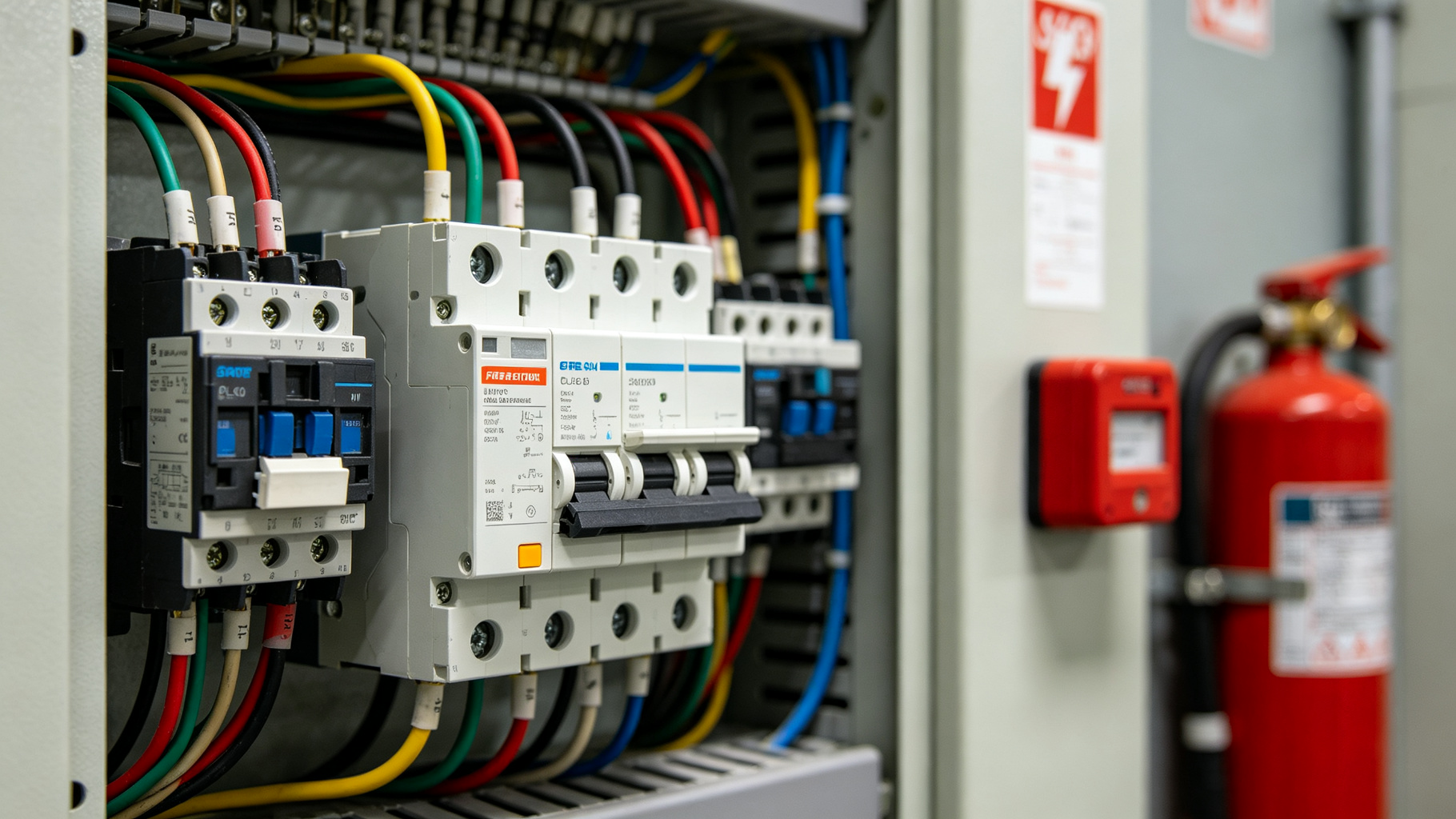
What is the recommended fire protection architecture for an industrial control panel or PLC cabinet?
An industrial control panel or PLC cabinet is best protected by: (1) passive FK-5-1-12 patches on the power supply and the I/O terminal blocks, (2) a heat detector that triggers a clean agent system or process shutdown, and (3) regular thermal imaging to identify hot spots before they become fires.
1. The Industrial Control Panel Hazard
An industrial control panel typically contains a PLC, I/O modules, terminal blocks, a 24V DC power supply, contactors, motor starters, and wiring. The fire hazard is dominated by the terminal blocks and the wiring, which can overheat from loose connections, the power supply, which can fail internally, and the contactors, which can arc during switching. A single loose connection on a 10A terminal can heat to 200°C within 30 minutes and ignite the surrounding PVC wiring insulation. The result is a small but intense fire that can destroy the entire panel and disrupt the controlled process within 5-10 minutes.
2. Why Detection Is Hard
Industrial control panels are typically sealed (NEMA 4 or IP65) to keep out dust and water. This makes smoke detection difficult: the smoke must escape the panel before it reaches the detector. The 2026 best practice is to mount the smoke detector inside the panel, where it can detect the incipient fire within 30-60 seconds. An alternative is to use a heat detector (rate-of-rise or fixed-temperature) inside the panel, which is less sensitive to nuisance alarms but slower to respond.
3. Suppression Options
Sprinkler systems are not used inside control panels because the water damage is unacceptable. Clean agent total-flooding is impractical because the panel is too small to maintain the 10-minute hold time. The 2026 best practice is passive FK-5-1-12 patches inside the panel, sized for the panel volume and the expected fire load. A typical 2 m³ control panel gets 1-2 QuellPatch units on the power supply and terminal blocks. The patches fire on thermal trigger at 80°C and suppress the fire before it can propagate to the wiring or the PLC.
4. QuellPatch for Industrial Panels
FIREQUELL QuellPatch in the 2g and 5g sizes is the most reliable answer for industrial control panel fire protection. The patch is mounted on the power supply, the I/O terminal blocks, or the contactor housing, with thermal-conductive adhesive. The 80°C activation temperature is below the auto-ignition temperature of PVC insulation (400°C) and the failure temperature of most electronic components (200-300°C), giving the patch a 60-120 second operating window. The patch is good for 10+ years and requires no maintenance.
5. Process Shutdown Integration
An industrial control panel fire event should also trigger a process shutdown. The 2026 best practice is to integrate the QuellPatch activation sensor (a thermal sensor that detects the patch's FK-5-1-12 release) with the PLC, which then initiates a controlled shutdown of the process. This integration takes 2-4 hours of PLC programming and can prevent catastrophic secondary damage from an uncontrolled process (e.g., a chemical reactor running away after the control panel is destroyed).
6. Thermal Imaging for Predictive Maintenance
The most effective way to prevent industrial control panel fires is to identify and fix loose connections before they become fires. The 2026 best practice is quarterly thermal imaging of every control panel, using a handheld or mounted infrared camera. A loose connection shows up as a 10-30°C hot spot, well before the failure temperature. The cost of a thermal imaging program is roughly US$50-200 per panel per year, and the ROI is 10-20x in avoided downtime and panel replacement costs.
7. Standards and Compliance
The applicable standards for industrial control panel fire protection are: NFPA 79 (industrial machinery), UL 508A (industrial control panels), IEC 60204-1 (electrical equipment of machines), and the emerging IEC 61496 (electro-sensitive protective equipment). Most insurance underwriters require a documented fire risk assessment and a thermal imaging program for industrial facilities with significant control panel populations. The FIREQUELL QuellPatch product line is UL listed and FM approved, and is the only passive suppression product engineered specifically for industrial control panel applications.
8. Conclusion
Industrial control panel fire protection is a maintenance-constrained, cost-sensitive application. The 2026 best practice is layered: thermal imaging for predictive maintenance, passive FK-5-1-12 patches inside the panel for last-line-of-defense suppression, and PLC integration for process shutdown. The FIREQUELL QuellPatch is the only product engineered specifically for this application, with documented 5-second suppression time and a 10-year maintenance-free interval.
Frequently Asked Questions
How often should I do thermal imaging on my control panels?
Quarterly thermal imaging is the 2026 best practice. Critical panels (those controlling safety-critical processes) should be imaged monthly. The imaging takes 2-5 minutes per panel and can identify loose connections 6-12 months before they fail.
Can I use a sprinkler inside a control panel?
No. The water damage is unacceptable. The 2026 best practice is passive FK-5-1-12 patches inside the panel, sized for the panel volume and the expected fire load. A typical 2 m³ control panel gets 1-2 QuellPatch units on the power supply and terminal blocks.
How do I integrate the patch activation with my PLC?
QuellPatch has an optional thermal sensor that detects the FK-5-1-12 release. The sensor signal is wired to a digital input on the PLC, which then triggers a controlled shutdown of the process. The integration takes 2-4 hours of PLC programming and can prevent catastrophic secondary damage.
Need a Passive Fire Suppression Solution?
FIREQUELL QuellPatch delivers automatic, maintenance-free clean-agent protection for electrical panels, battery cabinets and control rooms — designed to meet FM Approved, UL Listed, CE and UKCA requirements.