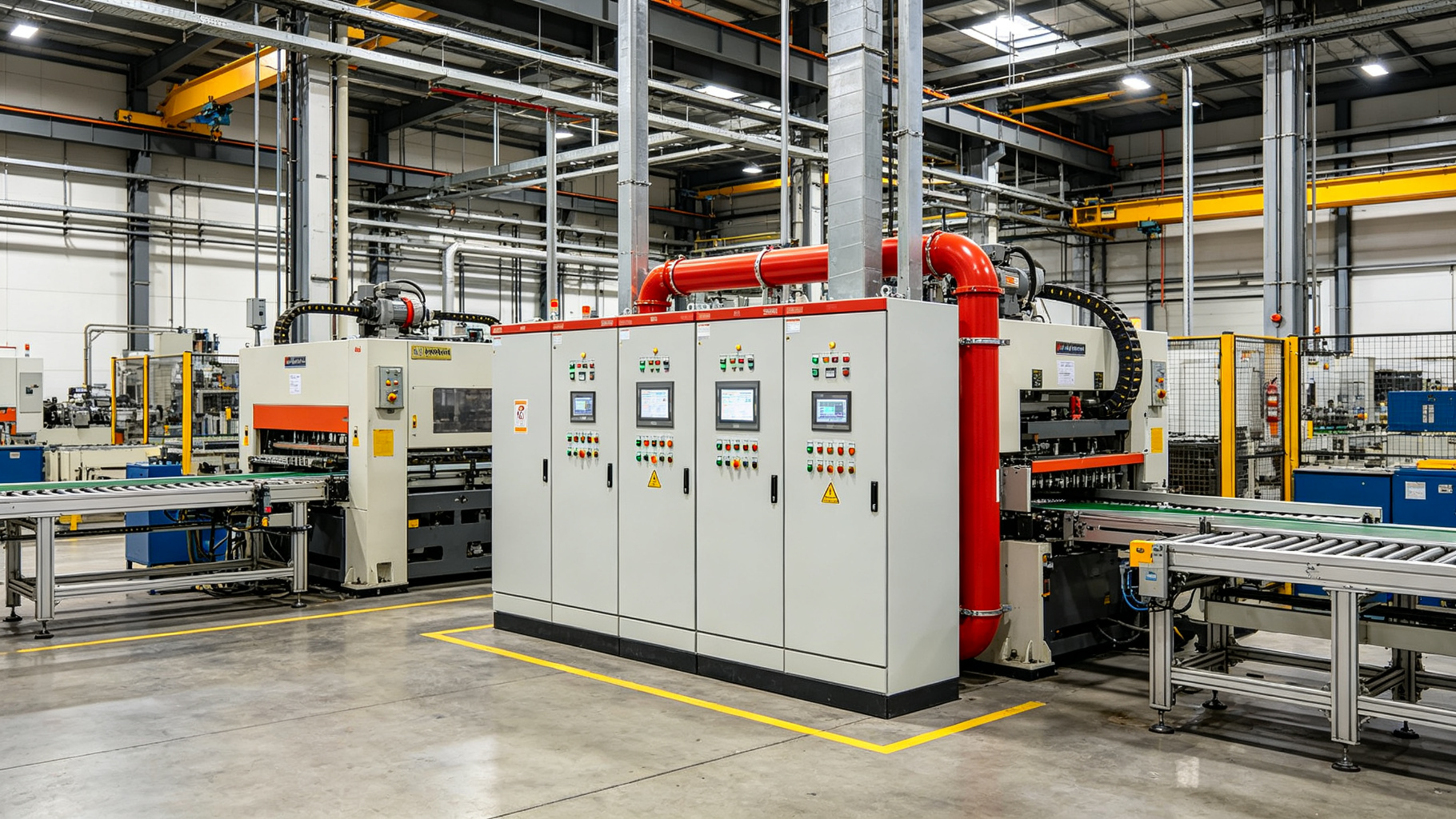
Technical guide on industrial case study for electrical fire protection
A mid-sized automotive parts manufacturer lost $1.2 million in a single shift when a dust explosion ignited a control panel, halting production for three weeks. This case study walks through their retrofit journey: how they identified high-risk zones, selected passive suppression devices that required no external power, and reduced potential downtime by 80%. The result? A cost-effective solution that meets NFPA 75 and keeps operations running.
This industrial case study examines fire protection for a control cabinet at a 24-hour metal fabrication plant producing welded chassis assemblies. The cabinet controlled two automated conveyor sections and a robotic welding cell. Like many manufacturing facilities, the plant combined continuous operation, airborne oil mist, conductive dust, and high-current motor drives. The facility’s prior manufacturing fire occurred in a similar cabinet when a loose power lug ignited wire insulation; the resulting smoke and heat damaged the PLC rack, motor drives, and adjacent wiring, leading to approximately 10 days of lost production.
After that event, the plant engineering team evaluated several factory protection options. Total-flood clean-agent systems were effective but required enclosure integrity, control panels, and periodic maintenance that were difficult to justify for every distributed cabinet. Sprinklers and portable extinguishers were not expected to control an incipient fire inside a closed electrical cabinet quickly enough. The selected solution was QuellPatch, a passive clean-agent fire suppression patch applied directly inside high-risk electrical enclosures.
The protected cabinet was a floor-standing IP54 enclosure measuring 2,200 mm high by 800 mm wide by 600 mm deep, with an internal volume of approximately 1.06 m³. It contained a 480 V three-phase, 250 A main disconnect, two 75 kW variable frequency drives, a PLC with distributed I/O, two 24 V DC power supplies, contactors, circuit breakers, and terminal blocks. Cooling was provided by filtered fans and side vents.
The principal fire scenarios were:
The fire load was not uniformly distributed. Most combustible material consisted of PVC-insulated conductors, polycarbonate device covers, capacitor sleeves, label materials, and accumulated residue. An incipient fire could develop locally around a lug or capacitor before producing enough smoke to actuate room detection.
The production area had addressable smoke detectors and a sprinkler system, but neither was optimized for a fire inside a closed control cabinet. Room detectors responded only after smoke leaked around doors or vents, while sprinklers operated after the fire had grown beyond the enclosure. Cabinet door interlocks removed power when opened, but they did not suppress combustion. The plant needed a method that could act within the first minute of an incipient fire, without requiring external power or detection logic.
QuellPatch uses microencapsulation to hold FK-5-1-12 clean agent within small polymer shells integrated into a flexible patch. FK-5-1-12 is electrically non-conductive, vaporizes readily when released, and is commonly used in clean-agent systems because it does not leave particulate residue on electronics. In the patch format, the agent remains sealed until thermal exposure softens or ruptures the capsules at a rated temperature. Release occurs directly above the developing fire, placing agent near the flame zone rather than relying on long pipe runs or cylinder discharge.
Because the patch is passive, it does not require a control panel, pressure vessel, pneumatic detection tubing, or external power. This reduces failure modes associated with detector placement, wiring faults, or loss of control power. It also means the device does not, by itself, provide alarm notification; plant staff must still connect cabinet smoke or heat detection to the building fire alarm system where annunciation is required.
QuellPatch is available with activation temperatures of 80°C, 140°C, and 180°C. Temperature selection required balancing response speed against the risk of nuisance activation from normal component heating. The engineering team used thermographic survey data and manufacturer temperature limits:
Passive thermal activation depends on heat transfer from the fire plume or hot surface to the patch. A higher-rated patch is not inherently “better”; it is intended for locations where elevated normal temperatures could cause premature release of a lower-temperature variant.
QuellPatch is designed for incipient, localized enclosure fires rather than fully developed fires. For this cabinet, the manufacturer’s engineering guidance recommended approximately one patch per 0.15–0.25 m³ of enclosure volume, with additional units placed directly above the highest-risk components. The design used six patches, giving coverage consistent with that guidance while concentrating agent around the VFDs and power connections. The intent was to interrupt flame spread early enough to limit damage and allow operators to de-energize the cabinet safely.
Two 80°C patches were mounted on the interior back panel over the terminal block and PLC power supply zones. Two 140°C patches were installed above the VFD capacitor banks and dynamic brake module. Two 180°C patches were located near the top of the main bus and brake resistor compartment. Patches were mounted high enough to intercept rising plume gases but not directly on moving parts or sharp edges.
The installation team avoided blocking filtered intake or exhaust paths. In the VFD area, where mechanical vibration was higher, patches were secured with both the factory adhesive and supplemental mechanical clips. Installation was completed during a scheduled eight-hour maintenance window and did not require modification of the cabinet’s power circuit.
Although QuellPatch operates passively, the plant added the installation to its CMMS with quarterly visual inspections during thermography rounds. Inspectors checked for patch displacement, coating contamination, mechanical damage, and date-code visibility. The product has a 5-year service life, after which replacement is recommended. Unlike pressurized cylinders, the patches do not require pressure gauges or hydrostatic testing, but they should be replaced after activation or if the encapsulation layer is damaged.
Approximately 11 months after installation, a VFD fault alarm appeared on the SCADA system. Maintenance personnel arrived to find light smoke seeping from the cabinet top vent. The cabinet was de-energized using the external disconnect before the door was opened. Post-incident examination showed that a line-side lug on one VFD had loosened, developed resistive heating, and ignited adjacent conductor insulation and a portion of the VFD cover.
The 140°C patch above the affected VFD had activated, and one 80°C patch near the terminal block section also released, apparently because hot gases migrated upward within the cabinet. The 180°C patches near the main bus remained intact. The plant’s room smoke detector activated roughly three minutes after the VFD fault, while the patch release was estimated to have occurred during the first minute based on the limited burn pattern and VFD fault log.
Damage was confined to the loose lug, approximately 0.3 m of adjacent conductor insulation, and the VFD’s plastic cover. The PLC rack, second VFD, I/O modules, and most wiring remained usable. The cabinet was cleaned, the affected conductors were replaced, all lugs were retorqued, and all six patches were replaced as a precaution. Production resumed after about eight hours. Plant cost records for the event were substantially lower than the 2021 cabinet fire, which had required extensive drive and PLC replacement.
The case also confirmed several limitations. Passive patches do not alert operators by themselves, so rapid response still depended on the VFD fault and room smoke detection. They are not a substitute for electrical maintenance, such as torque verification, thermography, and VFD capacitor inspection. The unaffected 180°C patch showed that placement matters: if the fire plume does not reach a patch, that patch will not activate. For high-value or high-risk cabinets, QuellPatch should be viewed as one layer in a factory protection program that includes detection, controlled shutdown, inspection, and emergency response.
This industrial case study demonstrates how a passive, microencapsulated FK-5-1-12 patch can be applied to a manufacturing control cabinet to address an incipient electrical fire before it spreads through the enclosure. The selected 80°C, 140°C, and 180°C activation temperatures were matched to measured component temperatures, reducing the likelihood of nuisance release while maintaining response to abnormal heating. The installed patches activated during an actual VFD lug fire and limited damage to the immediate fault area.
The result was not an assurance that every cabinet fire will be controlled. Deep-seated failures, large fuel loads, or delayed discovery can exceed the capability of local passive suppression. However, for distributed control cabinets where total-flood systems are impractical, QuellPatch offers a low-maintenance, electrically compatible layer of protection that can be integrated with existing inspection and shutdown procedures.
A: Usually not. QuellPatch is a local, incipient-stage suppression device intended for targeted protection of specific ignition sources inside cabinets or equipment. A total-flood clean-agent system may be more appropriate for large enclosures, high fuel loads, sealed volumes, or spaces requiring whole-enclosure agent concentration. In many manufacturing installations, QuellPatch is used as a complementary first-line defense rather than a replacement for code-required total-flood or sprinkler protection.
A: Select the rating based on the maximum normal surface or air temperature at the mounting location, with a margin to avoid nuisance activation. The 80°C patch is commonly used near normal-temperature electronics, 140°C in warmer industrial compartments, and 180°C where equipment runs hot under normal conditions. Temperature data from the actual cabinet or component location should drive the final selection.
A: No. FK-5-1-12 is electrically non-conductive and leaves no residue, making it suitable for use on PLCs, VFDs, servers, HMIs, relays, and other sensitive electrical equipment. Unlike water or powder-based agents, it is designed to minimize post-discharge cleanup and secondary damage to electronics. Equipment should still be inspected and recommissioned according to manufacturer procedures after any fire event.
A: There is no universal count because quantity depends on cabinet volume, layout, fuel load, airflow, fan operation, and the locations of highest-risk components such as terminal blocks, contactors, power supplies, and VFD heatsinks. Engineering should place patches close to likely ignition points rather than relying only on cabinet square footage. The case-study approach uses a site risk assessment and defined cabinet fire scenario to determine placement and coverage.
A: In the documented deployment, the patch was installed locally within the industrial cabinet near the at-risk electrical components. When the incipient fire heated the patch to its rated activation temperature, the passive device released FK-5-1-12 without requiring panel power or manual intervention. The observed performance supported rapid local suppression and reduced equipment damage, while the site followed its normal incident-response and post-event inspection procedures.
FIREQUELL QuellPatch delivers automatic, maintenance-free clean-agent protection for electrical panels, battery cabinets and control rooms — designed to meet FM Approved, UL Listed, CE and UKCA requirements.
Request a Site Assessment