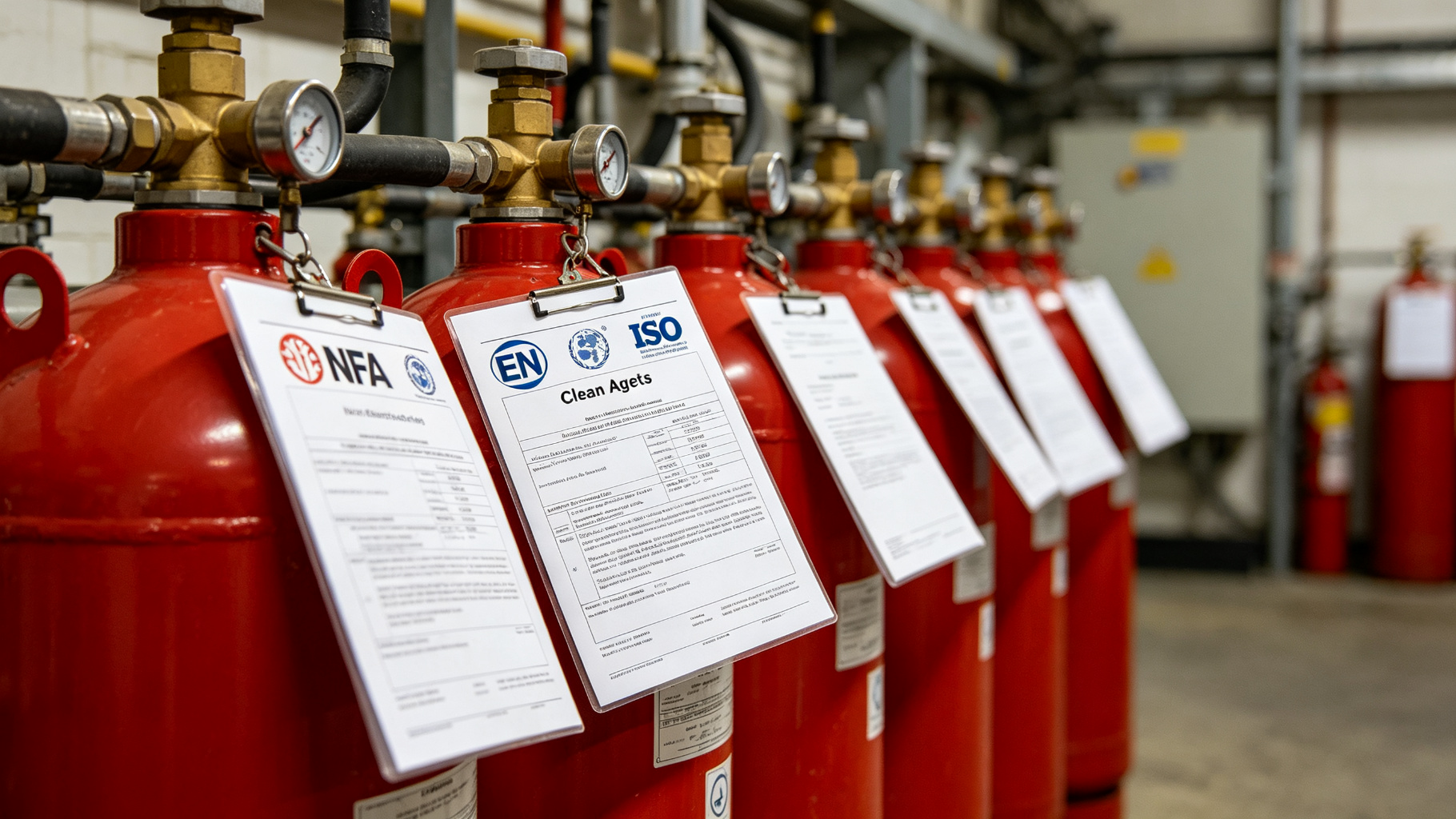
Technical guide on NFPA EN ISO for electrical fire protection
NFPA 75, EN 1366, and ISO 23932—three standards, three different approaches to electrical fire safety, yet many buyers assume they're interchangeable. In reality, compliance gaps can delay project approvals or void insurance claims. This comparison breaks down the key requirements for passive fire protection in electrical cabinets across North America, Europe, and international markets, helping you choose products that meet the right certifications for your export destinations.
Multinational electrical infrastructure projects often face a difficult compliance question: when NFPA, EN, and ISO clean-agent requirements overlap, which provisions govern design, installation, and maintenance? This fire standard comparison focuses on how the three frameworks treat FK-5-1-12 clean-agent systems and, more specifically, how passive point-protection devices such as the QuellPatch product line fit within an international fire code environment.
Traditional clean-agent standards were developed mainly for engineered total-flooding systems: cylinders, piping, nozzles, detection panels, and controlled discharge. QuellPatch uses a different architecture. FK-5-1-12 is held in microencapsulated form within a flexible patch applied directly inside electrical enclosures. When local temperatures reach the rated threshold, passive thermal activation causes the capsules to release agent near the incipient fire. The product is offered with 80°C, 140°C, and 180°C activation thresholds and has a 5-year service life under specified conditions. Understanding the standards therefore requires distinguishing agent-level requirements from system-level certification and from novel component qualification.
NFPA 2001, Standard on Clean Agent Fire Extinguishing Systems, is the primary U.S. clean agent standard. It covers total-flooding and, where applicable, local-application systems using halocarbon or inert gaseous agents. It is commonly adopted through local fire codes and is used alongside NFPA 72 for detection and signaling, NFPA 70 for electrical installation, and NFPA 75 for information technology equipment rooms.
NFPA 2001 is performance-based in structure but includes detailed prescriptive tables for agent concentration, enclosure integrity, discharge time, and inspection. It also gives the authority having jurisdiction a defined role in accepting alternative designs, which is relevant when a passive device does not match the standard’s conventional system architecture.
The EN 15004 series is the European standard for gaseous fire-extinguishing systems. It addresses design, installation, commissioning, and maintenance, and is linked to European conformity assessment and CE marking requirements under the Construction Products Regulation. Compared with NFPA, EN 15004 tends to place more emphasis on notified-body verification and documented manufacturer performance data.
For electrical infrastructure projects in the EU, EN 15004 is typically the default clean agent standard, although national annexes or local fire regulations may add requirements. Detection components may also need to satisfy relevant EN 54 family standards.
ISO 14520 provides an internationally recognized model for gaseous extinguishing systems. It is frequently used as a baseline in countries that do not maintain a fully developed national clean-agent standard, and it can also serve as a technical reference in multinational specifications. ISO 14520 contains general requirements plus agent-specific provisions, including requirements for FK-5-1-12.
Because ISO standards are not automatically enforceable unless adopted by a national or local authority, project specifications should identify which edition has contractual status. In practice, ISO 14520 often aligns closely with NFPA and EN technical objectives, even where wording or conformity routes differ.
FK-5-1-12 is accepted under NFPA 2001, EN 15004, and ISO 14520 as a halocarbon clean agent. It is electrically nonconductive, evaporates rapidly after discharge, and has a relatively low atmospheric lifetime. The standards rely on cup-burner and large-scale test data to establish minimum extinguishing concentrations.
For typical listed designs, FK-5-1-12 is commonly applied at design concentrations of approximately 3.5% by volume for Class A surface-type hazards and 4.5% by volume for heptane-based Class B hazards. These values include safety margins above the measured cup-burner extinguishing concentration. The standards also require consideration of enclosure temperature, altitude, ventilation, and leakage through openings. For occupied spaces, FK-5-1-12 has a reported no-observed-adverse-effect level of about 10% by volume and a lowest-observed-adverse-effect level of about 12% by volume, which is why conventional systems include predischarge alarms, personnel evacuation procedures, and locked access controls.
Electrical fires are treated as Class C hazards in NFPA terminology because the fuel is energized equipment. The clean agent itself must not conduct electricity, but the required concentration is generally based on the underlying solid or liquid fuel once the equipment is de-energized. This principle matters for QuellPatch: the patch addresses incipient fires within panels, busbar compartments, UPS cabinets, and similar enclosures, but it does not eliminate the need for electrical isolation, lockout/tagout, or coordination with larger suppression systems.
Because QuellPatch releases agent locally rather than through engineered nozzles, its performance should be verified through product-specific fire testing rather than by assuming that total-flooding concentration calculations automatically apply. The relevant standard may accept such testing if it demonstrates fire control or extinguishment under representative enclosure conditions.
NFPA, EN, and ISO all require reliable detection, releasing logic, and agent distribution. Conventional gaseous systems use smoke or heat detectors, a control panel, supervised releasing circuits, and pressurized cylinders. Discharge must occur within specified time limits, and enclosure integrity must be confirmed through door-fan testing or equivalent leakage assessment.
Passive thermal activation changes this model. QuellPatch does not require a detector, control panel, piping, or stored pressure. Its detection and release functions are integrated into the microencapsulation system: when the local temperature reaches the selected rating, the capsule material softens or ruptures, releasing FK-5-1-12 directly at the protected component. This reduces failure modes associated with external power or electronic releasing, but it also means that activation is local and generally does not transmit an alarm unless separately monitored.
The standards require system components to be rated for the ambient temperature range, humidity, vibration, and other environmental conditions expected at the installation point. For QuellPatch, the engineering parameters include:
Activation temperature should be selected by measuring the maximum normal enclosure temperature under full load and adding an appropriate engineering margin. Selecting too low a rating may increase the risk of nuisance release; selecting too high a rating may delay response to an incipient electrical fault.
NFPA, EN, and ISO do not contain identical prescriptive clauses for microencapsulated clean-agent patches because the technology differs from the piped gaseous systems that the standards primarily address. A compliant specification should therefore identify the applicable product listing, laboratory report, or performance-based approval route. The documentation should show agent retention, activation consistency across the rated temperature range, resistance to humidity and vibration, and fire performance in representative electrical enclosures.
QuellPatch is typically installed on interior surfaces near high-risk components such as terminal blocks, contactors, relays, or cable junctions. The patch should not obstruct ventilation, moving parts, or required electrical clearances. Installation records should include location, quantity, activation rating, batch information, and installation date.
NFPA 2001, EN 15004, and ISO 14520 all require periodic inspection and maintenance by competent personnel. For conventional systems, this includes cylinder pressure checks, enclosure integrity tests, control-panel testing, and scheduled internal maintenance. For passive patches, maintenance is simpler but still requires visual verification that the patch is present, adhered, undamaged, and not exposed to temperatures outside its rated range.
QuellPatch has a rated 5-year service life under specified environmental conditions. At the end of that period, replacement is generally recommended unless the manufacturer’s documentation or applicable listing supports an alternative inspection-based extension. Facility teams should maintain replacement records because passive devices do not provide a pressure gauge or electronic trouble signal to indicate end of life.
When a project uses multiple standards, the specification should establish a hierarchy: local legal requirements first, adopted national code second, and contractual project standards third. For example, a U.S.-owned facility in Europe may need EN 15004 compliance for the main gaseous system while using NFPA-based maintenance practices. In such cases, QuellPatch can be specified as supplementary point protection, but it should not be represented as a replacement for a required total-flooding system unless the authority having jurisdiction accepts an alternative engineering analysis.
NFPA, EN, and ISO clean-agent standards converge on several core principles: FK-5-1-12 is an accepted electrically nonconductive clean agent, design concentrations must include validated safety margins, occupied spaces require safeguards, and maintenance must be documented. They differ mainly in regulatory structure, conformity assessment, and the degree of prescriptive detail. For passive devices such as QuellPatch, the most practical compliance path is to use the standards for agent safety and system-level objectives while relying on product-specific fire and environmental testing to demonstrate performance. Correct activation-temperature selection, proper installation, periodic visual inspection, and replacement at the 5-year service life are essential engineering controls.
A: Start with the local code and the authority having jurisdiction, because NFPA, EN, AS, GB, or ISO requirements become legally enforceable only when adopted locally. For multinational sites, it is common to design to the most stringent applicable requirement while documenting deviations and equivalencies. The final basis of design should identify adopted codes, listed equipment, design concentrations, inspection duties, and approval conditions.
A: No. QuellPatch is generally intended as point protection for specific electrical enclosures, panels, controllers, or components, not as a substitute for a required total-flooding clean-agent system. It may supplement detection and suppression by addressing a fire at its source inside high-risk equipment. If the room or risk assessment requires total-flooding protection, that system must still meet the applicable NFPA, EN, ISO, or local code.
A: The required FK-5-1-12 concentration depends on the hazard class, listing, and adopted standard, but electrical and Class A-type designs commonly fall in the roughly 4.5% to 5.9% by volume range before safety factors. NFPA 2001, EN 15004, and ISO 14520 all require the design to use validated extinguishing concentrations and account for enclosure leakage and hold time. The exact value must come from the listed system documentation, not a generic rule of thumb.
A: FK-5-1-12 is recognized in major clean-agent standards when the device and system are listed or approved for the intended application, but local adoption varies. EN 15004 and ISO 14520 address gaseous agent systems, while Australian and Chinese requirements may depend on local building, marine, or industrial codes and AHJ acceptance. Point-protection patches must be evaluated against their specific listing, installation instructions, activation method, and service-life requirements.
A: Standards generally require activation to be reliable for the protected hazard, resistant to false operation, and supported by documented test or listing evidence. QuellPatch offers 80°C, 140°C, and 180°C activation options so the selected threshold can be matched to normal equipment temperatures and ambient conditions. Hardware should meet applicable listing or certification requirements such as UL-related evidence where claimed, and the design file should record the selected rating, location, and replacement interval.
FIREQUELL QuellPatch delivers automatic, maintenance-free clean-agent protection for electrical panels, battery cabinets and control rooms — designed to meet FM Approved, UL Listed, CE and UKCA requirements.
Request a Site Assessment