
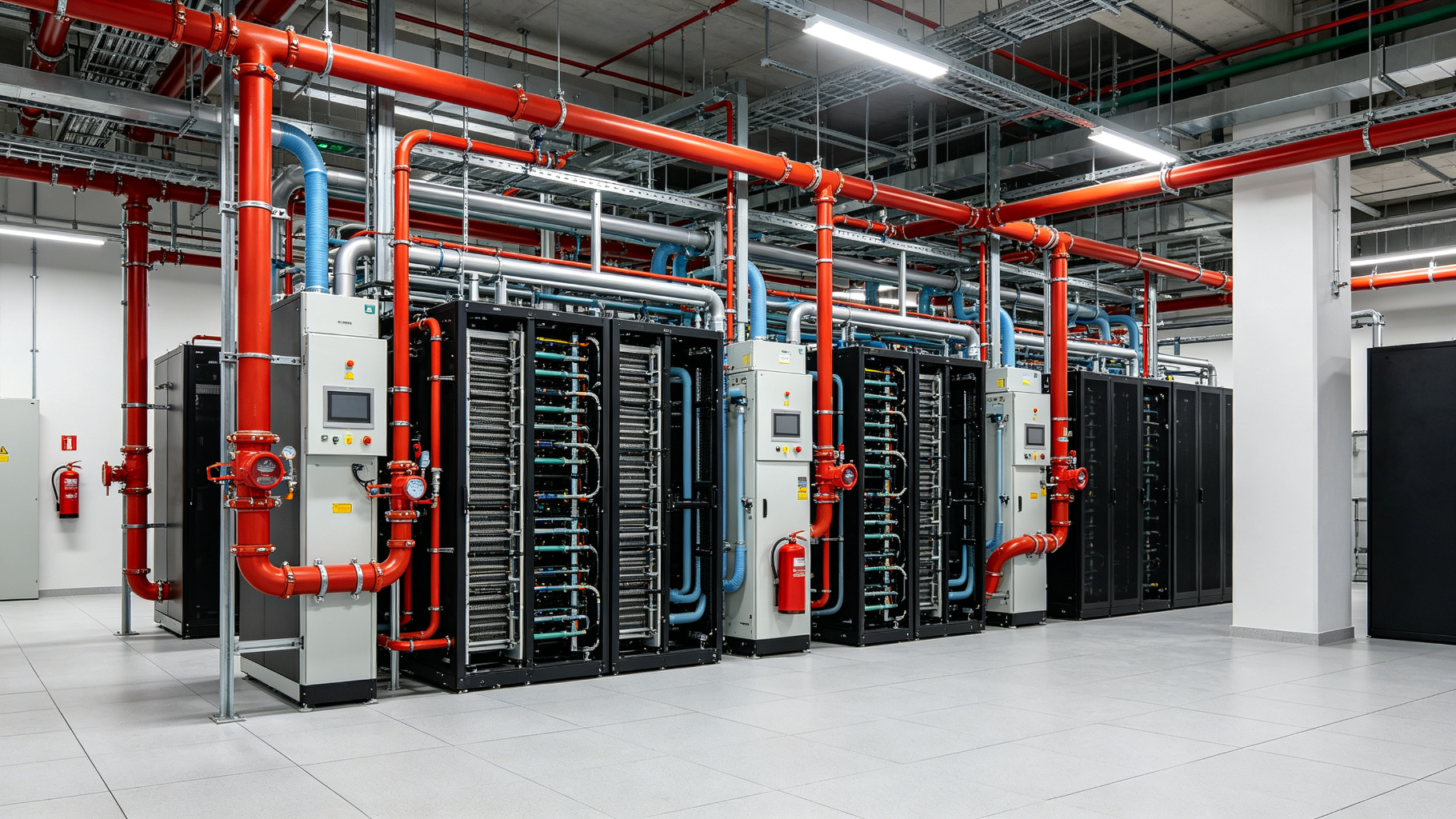
How does liquid cooling change the fire protection design of a data center, and what new hazards must be addressed?
Liquid cooling introduces two new fire hazards: (1) the dielectric coolant itself, which can leak and create a fuel source, and (2) the coolanto's incompatibility with water-based suppression. The recommended protection is dielectric-fluid-specific suppression (FK-5-1-12 clean agent or dedicated dielectric suppression), with cell-level passive patches on the IT equipment as a backup.
1. The Liquid-Cooled Data Center
By 2026, roughly 35% of new hyperscale data center capacity is liquid-cooled, up from 8% in 2022. The drivers are clear: liquid cooling can remove 50-100 kW per rack (vs 15-25 kW for air), enables 50-100% higher compute density, and reduces the data center PUE from 1.4-1.6 (air) to 1.05-1.15 (liquid). The dominant liquid cooling technologies are direct-to-chip (D2C) and immersion. Both introduce new fire hazards that traditional data center fire protection is not designed to address.
2. Dielectric Coolant Hazards
D2C systems use a water-glycol mixture (60% water, 40% glycol) or a synthetic dielectric fluid (e.g., 3M Novec, Shell S5/Castrol DC). The water-glycol mixture is mildly flammable (flash point 110°C for the glycol component) and creates a hot-zone fire hazard if it leaks onto a hot IT component. The synthetic dielectric fluids are non-flammable but expensive (US$50-200 per liter) and can create a significant hazardous material release if a leak occurs. Immersion systems use a much larger volume (typically 2,000-10,000 liters per data hall) of synthetic dielectric fluid, which is a major fire load if it ignites.
3. Coolant Leak Detection
Coolant leak detection is the first line of defense in a liquid-cooled data center. The 2026 best practice is a multi-layer detection: (a) point sensors at every coolant distribution unit, (b) linear leak detection cable along every coolant pipe run, (c) optical imaging of the IT equipment floor with automated spill detection, and (d) flow rate monitoring on every coolant loop with leak detection by mass balance. The detection-to-isolation target is under 30 seconds, with automatic shutoff valves on every coolant distribution unit.
4. Coolant Compatibility with Suppression
Water-based suppression (sprinklers, water mist) is generally compatible with water-glycol coolants but creates a 200-500 liter water hazard zone per leak event. Water is not compatible with synthetic dielectric fluids, which can react violently with water to produce HF and other toxic gases. The recommended suppression for synthetic dielectric fluid hazards is FK-5-1-12 clean agent (which is non-reactive with all common dielectric fluids) or a dedicated dielectric suppression system (e.g., F-500 Encapsulator Agent). The FIREQUELL QuellPatch is engineered for compatibility with all common dielectric fluids.
5. Immersion Cooling Fire Protection
Immersion cooling is the most fire-sensitive liquid-cooled topology. The entire IT equipment is submerged in 2,000-10,000 liters of synthetic dielectric fluid. The fire hazard is dominated by: (a) the coolant itself (although non-flammable, it can decompose at high temperatures); (b) the IT equipment (which can still catch fire if the coolant leaks or is displaced); (c) the tank structure (which can fail if the internal pressure rises during a fault). The recommended protection is a sealed tank design with pressure relief, leak detection, and FK-5-1-12 clean agent in the data hall as a backup. QuellPatch is not used inside the immersion tank (the dielectric fluid is the primary suppression) but is used on the coolant distribution units and the IT power supplies outside the tank.
6. D2C Fire Protection Architecture
For a D2C data center, the recommended fire protection architecture is: (1) coolant leak detection with automatic shutoff, (2) smoke detection in the data hall (VESDA air-sampling), (3) FK-5-1-12 clean agent total-flooding in the data hall at 5.5-6.0% design concentration, (4) passive FK-5-1-12 patches on every IT rack's power supply and on every coolant distribution unit, and (5) water mist as a backup for catastrophic events where the coolant pool is large enough to sustain a fire. The total cost of this layered system is typically 30-50% higher than an equivalent air-cooled data center fire protection system.
7. Standards Status
The fire protection standards for liquid-cooled data centers are still evolving. The most commonly cited are: NFPA 75 (information technology equipment), ASHRAE TC 9.9 (data center thermal management), and the emerging ASHRAE A2L refrigerant standards for systems using low-GWP refrigerants. The 2026 insurance market is still developing the underwriting model for liquid-cooled data centers, with most underwriters requiring a documented fire risk assessment and a UL 9540A-style test report for the specific configuration.
8. Conclusion
Liquid-cooled data centers introduce new fire hazards (dielectric coolant, water-glycol mixtures) that traditional fire protection is not designed for. The 2026 best practice is a layered system: coolant leak detection, FK-5-1-12 clean agent total-flooding, cell-level passive patches, and water mist as a backup. The FIREQUELL QuellPatch is the only cell-level passive suppression product engineered for compatibility with all common dielectric fluids, providing a reliable last-line-of-defense suppression that fires regardless of the detection system status.
Frequently Asked Questions
Are liquid-cooled data centers more dangerous than air-cooled?
They have different hazards, not necessarily more dangerous. The dielectric coolant can create a fuel source if it leaks, and the water-glycol mixture can be mildly flammable. However, the fire protection system is also more comprehensive: leak detection, clean agent suppression, and passive cell-level suppression. With proper design, liquid-cooled data centers can be as safe as air-cooled.
Can water suppress a synthetic dielectric fluid fire?
No. Water can react with synthetic dielectric fluids (e.g., 3M Novec, F-Gases) to produce HF and other toxic gases. The recommended suppression for synthetic dielectric fluid hazards is FK-5-1-12 clean agent (non-reactive with dielectric fluids) or a dedicated dielectric suppression agent like F-500 Encapsulator.
What standards govern liquid-cooled data center fire protection?
NFPA 75 (information technology equipment), ASHRAE TC 9.9 (data center thermal management), and the emerging ASHRAE A2L refrigerant standards. Most insurance underwriters require a documented fire risk assessment and a UL 9540A-style test report for the specific configuration.
Need a Passive Fire Suppression Solution?
FIREQUELL QuellPatch delivers automatic, maintenance-free clean-agent protection for electrical panels, battery cabinets and control rooms — designed to meet FM Approved, UL Listed, CE and UKCA requirements.