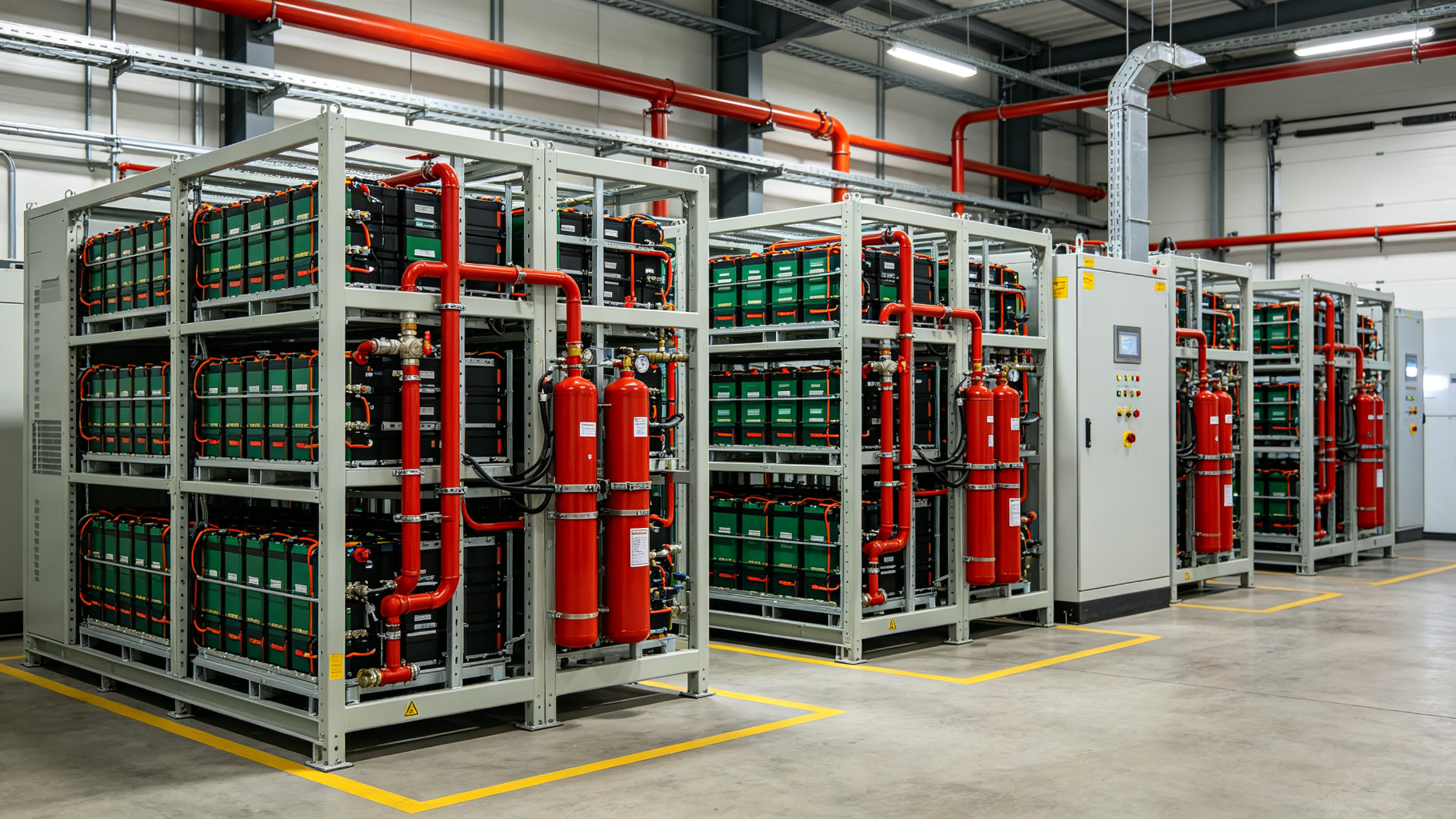
Technical guide on lithium fire trends for electrical fire protection
With lithium-ion battery installations projected to grow 30% annually through 2030, thermal runaway fires are becoming a top concern for facility managers. Unlike traditional electrical fires, battery fires can reignite hours after suppression, demanding innovative solutions. This trend analysis explores how passive fire protection is evolving—from heat-activated patches to new agents that cool cells and prevent propagation—to keep up with the unique risks of energy storage systems.
Lithium-ion battery deployments continue to expand across utility energy storage, telecommunications backup, uninterruptible power supplies, and electric-vehicle charging infrastructure. This growth is changing lithium fire trends: incidents are less often isolated cell failures and more often system-level propagation events involving dense module packaging, high-voltage architectures, and flammable vent gases. For engineers and facility managers, the battery protection future is not simply about adding more detection; it is about placing suppression close to the failure point and aligning hardware with evolving fire regulation.
Passive clean-agent patches represent one response to these energy storage trends. The QuellArmor product line uses microencapsulated FK-5-1-12 agent and passive thermal activation to discharge directly at a battery cell, connector, or module surface when a predefined temperature is reached. This article examines the technical rationale for localized suppression, how QuellArmor patches are engineered, and how such devices fit into current and emerging compliance pathways.
Lithium-ion thermal runaway typically progresses through identifiable temperature bands. Solid-electrolyte interlayer decomposition can begin near 80–120°C, separator softening or melting may occur from roughly 130–170°C, and cathode decomposition can accelerate above 180–200°C depending on chemistry. These thresholds matter because the first 10–30 minutes after abnormal heating often determine whether a single-cell fault remains manageable or propagates to adjacent cells.
During this window, a cell may vent electrolyte aerosols, hydrogen, carbon monoxide, methane, and ethylene. If those gases reach a flammable concentration and encounter an ignition source, the resulting fire can expose neighboring cells to radiant and convective heat. Suppression that intervenes before propagation can reduce peak heat exposure, although no device can eliminate all consequences of a severe battery fault.
Total-flood clean-agent systems and sprinklers remain important parts of battery room protection, but they have timing and enclosure limitations. A central system depends on detection, control-panel logic, piping, and agent distribution. In open racks, cable penetrations, ventilation openings, or damaged enclosure seals can reduce agent concentration. Sprinklers can control large package fires but may not reach an incipient cell inside a sealed module before propagation begins.
Localized passive patches address a different part of the fire timeline. They do not wait for smoke to travel to a detector or for agent to fill a room; instead, they respond to surface temperature at the likely source. This makes them useful as a supplementary layer within modules, battery management system compartments, busbar zones, and electrical cabinets.
QuellArmor patches contain FK-5-1-12, a clean agent commonly used in electrical hazard protection because it is electrically nonconductive, leaves no residue, and has a short atmospheric lifetime. In the QuellArmor design, the agent is held in microcapsules bonded to a flexible patch substrate. Microencapsulation eliminates the need for a pressure vessel, piping network, or electromechanical valve at the protected location.
When local heating reaches the patch rating, the capsule shells rupture and release FK-5-1-12 directly onto or adjacent to the heated surface. The agent vaporizes rapidly, absorbing heat and releasing suppressant vapor near the fault. Because discharge occurs at the source, the patch can target an incipient event before it generates enough smoke or heat to trigger a room-scale system. The exact effect depends on patch coverage, cell chemistry, module geometry, and ventilation.
The QuellArmor product line includes activation ratings of 80°C, 140°C, and 180°C. These ratings allow engineers to match patch response to the normal operating temperature and failure profile of the protected component.
Selecting the correct rating requires thermal mapping of the equipment under worst-case operating and fault conditions. A patch that activates too early may discharge during routine high-load operation; one rated too high may delay agent release until propagation has already begun.
Passive thermal activation means the patch requires no external power, detector input, or communication link. Its actuation depends only on the thermal response of the microcapsule material. This can be valuable in remote energy storage sites, rooftop installations, or older facilities where control-system upgrades are impractical.
QuellArmor patches have a 5-year service life when installed within the manufacturer’s specified temperature and environmental limits. Maintenance is limited to visual inspection for damage, adhesion loss, or coating degradation, and replacement at the end of rated service life. Date coding and installation records should be maintained as part of the asset’s fire-safety documentation.
Energy storage trends continue toward higher-capacity prismatic and pouch cells, tighter cell spacing, and larger 1500 V DC systems. These designs improve energy density but reduce the physical gap that can slow cell-to-cell heat transfer. In such packages, even a small delay in suppression can allow adjacent cells to reach their runaway threshold.
QuellArmor patches can be installed between cells, on module covers, or near high-resistance connections to provide local agent discharge. Because the patches are thin and conformable, they can be integrated where gas-based distribution tubes or nozzles would be difficult to route. They are not a replacement for cell quality, thermal barriers, or battery management controls; rather, they provide an additional suppression layer within the package.
Behind-the-meter storage, telecom cabinets, and microgrid installations often place batteries in occupied buildings, parking structures, or roadside cabinets. These sites may lack dedicated battery rooms, gaseous system enclosure integrity, or 24-hour on-site response. Passive patches are relevant here because they add protection without requiring major architectural modifications.
For outdoor cabinets, designers must consider solar loading, ambient temperature cycling, and humidity. The 140°C or 180°C ratings may be more appropriate than the 80°C rating if cabinet skin temperatures can rise during high-temperature operation. Thermal testing under expected solar and load conditions is recommended before finalizing patch placement.
Original equipment manufacturers can incorporate QuellArmor patches during module assembly, placing them in locations identified through thermal-runaway testing. Retrofit applications require more conservative engineering because adding patches near energized buswork or cells may affect airflow, dielectric clearances, or warranty terms. Installation should follow equipment manufacturer instructions and applicable electrical safety practices.
Fire regulation for lithium-ion systems is moving from simple separation requirements toward performance-based evaluation of propagation, explosion hazard, and suppression effectiveness. Key references include NFPA 855 for energy storage systems, UL 9540A thermal runaway testing, the International Fire Code provisions for battery systems, and regional standards such as IEC 62619 for industrial battery safety. These documents generally require system-level testing or analysis to demonstrate whether a single-cell failure propagates within a module, rack, or room.
Regulators and authorities having jurisdiction are increasingly interested in measures that reduce propagation risk, limit vent-gas ignition, and improve responder safety. Passive clean-agent patches may support these objectives when included as part of a tested battery assembly. They should not be described as standalone compliance solutions, because approval depends on the complete system, installation, and local code requirements.
When submitting a design for approval, engineers should provide patch placement drawings, activation-temperature rationale, agent quantity, service-life records, and relevant test data. UL 9540A reports, for example, may show whether a battery module with installed patches exhibits delayed propagation, lower external temperatures, or reduced gas ignition risk compared with an unprotected baseline. Such data can help the authority having jurisdiction evaluate whether the design meets performance-based code options.
Because fire regulation varies by jurisdiction, early engagement with code officials is advisable. A patch configuration accepted in one listed assembly may not be accepted in another without additional testing or engineering judgment.
Lithium fire trends are being driven by denser battery packaging, distributed energy storage deployment, and more rigorous performance-based fire regulation. The battery protection future will likely combine improved cell chemistry, active monitoring, thermal barriers, ventilation, and suppression rather than relying on a single safeguard. QuellArmor passive clean-agent patches fit this model by delivering microencapsulated FK-5-1-12 at the heat source through passive thermal activation, with selectable 80°C, 140°C, and 180°C ratings and a 5-year service life. When specified through thermal analysis and validated as part of a tested system, they can provide a useful localized layer of protection for electrical and battery infrastructure.
A: Sprinklers and total-flood clean-agent systems typically protect a room or enclosure after a fire has grown enough to be detected, often requiring external power, detection, or piping. Passive patches such as QuellArmor mount directly at or near the potential fault point and release FK-5-1-12 locally when the activation temperature is reached. This makes them suitable for incipient-stage intervention at cell, module, or pack level rather than whole-room suppression.
A: QuellArmor patches are designed to suppress incipient fires and reduce the likelihood or speed of propagation at the protected location. In a large rack, performance depends on patch coverage, cell chemistry, pack geometry, ventilation, and whether the event is detected early. They should be treated as part of a layered protection strategy, not as a guarantee that every multi-cell or fully developed rack fire will be stopped.
A: Activation temperature should be selected above normal operating temperatures but below the expected thermal-runaway onset for the application. Common QuellArmor variants include 80°C for controlled indoor enclosures, 140°C for general transport or storage environments, and 180°C for higher-ambient or high-temperature compartments. Selection should consider cell chemistry, maximum ambient temperature, pack geometry, and the desired intervention point.
A: The trend is moving from room-level fire response toward localized, early intervention at the cell or module level before propagation occurs. Buyers and engineers are also increasingly evaluating performance-based mitigation rather than relying only on prescriptive packaging or sprinkler requirements. This has increased interest in passive devices, thermal monitoring, propagation control, and systems aligned with NFPA 855, UL 9540A, and IEC storage safety guidance.
A: Thermal runaway can develop within seconds to minutes after a cell enters self-heating, so the most effective intervention occurs during the incipient stage before venting, flame ejection, or propagation to adjacent cells. Detection and suppression timing should be based on UL 9540A-style thermal runaway data for the specific cell chemistry and module design. Passive patches are intended to respond automatically at a preset temperature threshold without waiting for room-level detection.
FIREQUELL QuellPatch delivers automatic, maintenance-free clean-agent protection for electrical panels, battery cabinets and control rooms — designed to meet FM Approved, UL Listed, CE and UKCA requirements.
Request a Site Assessment