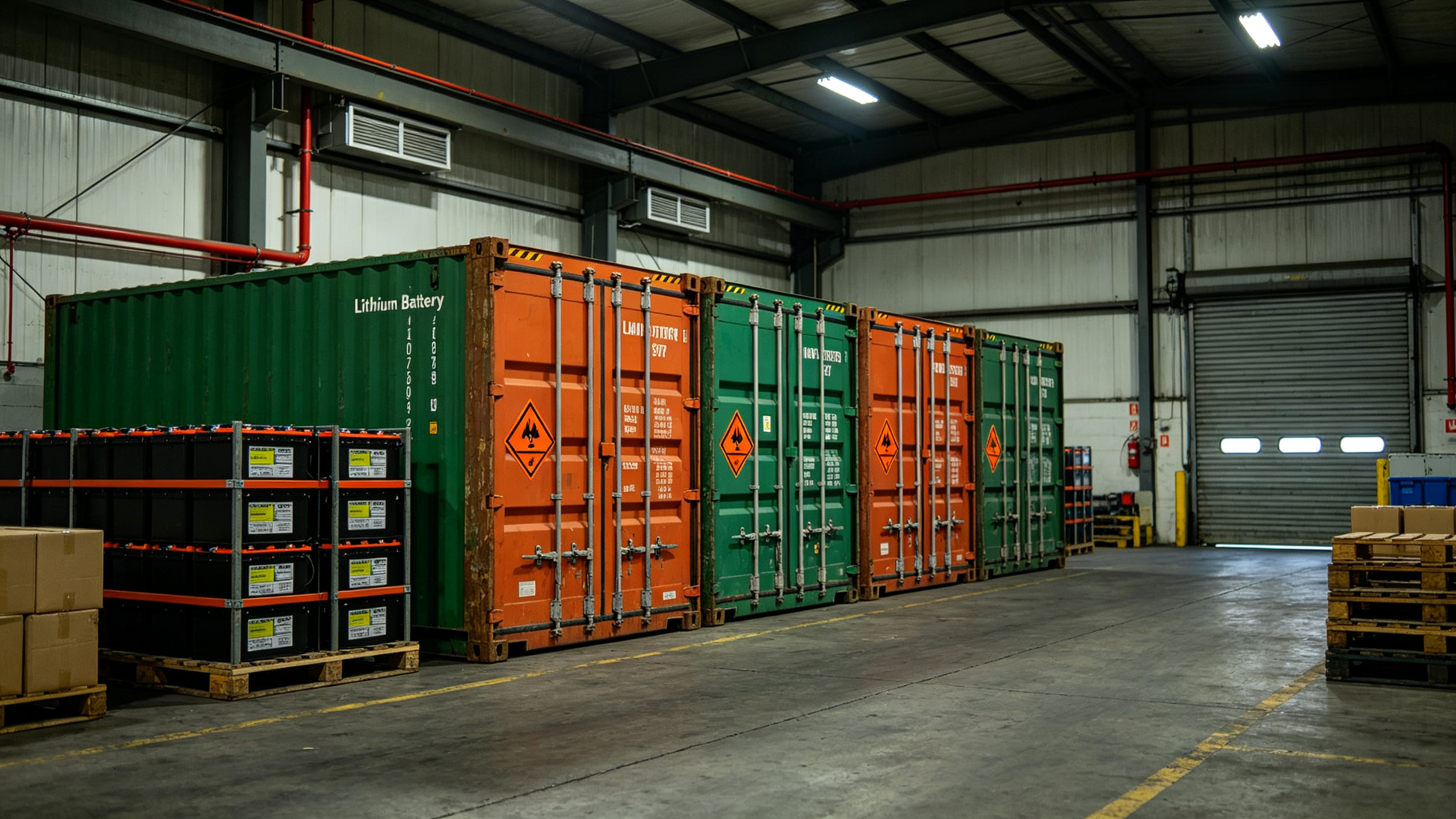
Technical guide on lithium battery transport for electrical fire protection
Shipping lithium batteries isn't just about slap-dash labeling—it's a maze of UN 38.3 tests, packing instructions, and state-of-the-art storage rules that can trip up even seasoned logistics teams. If you're moving cells by air, sea, or road, one misstep can ground your cargo or spark a costly fire. Here's what the regulations actually demand.
Lithium battery transport and battery storage regulation continue to tighten because lithium-ion cells and batteries are classified as dangerous goods and can enter thermal runaway if damaged, overcharged, short-circuited, or exposed to heat. Compliance is not a single label or packaging certificate; it is a documented chain covering classification, testing, state of charge, packaging, marking, documentation, storage separation, emergency planning, and fire risk control. For electrical infrastructure operators, logistics providers, and warehouse managers, lithium fire compliance requires both regulatory conformance and engineering controls that work when no operator is present.
The QuellPatch product line is a passive, clean-agent fire suppression patch intended for localized use in electrical enclosures, battery cabinets, charging carts, reusable transport containers, and related infrastructure. This article examines how QuellPatch fits into lithium battery transport and storage regulations, with emphasis on FK-5-1-12 clean-agent technology, microencapsulation, passive thermal activation, activation-temperature selection, and documentation practices.
Lithium-ion batteries are generally classified under UN 3480 when shipped alone and UN 3481 when contained in or packed with equipment. Lithium-metal batteries fall under UN 3090 and UN 3091. Consignments must meet the UN Manual of Tests and Criteria, including Section 38.3 testing, before offering them for transport. Modal rules then impose additional requirements: the IATA Dangerous Goods Regulations and ICAO Technical Instructions for air, the IMDG Code for sea, ADR for road in Europe, and 49 CFR in the United States.
These rules control cell watt-hour ratings, battery watt-hour ratings, packaging types, labels, marks, dangerous goods declarations, and state of charge. For example, air transport generally requires standalone lithium-ion batteries to be shipped at not more than 30% state of charge, subject to exceptions and competent authority approvals. Damaged, defective, recalled, or waste batteries often require stricter packaging, declaration, and carrier approval. A passive suppression patch does not change these obligations and should be treated as one component of the dangerous goods control system.
Storage is governed by a different but overlapping set of requirements. Facilities may be subject to local fire codes, NFPA 1, NFPA 855 for stationary energy storage systems, the International Fire Code, NEC requirements, OSHA general-duty and material-handling rules, and UL 9540 or UL 9540A evaluation documentation. Warehouses that stage lithium batteries before or after transport must also consider quantity limits, aisle separation, stacking heights, charging controls, ventilation, detection, and sprinkler or clean-agent suppression.
For lithium fire compliance, the authority having jurisdiction typically expects a risk-based approach rather than reliance on a single product. QuellPatch can support this approach by adding local suppression at the battery, module, or enclosure level, but it should be coordinated with sprinklers, gas detection, emergency response procedures, and storage layout controls.
A lithium-ion cell can enter thermal runaway when internal heat generation exceeds heat removal. Separator failure, internal short circuits, overcharging, crushing, or external heating can initiate exothermic reactions. Depending on chemistry and state of charge, significant decomposition may begin in the approximate range of 120–160°C, with venting of flammable and toxic gases including carbon monoxide, hydrogen, methane, and ethylene. Ignition can produce jet flames and rapid heating of adjacent cells.
In transport packages or storage cabinets, the risk is not only a single-cell failure but propagation between cells, modules, or packages. Early intervention during the incipient heating or flaming stage may reduce flame spread and limit the thermal exposure needed to trigger neighboring cells. Passive suppression is particularly relevant in unattended locations where detection, alarm, and manual response may take time.
UN specification packaging is designed and tested to survive normal transport hazards such as drops, stacking, vibration, and short-circuit conditions. It is not necessarily designed to extinguish a developing lithium battery fire or to stop propagation after thermal runaway has begun. Fire-resistant packaging, thermal barriers, and separation can reduce risk, but they do not actively interrupt combustion.
QuellPatch addresses a different point in the failure sequence: it releases clean agent locally when heated to its rated temperature. This can suppress flaming combustion in the immediate enclosure volume and reduce the likelihood that a small ignition becomes a large loss. It does not replace UN 38.3 testing, proper classification, approved packaging, or state-of-charge controls.
QuellPatch uses microencapsulation to contain FK-5-1-12 clean agent within a flexible patch structure. The agent is held in discrete polymer capsules rather than in a pressurized cylinder, which removes the need for piping, nozzles, pressure switches, or external detection wiring. FK-5-1-12 is electrically nonconductive, leaves little or no residue on equipment, and has zero ozone-depletion potential, a global warming potential of approximately 1, and an atmospheric lifetime measured in days rather than decades. These characteristics make it suitable for use near electrical and electronic infrastructure.
The microencapsulated format also allows distributed agent delivery. Multiple patches can be placed around high-risk components so that agent is released close to a potential ignition source. This differs from a total-flood system that requires a defined enclosure volume and controlled leakage. QuellPatch is intended for local protection and should be applied using manufacturer coverage guidance based on enclosure volume, leakage area, and hazard location.
QuellPatch variants are available with activation temperatures of 80°C, 140°C, and 180°C. Activation is passive and thermal: when the patch surface reaches its rated temperature, the microcapsule material releases FK-5-1-12 directly into the surrounding space. No external power, control panel, or manual intervention is required.
Temperature selection should be based on the maximum expected ambient temperature plus an appropriate margin to avoid nuisance activation. The 80°C variant may be suitable for climate-controlled battery cabinets or indoor storage areas where ambient temperatures remain well below the activation threshold. The 140°C variant is commonly considered for general lithium battery transport, reusable containers, charging carts, and industrial electrical cabinets. The 180°C variant is intended for higher-ambient compartments or locations near heat-generating equipment where a lower-temperature patch could be activated by non-fire conditions. The rated temperature refers to the patch surface, not the average room or container air temperature.
QuellPatch has a 5-year service life under specified storage and operating conditions. Because the patch is not pressurized, routine inspection is primarily visual. Facilities should inspect patches for detachment, physical damage, excessive discoloration, or obstruction during scheduled maintenance intervals. Patches should be replaced after activation, visible damage, or at the end of their rated service life. Lot and date coding on each patch supports traceability and compliance recordkeeping.
In lithium battery transport applications, QuellPatch can be installed inside reusable battery shipping containers, enclosed carts, maintenance boxes, or approved cargo compartments. Because the patch contains a clean agent, it may be classified as a safety device or article depending on the mode and jurisdiction. The shipper or operator should confirm carrier and competent-authority requirements and document the presence of the device where required. It should not be applied in a way that damages UN specification packaging, obstructs required markings, or interferes with ventilation or closure systems.
Typical placement is on upper interior surfaces or near the highest-risk battery modules, because FK-5-1-12 vapor is heavier than air and disperses downward after release. Coverage should be calculated from the net enclosure volume and expected leakage, not from floor area alone.
For storage, QuellPatch can be applied inside battery cabinets, server racks, charging lockers, test stands, and BESS subcompartments. It should be coordinated with other controls required by battery storage regulation, such as separation distances, smoke detection, gas monitoring, exhaust ventilation, sprinklers, and emergency shutdown procedures. The patch is not a replacement for area-wide sprinkler protection where required by code.
When submitted to an authority having jurisdiction, documentation should include patch locations, selected activation temperature, design rationale, inspection schedule, and replacement interval. If UL 9540A or other large-scale test data is used to support the installation, the patch should be identified as part of the tested or documented mitigation strategy.
Compliance files should include the following:
These records help demonstrate that passive suppression has been integrated into the dangerous goods and storage safety program rather than added without engineering review.
Lithium battery transport and battery storage regulation require a layered compliance strategy that begins with classification and packaging and extends through storage controls, maintenance, and emergency planning. QuellPatch provides a passive clean-agent layer using microencapsulated FK-5-1-12, with activation temperatures of 80°C, 140°C, and 180°C, a 5-year service life, and no need for external power or pressurized cylinders. When selected, placed, and documented correctly, it can support lithium fire compliance by adding localized suppression in enclosures where battery fires may begin. It should be used as part of a broader compliance and fire safety program, not as a substitute for regulatory obligations.
A: No. QuellPatch is a supplementary fire safety device and does not replace UN classification, UN 38.3 testing, approved packaging, marking, labeling, state-of-charge controls, or dangerous goods documentation. UN 3480 applies to lithium-ion batteries transported alone, and compliance must be assessed against the applicable modal regulations such as IATA, IMDG, ADR, or 49 CFR. QuellPatch may support a fire-risk mitigation program, but it does not by itself create regulatory compliance.
A: The 80°C variant may be appropriate for climate-controlled indoor cabinets with low maximum ambient temperatures and where early intervention is desired. The 140°C variant is commonly used for general transport and storage applications where normal ambient temperatures can rise but should remain below activation. The 180°C variant should be considered only for high-ambient compartments where lower-temperature patches could nuisance-activate.
A: UN 38.3 is the United Nations test standard that lithium-ion and lithium-metal cells and batteries must pass before transport, covering altitude, thermal cycling, vibration, shock, external short circuit, impact, overcharge, and forced discharge. It addresses transport safety under abusive conditions but is not a full fire suppression or storage performance standard. Shippers must also meet packaging, marking, labeling, state-of-charge, and documentation requirements under the applicable modal rules.
A: Packaging alone is limited because it is usually designed to contain or mitigate hazards rather than suppress an internally initiated cell thermal event. Once a cell enters runaway, it can release flammable gas, reach temperatures above 600°C, and propagate heat to adjacent cells or packages. Supplementary mitigation such as QuellPatch, separation, thermal barriers, state-of-charge control, and compliant outer packaging should be evaluated as part of a layered safety approach.
A: QuellPatch uses microencapsulated FK-5-1-12 clean agent designed to release locally when exposed to a selected activation temperature, such as 80°C, 140°C, or 180°C. The agent is electrically nonconductive and leaves no residue, making it suitable for use near battery cells, modules, and energized electrical equipment. Activation is intended to occur at the incipient stage of a thermal event to help reduce flame development and propagation risk.
FIREQUELL QuellPatch delivers automatic, maintenance-free clean-agent protection for electrical panels, battery cabinets and control rooms — designed to meet FM Approved, UL Listed, CE and UKCA requirements.
Request a Site Assessment