Technical guide on thermal runaway for electrical fire protection
Thermal runaway in a lithium-ion battery isn't a random event—it's a predictable chain of exothermic reactions that can spike internal temperatures by 200°C per minute once triggered by overcharge, puncture, or internal short. Understanding that mechanism is the first step to designing fire protection that actually stops the cascade before it starts. Here's how the physics plays out.
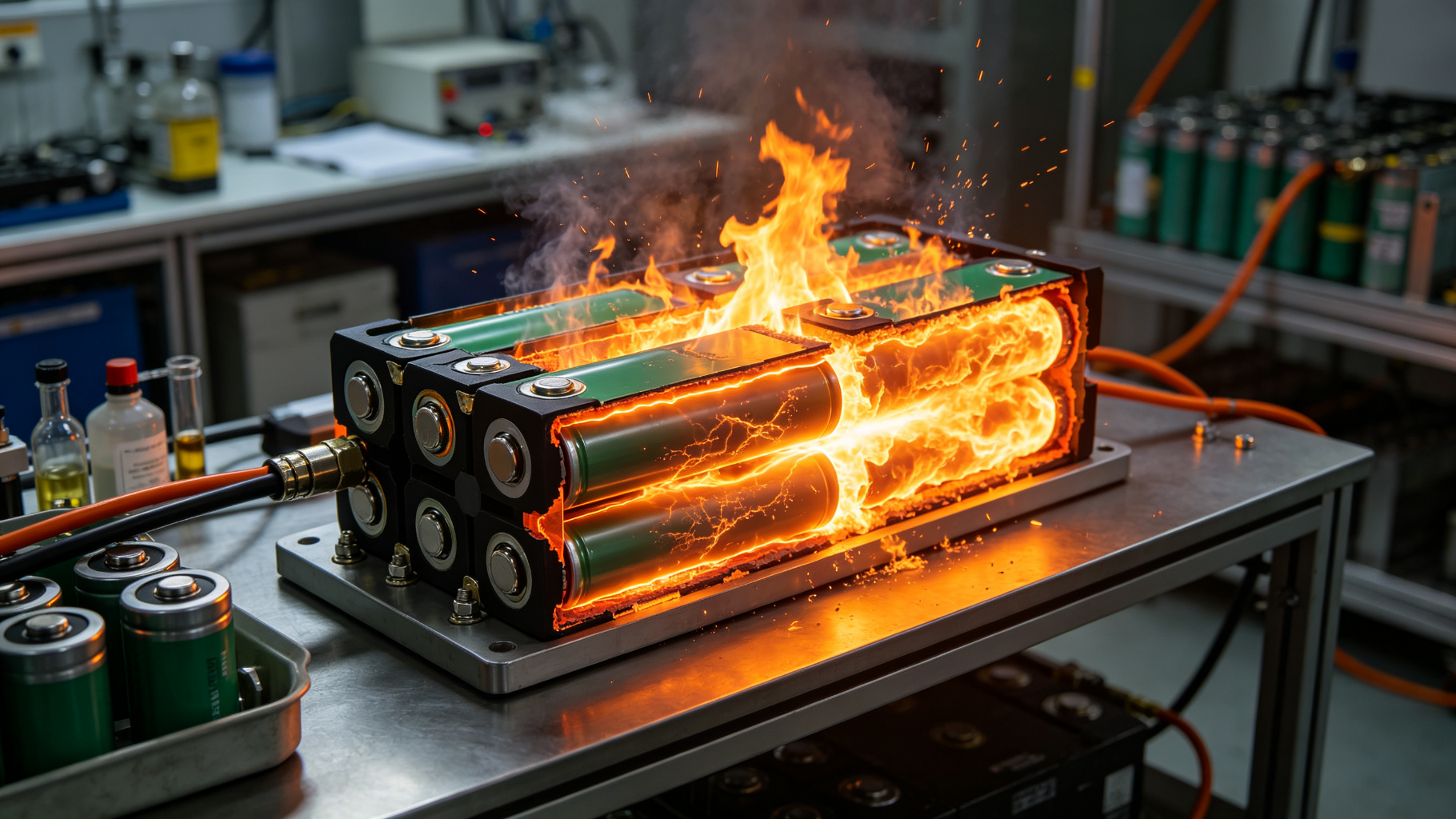
Lithium-ion batteries provide high energy density for UPS systems, energy storage cabinets, telecom sites, and industrial electrical infrastructure, but their stored energy also creates a distinct battery thermal event risk. A localized overheat can progress into thermal runaway when internal exothermic reactions outpace heat removal, producing high temperatures, flammable gas, vented electrolyte, and flame. Once a single cell enters this state, runaway propagation can carry the failure through a module, rack, or enclosure.
Effective protection therefore requires more than flame knockdown. It requires understanding the temperature thresholds at which reactions begin, the pathways by which heat moves between cells, and the practical limitations of suppression in energized, confined equipment. This article reviews those mechanisms and describes how FIREQUELL QuellArmor passive patches use microencapsulated FK-5-1-12 clean agent to support early, localized intervention.
A lithium-ion cell is thermally stable only within a limited temperature range. Abuse conditions such as internal shorting, overcharge, external heating, crushing, or charging fault can raise cell temperature and trigger a sequence of exothermic reactions. The solid-electrolyte interphase on the graphite anode may begin decomposing at approximately 80–120°C, exposing reactive lithiated graphite to the electrolyte. The resulting reaction generates additional heat and combustible gas.
As temperature increases, the separator loses integrity. Polyethylene separators may shrink or melt near 130°C, while polypropylene separators commonly fail closer to 160–170°C. Separator failure creates internal short circuits and accelerates Joule heating. At still higher temperatures, cathode materials decompose and release oxygen. NMC and NCA cathodes may enter strong decomposition near 200–250°C, while LFP cathodes generally have a higher onset, often in the approximate 250–300°C range. Electrolyte solvents can then ignite, cell pressure rises, and the cell vent opens.
Onset temperature and heat release are not uniform. Higher state of charge generally increases available energy and severity. NMC and NCA cells may produce more rapid pressure rise and heat release during a battery thermal event, whereas LFP cells often have a higher thermal stability threshold but can still propagate under sustained heating or dense packing. Cell format also matters: prismatic and pouch cells offer large conductive contact surfaces, while cylindrical cells may transfer heat through cell walls, busbars, holders, and ejected hot debris.
A single failing cell does not usually remain isolated. Runaway propagation occurs through several parallel mechanisms:
Because the failing cell can continue producing heat and oxygen from cathode decomposition, suppressing visible flame may not immediately stop internal heating. The key engineering target is to reduce heat flux to adjacent cells before they reach their own onset thresholds.
Propagation timing varies from tens of seconds to several minutes depending on cell capacity, spacing, state of charge, enclosure leakage, and cooling system integrity. A small cylindrical cell may produce several kilowatts during peak venting and burning; a multi-cell module can produce substantially higher heat release rates. Flammable gases including hydrogen, carbon monoxide, methane, and volatile organic compounds may accumulate and ignite if not managed by venting. This is why lithium ion fire protection must address both heat transfer and gas behavior, not only flame extinction.
Conventional suppression assumptions can be misleading in battery systems. Water can provide cooling, but it may require large volumes, present electrical conduction concerns in energized equipment, and may not readily reach interstitial spaces between cells. gaseous total-flooding systems can suppress flames, but they may be diluted when battery enclosures vent during a thermal event. They also cannot reliably stop electrochemical reactions already underway inside a cell.
A more realistic objective is layered intervention: detect abnormal heating early, suppress incipient flame near the source, absorb local heat, reduce the probability of runaway propagation, and provide time for isolation, ventilation, and emergency response. Passive protection is particularly valuable in unmanned or sealed electrical compartments where active systems depend on detectors, controls, and power.
FK-5-1-12 is a fluorinated ketone clean agent with properties that make it suitable for electrical infrastructure applications. It has a boiling point near 49°C, vaporizes readily, is electrically nonconductive, and leaves little or no residue on electronics. Its atmospheric lifetime is approximately 0.014 years, with a reported global warming potential near one. In a fire zone, FK-5-1-12 contributes to heat absorption and can interrupt combustion processes in the gas phase.
For battery systems, delivery location is as important as agent chemistry. Discharging agent only at the cell or module nearest the thermal event can be more effective than waiting for a whole-enclosure concentration to develop, especially when vents are open and gases are moving. This principle underlies passive, locally activated patch designs.
QuellArmor patches contain microencapsulated FK-5-1-12 within a polymer carrier. The microcapsules are engineered to remain intact under normal operating conditions but to release agent when their shells soften or rupture at defined temperatures. FIREQUELL offers activation temperatures of 80°C, 140°C, and 180°C, allowing the patch specification to be matched to the expected thermal environment and intervention point.
The 80°C variant is suited to early intervention in enclosed, high-density packs where abnormal heating may precede separator failure. The 140°C variant aligns with the separator softening and melting range in many lithium-ion designs. The 180°C variant may be appropriate for higher-ambient compartments or locations exposed to hot ejecta, where lower-temperature activation could create nuisance discharge concerns. Because activation is passive and thermal, no external detector, control panel, or pressurized cylinder is required. Only the patches exposed to threshold heat release agent, which helps concentrate FK-5-1-12 near the developing battery thermal event.
QuellArmor patches are typically applied to cell tops, vent paths, module sidewalls, busbar compartments, and interstitial gaps where heat and flame are likely to pass. Engineering layout should consider cell format, module energy density, normal ambient temperature, airflow, enclosure leakage, and required electrical clearances. The patches have a 5-year service life under specified conditions and do not require pressure testing or mechanical servicing during that period, though periodic visual inspection should be included in facility maintenance procedures.
It is important to define the product role accurately. QuellArmor patches are designed as part of a layered protection scheme. They can help suppress incipient flame, reduce local heat flux, and delay runaway propagation, but they do not eliminate the need for battery management, overcurrent protection, gas detection, deflagration venting, or emergency response planning. After any confirmed battery thermal event, affected patches should be replaced and the battery system inspected before returning to service.
Lithium-ion thermal runaway is a multi-stage process driven by sequential decomposition reactions, internal shorting, cathode oxygen release, and ignition of electrolyte gases. Once initiated, propagation occurs through conduction, hot gas flow, ejecta, and radiation. Protection strategies should therefore focus on early local intervention and reducing heat transfer to adjacent cells rather than assuming that a single suppression event can terminate all internal reactions.
FK-5-1-12 offers electrical compatibility and clean-agent characteristics suitable for energized infrastructure, while QuellArmor patches use microencapsulation and passive thermal activation at 80°C, 140°C, or 180°C to deliver agent directly where a battery thermal event begins. With a 5-year service life and no reliance on external activation logic, the product line can be integrated into a layered design that improves the margin for safe response. System-specific layout, venting, and maintenance remain essential to managing lithium ion fire risk.
A: QuellArmor is intended for incipient or developing battery thermal events and for reducing the likelihood of runaway propagation. A fully developed lithium-ion fire can involve sustained internal heat generation, flammable gas venting, flame ejection, and propagation across multiple cells, which may exceed the capacity of a localized patch. For large or established fires, use the appropriate emergency response plan and fixed suppression system.
A: Select the activation temperature based on normal compartment temperatures, cell chemistry, pack geometry, and desired intervention point. The 80°C variant supports early response in controlled enclosures, the 140°C variant is a common choice for general transport and storage, and the 180°C variant is for higher-ambient environments where false activation must be avoided. The chosen threshold should be safely above peak normal temperatures but below the expected onset of thermal runaway.
A: Yes. QuellArmor uses FK-5-1-12, a clean agent that is electrically nonconductive and leaves no residue, making it suitable for use near energized electrical and electronic equipment. Because the patch is passive and localized, it does not require external power or complex detection wiring. Installation should still maintain required electrical clearances and follow the equipment manufacturer’s safety guidance.
A: Thermal runaway can be initiated by internal short circuit, overcharge, external short, crush or penetration, overheating, or manufacturing defects. As cell temperature rises, separator failure and exothermic electrode reactions can generate more heat than the cell can reject, leading to venting, fire, or propagation. Onset temperatures vary by chemistry, but abusive events can quickly move from 80–150°C range heating to temperatures exceeding several hundred degrees Celsius.
A: Propagation occurs when heat from a failing cell raises adjacent cells above their thermal-stability threshold through conduction, convection, hot gas ejection, or direct flame contact. Module spacing, cell chemistry, busbar design, cooling, venting, and thermal barriers all affect whether one cell failure spreads. Protection objectives should therefore focus on early heat control, suppression at the incipient stage, and delaying or preventing propagation in line with UL 9540A and NFPA 855 guidance.
FIREQUELL QuellPatch delivers automatic, maintenance-free clean-agent protection for electrical panels, battery cabinets and control rooms — designed to meet FM Approved, UL Listed, CE and UKCA requirements.
Request a Site Assessment