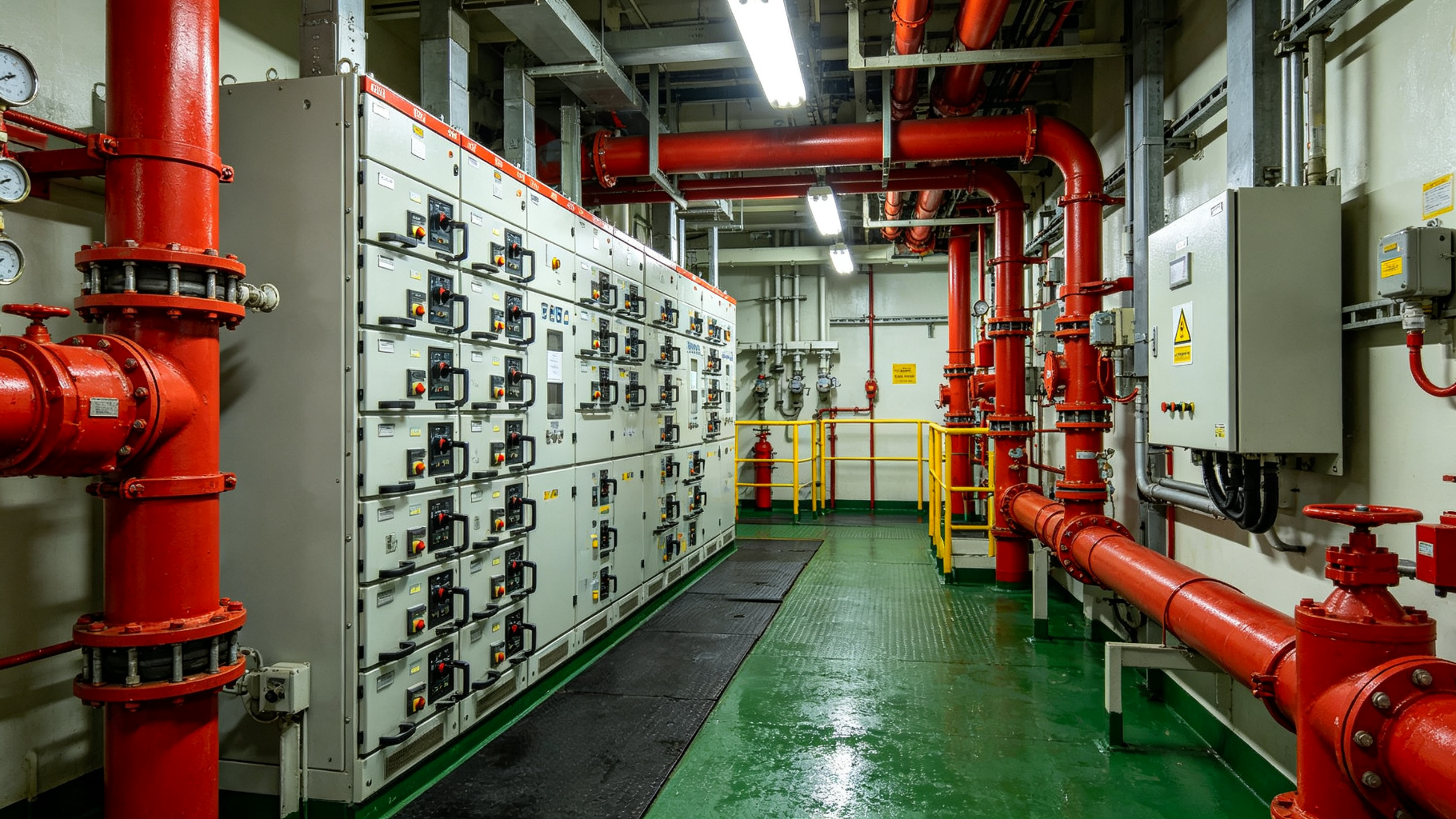
Technical guide on marine fire for electrical fire protection
On an offshore platform or a cargo vessel, an electrical fire isn't just a nuisance—it's a survival threat, with confined spaces, salt-laden air, and vibration all conspiring to shorten equipment life and ignite arcs. Marine regulations like SOLAS and class rules add another layer of complexity, demanding fire protection that works where water is scarce and evacuation is miles away. Here's what that means for your systems.
Marine and offshore electrical systems concentrate high-energy equipment in compact, often unattended enclosures. A ship electrical fire in a main switchboard, propulsion converter, or emergency panel can progress from an arcing fault to blackout or smoke in accommodation within minutes. On an offshore platform, the same event can disable emergency shutdown or process controls while evacuation options are limited. This guide explains how passive, thermally activated clean-agent patches can supplement maritime protection, with focus on the QuellArmor product line.
QuellArmor patches are not a replacement for required fixed fire-fighting systems, detection, or electrical maintenance. They provide local, automatic agent release where overheating or arcing begins, reducing the chance that an enclosure fire escalates into a larger marine fire.
Most ship electrical fires originate inside energized equipment: loose busbar joints aggravated by vibration, insulation tracking from salt or condensation, failed VFD capacitors, overheated terminations, or battery thermal runaway. Because these components are in steel cabinets, smoke may remain hidden until it reaches a detector or escapes through cable glands.
Offshore platform loads include high-voltage switchgear, compressor drives, and emergency generator controls that operate continuously. An internal arc can generate hot gases and molten metal; if suppression is delayed, cable bundles and transits can spread fire to adjacent compartments.
Land-based suppression assumptions do not always transfer. Engine-room ambient temperatures may reach 45–55°C, and internal cabinet surfaces near heat sinks can run higher. Vibration from engines and thrusters loosens terminations, while salt mist and humidity reduce insulation resistance over time.
Access is also constrained. MCCs in unmanned machinery spaces, bridge consoles, and under-deck junction boxes may be inspected only periodically. A passive device that needs no external power, control wiring, or pressure cylinder can be useful where conventional detection and piping are hard to install or maintain.
QuellArmor patches use a flexible laminate containing polymer microcapsules filled with FK-5-1-12 clean agent. FK-5-1-12 is electrically nonconductive, evaporates after discharge, and has a reported atmospheric lifetime of about five days with low global warming potential, making it suitable for energized electrical equipment.
Microencapsulation keeps the agent isolated until activation. When a capsule wall reaches its rated temperature, it ruptures and releases agent directly over the hot surface or arc. The patch requires no cylinder, solenoid, nozzle, or fire-alarm input, which simplifies installation in compact marine enclosures and reduces vibration- or corrosion-related failure points.
QuellArmor patches offer passive thermal activation at 80°C, 140°C, and 180°C. The rating should be above the maximum normal surface temperature in the mounting location, with a typical margin of 15–25 K, but below the expected ignition or thermal-runaway temperature.
A typical 200 mm × 200 mm patch carries a nominal 50–100 g FK-5-1-12 charge. For energized electrical hazards, a design concentration of roughly 4.5–6% by volume corresponds to roughly 0.04–0.15 m³ of protected net volume, depending on loading, leakage, and minimum ambient temperature. Larger cabinets require multiple patches or a separate total-flooding system.
Main and emergency switchboards are priorities because a fire can cause blackout. Patches are usually mounted on interior side or top panels above busbar connections, breaker cubicles, and drive heat sinks, not directly across ventilation openings. For VFDs, capacitor banks and DC bus sections are common targets; 140°C is often appropriate unless temperature data indicates otherwise.
Emergency switchboards, UPS modules, and navigation/communication racks support critical functions during a marine fire. These spaces often run cooler than engine rooms, so 80°C patches may be suitable if component temperatures are verified. Patches can be installed along rack tops or behind terminal strips without obstructing airflow or labels.
Cable transits and deck boxes collect terminations from many circuits and are hidden ignition points. Patches can be applied inside larger junction boxes or on the enclosure side of transit blocks. For lithium-ion battery modules, patches may release agent during early overheating but do not stop cell propagation or address vented gas; design must include BMS, ventilation, pressure relief, and class requirements.
Patches bond to clean, dry interior surfaces with pressure-sensitive adhesive. Surfaces should be free of salt, oil, rust scale, and loose paint; in high-vibration areas, approved edge retention may be used. Avoid mounting on moving parts, surfaces above the patch rating, or where maintenance could dislodge them. For vented enclosures, consider fan shutdown on detection so agent is not exhausted.
QuellArmor patches have a 5-year service life under rated marine enclosure conditions. They should be visually inspected during routine electrical checks and class surveys for ruptured capsules, bulging, discoloration, adhesive lift, or contamination. There is no pressure gauge; replace after activation, damage, or at 5 years. Retain records of location, rating, lot number, installation date, and temperature basis.
Ship and offshore electrical fires often begin inside enclosures that are hard to monitor and access. Passive thermal activation can deliver FK-5-1-12 directly to an overheating component without external power or piping, making QuellArmor patches a useful supplementary layer of maritime protection for switchboards, VFDs, emergency panels, and junction boxes. Ratings of 80°C, 140°C, and 180°C should be selected from measured surface temperatures, enclosure volume, and leakage. When installed as part of a maintained strategy, the patches can help contain a ship electrical fire before it affects propulsion, accommodation, or offshore platform operations.
A: Acceptance depends on flag-state rules, class notation, vessel design, and the installation file. QuellArmor patches are generally treated as supplementary local protection for electrical enclosures, not as a replacement for required fixed fire-extinguishing systems. The manufacturer should provide listing, material, activation, and installation documentation for class review.
A: A 140°C patch is commonly selected for engine-room switchgear, motor-control centers, and VFD cabinets where normal surfaces run warm but below that threshold. A 180°C patch may be required near boilers, exhaust surfaces, or other high-ambient locations. An 80°C patch can activate prematurely in hot engine-room environments and should be used only where measured operating temperatures justify it.
A: FK-5-1-12 is electrically nonconductive and leaves no residue, so it is commonly used for protection of electronics, switchgear, controllers, and other Class C electrical hazards. It vaporizes during discharge and generally does not require the cleanup associated with water, foam, or dry powder. Sensitive equipment should still be assessed for manufacturer-specific thermal or pressure tolerances.
A: No. QuellArmor is point protection for specific electrical enclosures or high-risk components and is normally considered supplementary to required fixed systems such as water mist, CO2, foam, or clean-agent systems. It can add protection in cabinets, junction boxes, VFDs, and localized electrical spaces where early suppression is valuable. The required fixed system must still meet SOLAS, flag-state, and classification-society requirements.
A: QuellArmor is designed for maritime electrical-enclosure protection using corrosion-resistant construction and a sealed FK-5-1-12 charge, but installation must follow the manufacturer’s location and mounting limits. Routine inspection should check for corrosion, mechanical damage, loose mounting, seal condition, and exposure to abnormal heat. The standard service interval is 5 years, with more frequent checks recommended in severe offshore or high-vibration areas.
FIREQUELL QuellPatch delivers automatic, maintenance-free clean-agent protection for electrical panels, battery cabinets and control rooms — designed to meet FM Approved, UL Listed, CE and UKCA requirements.
Request a Site Assessment