
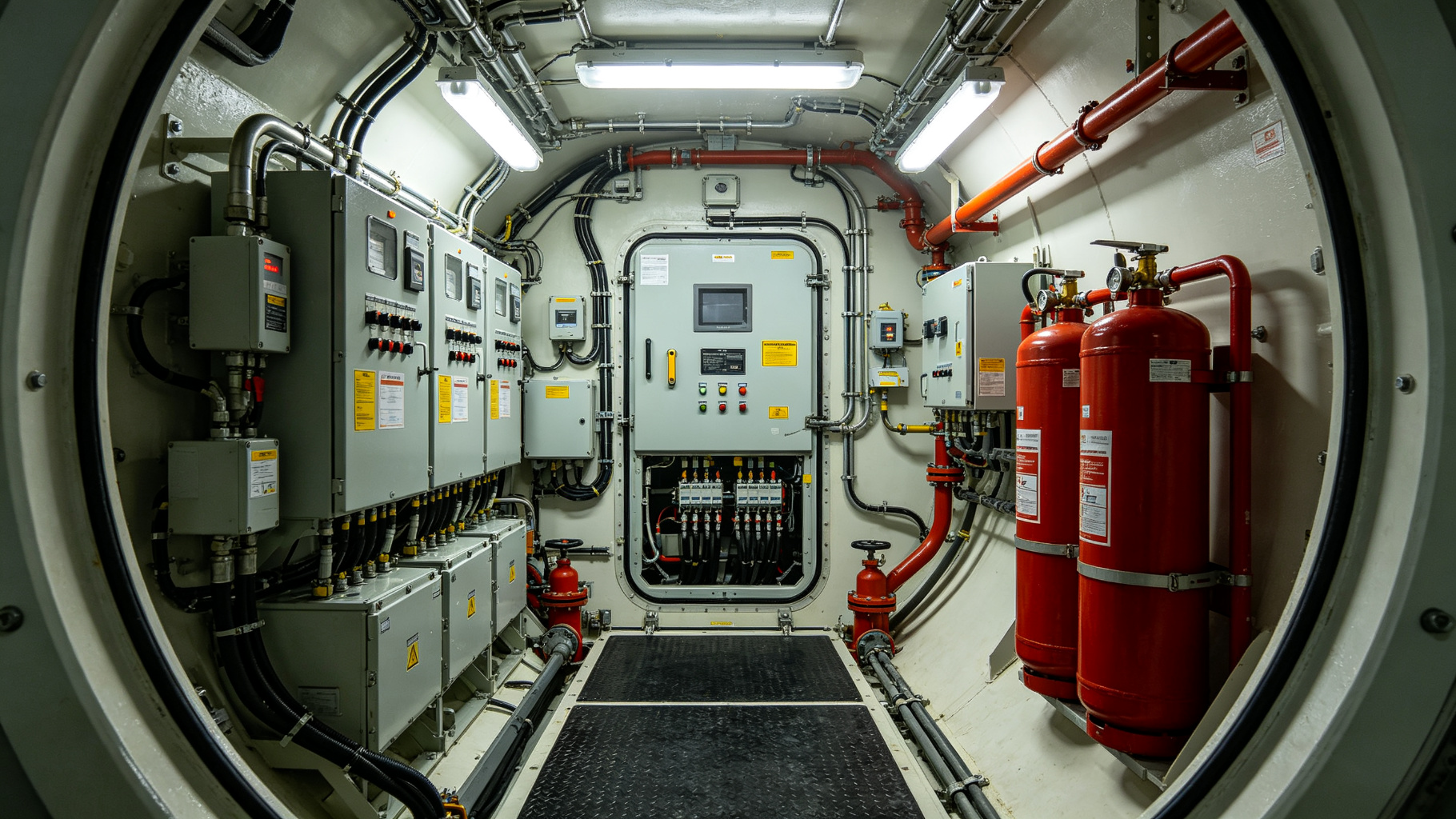
What unique fire protection challenges does an offshore wind turbine nacelle present?
Offshore wind nacelles combine a confined, high-ignition-load environment (gearbox oil, hydraulic fluid, electrical switchgear) with marine exposure (salt fog, vibration, 20+ year maintenance intervals). The fire protection system must be maintenance-free for the access-window interval (typically 6-12 months) and must survive 25-year marine exposure.
1. The Offshore Wind Hazard Profile
An offshore wind turbine nacelle is a 4-6 meter long steel or composite enclosure at the top of a 100-150 m tower, exposed to wind, salt fog, UV, and temperature cycles from -20°C to +45°C. Inside the nacelle, the main fire hazards are (a) the gearbox and its 200-600 liter oil reservoir, (b) the hydraulic pitch system with 30-80 liters of hydraulic fluid, (c) the LV/MV switchgear and the converter cabinet, and (d) the transformer. A single gearbox fire in an offshore turbine typically destroys the entire nacelle and results in a 12-18 month replacement cycle costing US$4-8M per event.
2. Why Conventional Suppression Does Not Work
Sprinkler systems cannot be used in a nacelle because the water supply is impractical and the false-discharge risk is unacceptable in a US$20M asset. Gaseous total-flooding systems (FK-5-1-12, inert gas) require tight containment, which a nacelle is not. Foam systems are too bulky. Aerosol systems are sensitive to humidity and the marine environment. The 2026 best practice is passive FK-5-1-12 patches installed at the highest-risk zones: gearbox oil reservoir, hydraulic pitch actuators, converter cabinet, and transformer.
3. Marine Environment Considerations
Salt fog accelerates corrosion of unprotected steel and aluminum. The standard protective treatment for nacelle-mounted fire protection is salt-fog testing per IEC 60068-2-52 severity 4 (28 days continuous salt fog) or ASTM B117-19 (1,000 hours). The FIREQUELL QuellPatch for offshore wind is supplied with a 316L stainless steel mounting bracket and a UV-stable EPDM seal, both of which pass the IEC 60068-2-52 severity 4 test. The patch itself is sealed against water ingress to IP67.
4. Vibration and Mechanical Shock
Nacelles vibrate continuously at 0.5-5 Hz from the rotor, with transient shocks of 5-10 g during emergency stops. The QuellPatch bracket is designed to withstand 10 g continuous and 30 g shock without loss of the patch seal, per IEC 60068-2-6 (vibration) and IEC 60068-2-27 (shock). The patch adhesive is a 2-part epoxy with a shear strength of 18 MPa on steel, sufficient to hold the 5-10 g patch in place for 25 years.
5. Detection in a Noisy Environment
Standard smoke detection in a nacelle produces 5-10 false alarms per year because of airborne dust, oil mist, and humidity. The 2026 best practice is dual-criteria detection: optical smoke + heat, with a 30-second confirmation window before alarm. For the highest-risk zones (gearbox, converter), infrared thermal imaging sampled at 1 Hz is increasingly common. Passive FK-5-1-12 patches are deliberately independent of the detection system: they fire on thermal trigger at 80°C without any electrical signal.
6. Maintenance Intervals
Offshore turbines are accessed by crew transfer vessel or helicopter, with a per-visit cost of US$30,000-100,000. The maintenance interval is typically 6-12 months, and any fire protection system that requires more frequent maintenance is operationally infeasible. QuellPatch is designed for a 10-year maintenance-free interval; the only routine check is a visual inspection during the scheduled annual maintenance visit. After activation, the patch is replaced; after 10 years, the entire patch set is replaced in a single 4-hour maintenance window.
7. Standards Compliance
The applicable standards for offshore wind fire protection are: IEC 61400-25 (wind turbine communications), DNV GL ST-0376 (offshore wind safety), and increasingly the IFC (International Fire Code) Section 912 for wind turbines. The German BSH Standard 7005 and the UK HSE Offshore Safety Notice OSD-3-2006 are also relevant for specific jurisdictions. Insurance underwriters typically require a documented test report from a third-party test lab (DNV, TÜV, or UL) before binding a wind farm policy.
8. Conclusion
Offshore wind nacelle fire protection is a maintenance-constrained, marine-exposed, vibration-loaded application. The 2026 best practice is passive FK-5-1-12 patches at each high-risk zone, with dual-criteria detection and a 10-year maintenance interval. The FIREQUELL QuellPatch product line is the only one engineered specifically for this application, with IEC 60068-2-52 severity 4 salt-fog certification, 30 g shock tolerance, and a 10-year maintenance interval.
Frequently Asked Questions
Can you use sprinkler systems in a wind turbine nacelle?
Not practically. The water supply is not available at the nacelle height, the false-discharge risk is unacceptable in a US$20M asset, and the water damage from a sprinkler activation would destroy the gearbox and electrical systems. The 2026 best practice is passive FK-5-1-12 patches in the highest-risk zones.
How often must nacelle fire protection be maintained?
QuellPatch in offshore wind is designed for a 10-year maintenance-free interval. The only routine check is a visual inspection during the annual scheduled maintenance visit. After activation, the patch is replaced; after 10 years, the entire patch set is replaced in a single maintenance window.
What standards govern offshore wind turbine fire protection?
IEC 61400-25, DNV GL ST-0376, and IFC Section 912 are the most commonly cited. The German BSH Standard 7005 and the UK HSE Offshore Safety Notice OSD-3-2006 are also relevant for specific jurisdictions. Insurance underwriters typically require a third-party test report.
Need a Passive Fire Suppression Solution?
FIREQUELL QuellPatch delivers automatic, maintenance-free clean-agent protection for electrical panels, battery cabinets and control rooms — designed to meet FM Approved, UL Listed, CE and UKCA requirements.