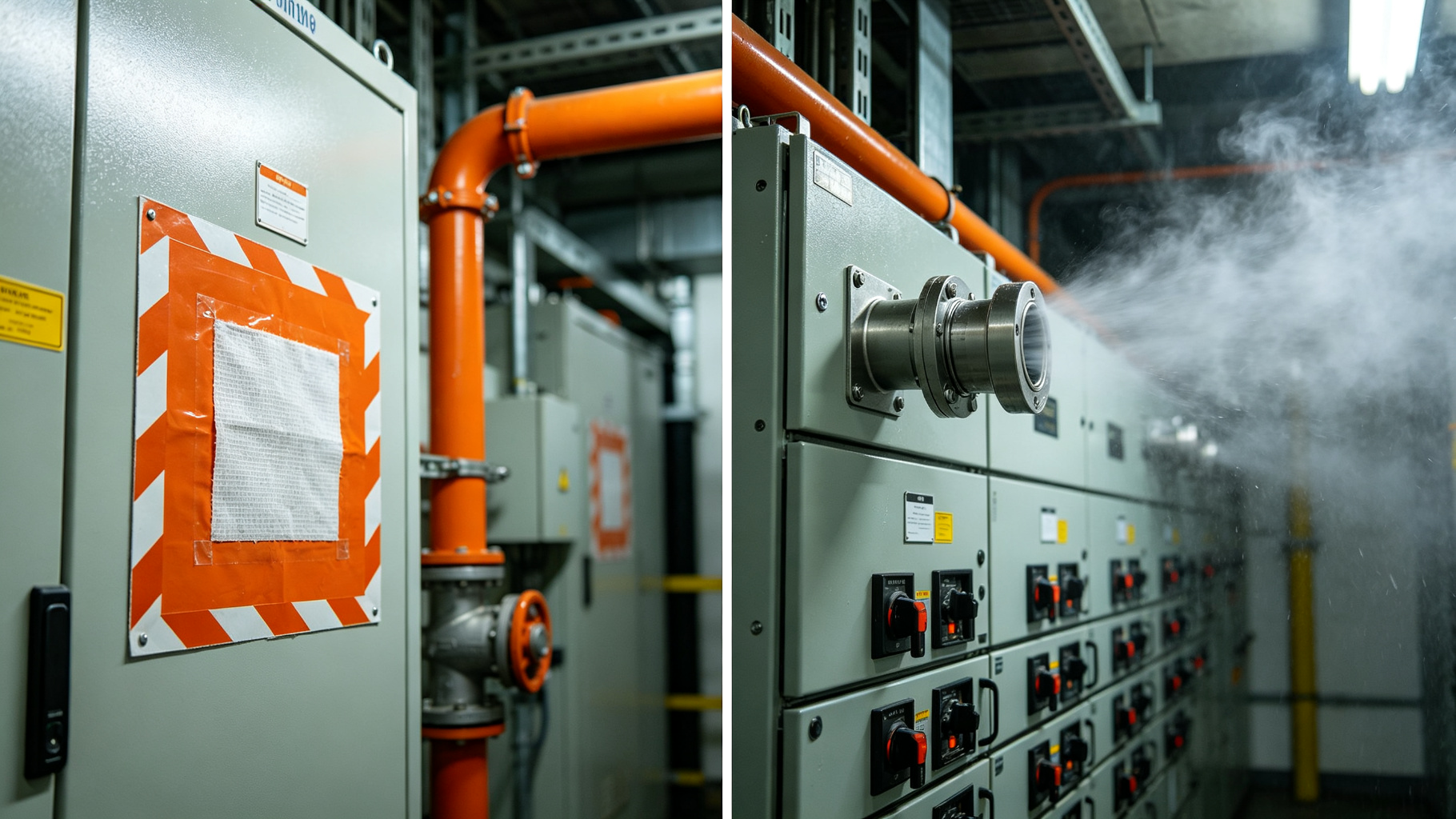
Technical guide on water mist for electrical fire protection
Water mist systems have long been a staple for electrical fire protection, but they demand water supply, pumps, and complex piping—none of which suit remote or compact installations. In contrast, passive patch technology offers a dry, maintenance-free alternative that reacts directly to heat, raising a key question: which approach truly minimizes risk in your environment?
Electrical fires in switchgear, uninterruptible power supplies, variable-frequency drives, rack power distribution units, and control panels commonly begin as localized overheating at terminations, busbars, circuit boards, or connector contacts. Suppression selection for these hazards requires more than flame-extinguishing performance; it must also account for conductivity, post-discharge downtime, installation access, maintenance burden, and response to incipient-stage heating. This fire suppression comparison compares the QuellPatch passive clean-agent patch line with water mist systems, with particular attention to water mist electrical compatibility, enclosure-scale application, and lifecycle reliability.
The passive patch comparison below is not a substitute for listing documents or site-specific engineering. It focuses on technical behavior: how each technology delivers suppression agent, how it interacts with energized components, what activation dependencies exist, and where each approach is typically applied.
QuellPatch units use microencapsulation to contain FK-5-1-12, a fluorinated ketone clean agent with a boiling point near 49°C. The agent is held within discrete polymer shells rather than in a pressurized cylinder. When the patch is exposed to heat at its rated threshold, the shell material softens or ruptures and releases the agent directly into the affected zone. Because FK-5-1-12 vaporizes readily at temperatures commonly found in electrical fires, it can reach shielded areas around components and absorb heat at the flame interface without producing a liquid residue.
QuellPatch is offered with nominal activation temperatures of 80°C, 140°C, and 180°C. The 80°C variant is intended for sensitive electronic enclosures where normal ambient remains well below the threshold; the 140°C variant is commonly used for general electrical cabinets; and the 180°C variant is suited to higher-ambient industrial compartments where heat cycling could otherwise produce premature response. Passive thermal activation means the patch requires no smoke detector, control panel, external power, or piping network to initiate discharge.
Water mist systems discharge water through specialized nozzles that produce droplets with a Dv0.9 typically below 1,000 µm, as defined in NFPA 750. Many high-pressure electrical nozzles target Dv0.9 values in the 100–200 µm range. Low-pressure systems generally operate below approximately 12.5 bar, while high-pressure systems may operate at 50–200 bar depending on nozzle and pump design.
The small droplet size provides a large surface-area-to-mass ratio. When droplets vaporize, 1 kg of water can absorb roughly 2,260 kJ of latent heat and expand by a factor of about 1,700, producing both flame cooling and local oxygen dilution. Water mist also attenuates radiant heat and can be effective for compartment-scale or larger local-application hazards. Unlike the patch, however, a water mist installation requires water storage or supply, piping, nozzles, detection, and a controlled release mechanism.
FK-5-1-12 is electrically nonconductive in its intended clean-agent service. A QuellPatch discharge does not introduce a conductive liquid stream across live buswork or circuit boards. This characteristic reduces the risk of phase-to-phase or phase-to-ground tracking during discharge, which is particularly relevant in medium-voltage switchgear, UPS cabinets, and densely packed electronic enclosures.
Water mist electrical performance is more conditional. Deionized or treated water can have high initial resistivity, but conductivity may increase as droplets contact ionic contaminants, cable insulation degradation products, fire residues, or metallic surfaces. Listed water mist systems can be suitable for certain electrical hazards, but approvals commonly specify voltage class, minimum nozzle-to-equipment clearance, water quality limits, and equipment isolation requirements. Even fine mist can leave a continuous conductive film on wetted surfaces, especially where contamination is present.
After a QuellPatch discharge, FK-5-1-12 typically evaporates without leaving residue. Soot and combustion byproducts may still require cleaning, but the agent itself does not leave corrosive deposits or require water extraction. This can reduce insulation-resistance testing time and support faster restoration of enclosed electrical equipment.
Water mist generally produces less water than traditional sprinklers, but it still introduces moisture into the protected space. Runoff can affect lower cabinets, cable trenches, documentation, and adjacent equipment. Moisture may also contribute to corrosion of uncoated steel contacts, connectors, and busbar surfaces over time if not promptly dried. In high-value electronic environments, post-event recovery may include dewatering, drying, insulation testing, and replacement of water-damaged components.
QuellPatch relies on passive thermal activation: discharge begins when the patch material reaches its rated temperature. This eliminates external dependencies such as detector wiring, control panels, solenoid valves, or backup power. It also means response is localized to the area where heat reaches the patch, so placement near likely ignition sources is an engineering requirement rather than a cosmetic choice.
The 80°C, 140°C, and 180°C ratings allow selection based on normal enclosure ambient and expected temperature rise. Lower thresholds may provide earlier response for sensitive electronics, while higher thresholds reduce the chance of activation from normal operating heat in industrial compartments. The product has a rated service life of 5 years under specified indoor conditions. Inspection is primarily visual: units should be checked for damage, obstruction, paint overspray, or prior discharge, and replaced after discharge or at the end of the 5-year service interval.
Water mist systems normally use smoke detectors, heat detectors, or a combination of both, with a control panel managing cross-zoning, time delays, and release circuits. This can allow discharge during the incipient stage before local surface temperatures reach a patch threshold. However, the system also depends on reliable power, backup batteries, pump or cylinder pressure, valve operation, water quality, and unobstructed nozzles.
Maintenance typically includes periodic inspection and testing in accordance with applicable standards such as NFPA 25 and NFPA 750. Tasks may include pump testing, strainer cleaning, nozzle replacement or blowdown, water-quality verification, and cylinder pressure checks. Accidental release, while not common, can cause widespread equipment downtime because a single zone may affect multiple cabinets or an entire room.
QuellPatch is a local-application product intended for specific enclosed electrical hazards. It is commonly considered for individual switchgear compartments, UPS modules, control cabinets, rack-level power equipment, and other spaces where a fire may start at a known component. It is not designed as a room-scale total-flooding solution and may not control deep-seated cable fires, large arcing faults, or fires outside the effective discharge zone.
Water mist is better suited to larger compartments or grouped hazards where the heat release may exceed the capacity of localized patches. It can protect multiple cabinets from a common piping network and can provide cooling beyond the immediate ignition point. Its effectiveness depends on nozzle spacing, droplet distribution, enclosure ventilation, and the ability of mist or steam to reach shielded fires.
For facilities with many distributed electrical cabinets, a hybrid approach can be appropriate: QuellPatch units inside individual enclosures for fast, clean, local suppression, with water mist reserved for room-scale protection where higher heat-release hazards exist.
The choice between QuellPatch passive patches and water mist for electrical use depends on hazard scale, voltage class, enclosure conditions, downtime tolerance, and maintenance capacity. QuellPatch provides local, nonconductive suppression using microencapsulated FK-5-1-12, with activation at 80°C, 140°C, or 180°C, a 5-year service life, and no external power or detection requirements. It is well suited to incipient fires inside electrical cabinets where residue and water damage must be minimized.
Water mist offers substantial heat-extraction capability for larger compartments and can protect multiple hazards from a central system. Its use around energized equipment is possible under listed conditions, but water quality, clearance, conductivity, moisture damage, and maintenance dependencies must be carefully evaluated. In many facilities, the two technologies are not mutually exclusive; patches can provide cabinet-level protection while water mist addresses broader room-scale risks.
A: Some listed water mist systems are approved for specific electrical hazards, but suitability depends on water purity, system voltage, electrical clearances, nozzle placement, and the exact terms of the listing. Conductivity can rise after discharge as water mixes with contaminants or combustion byproducts, so secondary damage and cleanup must be considered. For sensitive electronics, FK-5-1-12 clean-agent patches avoid water exposure and residue at the protected component.
A: No. FK-5-1-12 is a clean agent that vaporizes and leaves no powder, water, or oily residue on circuit boards, busbars, relays, or drives. That reduces post-fire cleanup and secondary loss compared with water-based suppression. It is still important to inspect and replace any discharged QuellPatch and evaluate damaged equipment before re-energizing.
A: QuellPatch has a rated service life of 5 years under specified indoor conditions. Units should be visually inspected periodically and replaced after discharge, physical damage, obstruction, detachment, or at the end of rated life. This differs from water mist systems, which may require cylinders, pumps, valves, nozzles, and controls to be maintained on a scheduled basis.
A: For small sealed cabinets, a passive patch can be more direct because it is mounted at the likely fault point and activates thermally without detectors, control panels, external power, piping, or nozzle distribution. Water mist reliability depends on detection, control logic, water supply or stored pressure, nozzle coverage, and agent transport into the cabinet. Passive protection is best for localized incipient faults, not as a replacement for code-required room or building systems.
A: Water mist can cause corrosion, tracking, insulation resistance loss, contamination, and downtime even when the fire is small, especially if runoff contacts powered or sensitive electronics. Damage risk depends on voltage, clearance, water quality, drainage, and whether the system is listed for the specific equipment. FK-5-1-12 patches release a gaseous clean agent locally, so they avoid water runoff and residue-related cleanup.
FIREQUELL QuellPatch delivers automatic, maintenance-free clean-agent protection for electrical panels, battery cabinets and control rooms — designed to meet FM Approved, UL Listed, CE and UKCA requirements.
Request a Site Assessment