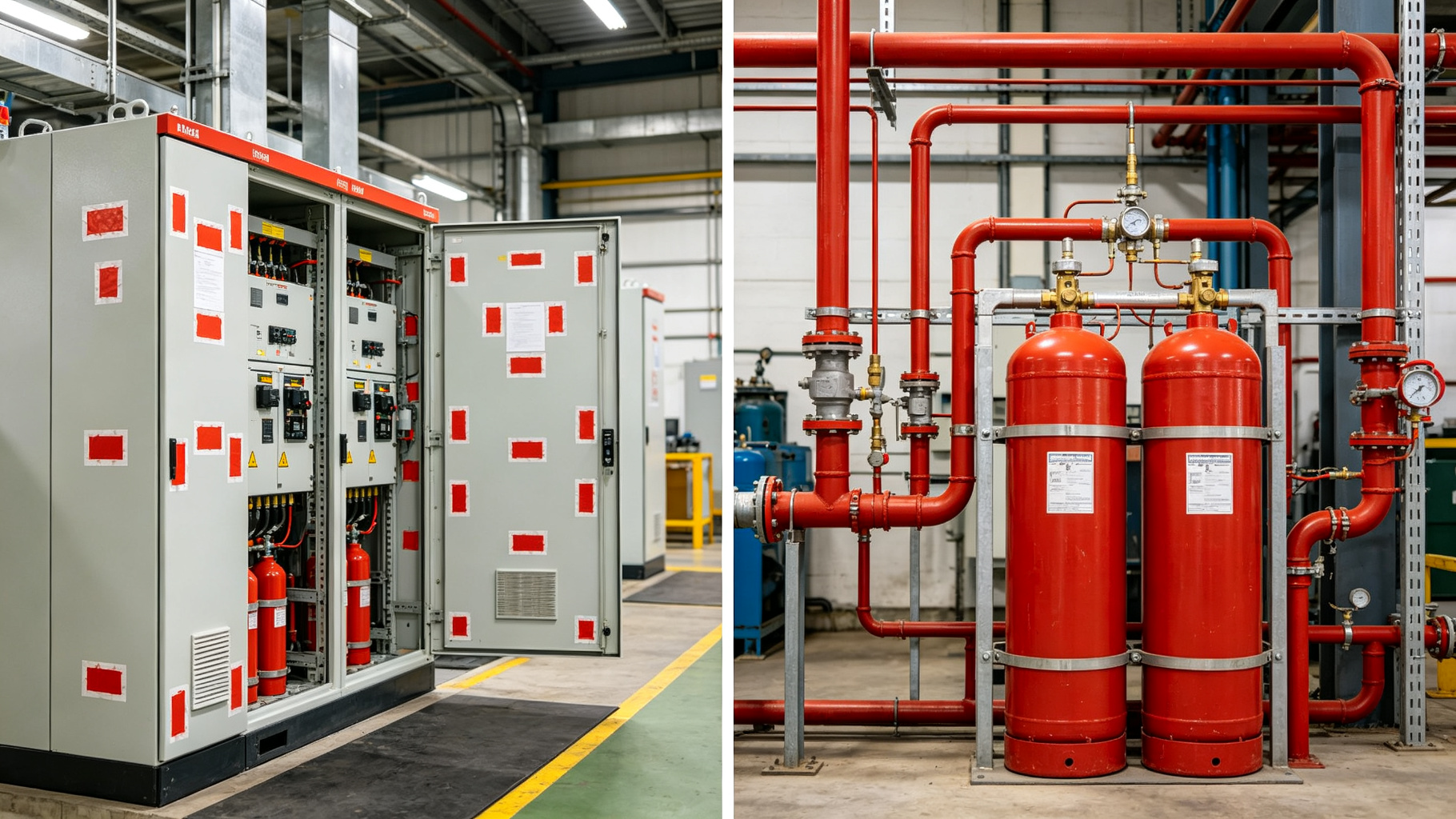
Technical guide on passive suppression for electrical fire protection
Every fire protection strategy boils down to a fundamental choice: intervene before flames spread (active) or contain them through design (passive). In electrical cabinets, where space is tight and false discharges are costly, understanding how each approach impacts response time and total cost of ownership is the first step toward a resilient system.
Electrical enclosures concentrate ignition risks in a relatively small volume: loose terminations, tracking insulation, failing capacitors, overloaded busbars, and power-semiconductor faults can all produce an electrical enclosure fire that remains hidden until smoke or thermal trip signals appear. Selecting between passive suppression and active suppression therefore requires more than a generic comparison of extinguishants. It requires analysis of detection timing, agent transport, enclosure leakage, power dependencies, inspection access, and service behavior in the specific enclosure environment.
This article compares the two approaches for cabinets, motor-control centers, variable-frequency drive panels, junction boxes, and similar electrical infrastructure. It focuses on the QuellPatch product line, a passive clean-agent patch system using microencapsulated FK-5-1-12. The objective is not to present one method as universally preferable, but to identify the engineering conditions under which each approach is more likely to provide effective, reliable protection.
Most enclosure fires begin as localized overheating rather than immediate flashover. A resistive connection may radiate heat to nearby polymer insulation, producing pyrolysis gases before visible flaming develops. Once flaming starts, the enclosure initially restricts oxygen, but heat can accumulate rapidly on internal surfaces. Cable jackets, terminal blocks, contactor housings, and capacitor materials then contribute fuel, and hot gases migrate toward the top of the cabinet.
This behavior matters because suppression effectiveness is highly time-dependent. A system that discharges during the incipient stage needs less agent and may prevent busbar damage, while a delayed discharge may face a larger, ventilation-controlled fire that has already spread beyond the compartment of origin.
An active clean-agent system typically depends on a sequence of engineered functions: detection, control-panel logic, alarm verification, releasing-device operation, agent expulsion, piping transport, and nozzle distribution. Each step adds some delay. Spot smoke or heat detectors may also be located near the top of the enclosure, while the fire may originate lower behind a duct or component. Aspirating systems or linear heat detection can reduce detection time, but they add cost, tubing, and supervision requirements.
Once activated, pressurized active systems can deliver high agent flow rates and are well suited to total-flooding protection for larger enclosures or rooms. Their performance, however, is tied to the integrity of the complete detection-and-release chain.
Passive suppression such as QuellPatch operates by direct thermal response rather than by a separate detection-and-control sequence. The patch contains FK-5-1-12 in discrete microencapsulated cells. When the polymer shells reach their rated temperature, they soften and rupture, releasing agent onto or adjacent to the overheated surface.
QuellPatch is offered in activation ratings of 80°C, 140°C, and 180°C. The 80°C variant is generally used in temperature-controlled enclosures with sensitive electronics, the 140°C variant in general electrical cabinets, and the 180°C variant in higher-ambient industrial locations where elevated normal temperatures could otherwise cause premature response. Because activation is local, the patch can begin releasing agent before heat or smoke reaches a ceiling-mounted detector, provided the patch is installed near the probable ignition source.
Active clean-agent systems are commonly designed as total-flooding systems. They must achieve and hold a sufficient concentration of gaseous agent throughout the protected volume. For FK-5-1-12 systems, typical Class C design concentrations are often in the approximate 4–6% range by volume, depending on the listing, fuel type, and enclosure geometry. The required agent mass is calculated from enclosure volume, design concentration, agent specific vapor volume, and temperature.
Electrical enclosures are not always gas-tight. Door gaskets age, cable glands leak, filtered vents provide intentional openings, and maintenance personnel may leave doors slightly ajar. Leakage reduces both peak concentration and hold time. In severe cases, the active system may discharge its cylinder without maintaining the concentration needed for extinguishment. Enclosure integrity testing and sealing are therefore essential parts of active suppression design.
QuellPatch uses a local-application principle rather than total flooding. FK-5-1-12 has a boiling point near 49°C and a vapor pressure of roughly 40 kPa at 25°C, so it vaporizes readily when released onto a hot surface. The microencapsulated cells break where thermal exposure is highest, placing agent close to the flame or overheated component. This reduces dependence on whole-enclosure mixing and can be useful in compartments with complex internal obstructions, such as wiring ducts, DIN rails, or drive heat sinks.
The trade-off is coverage area. A patch contains a finite quantity of agent and is intended for incipient or localized fires, not for a fully developed enclosure fire. Placement is therefore an engineering task: patches should be located near known high-risk components within the manufacturer’s specified coverage limits. They may also be used inside subcompartments where an active nozzle cannot effectively reach.
Active suppression systems require supervision to remain reliable. Control panels need primary power and often battery backup. Detectors, solenoids, manual release stations, and pressure switches must be monitored for fault conditions. Pressurized cylinders require weighing or pressure checks, and piping or detection tubing must remain unobstructed.
These features provide important benefits: remote annunciation, alarm signaling, coordinated shutdown, and manual release. They also introduce components that can be disabled during maintenance, affected by electrical surges, or compromised by wiring faults. In remote or lightly monitored enclosures, a faulted active system may remain undetected until a fire occurs.
QuellPatch represents a no-power fire suppression approach. It does not require control power, batteries, detectors, solenoids, or software. Its reliability block is comparatively short: the patch must be correctly installed, undamaged, within service life, and exposed to sufficient heat at the protected surface.
This does not eliminate failure modes. Patches can be painted over, mechanically damaged, exposed to incompatible chemicals, or installed too far from the ignition source. They also do not inherently provide remote alarm notification. For that reason, they are often applied as a supplementary layer within an overall protection scheme rather than as a replacement for supervised active systems where code or hazard analysis requires them.
Retrofitting active suppression into an existing enclosure can be mechanically and electrically intrusive. Cylinders require mounting space, nozzles require enclosure penetration, piping must be routed around live parts, and detection devices require connection to a supervised panel. These tasks may require extended downtime, particularly in energized switchgear or process-critical motor-control centers.
Passive patches are generally less intrusive. QuellPatch units can be mounted with adhesive or mechanical fasteners on interior surfaces near terminal blocks, circuit breakers, relays, drive modules, or bus connections. The reduced need for piping and wiring can make them practical for small enclosures, remote cabinets, and retrofit applications where installing a full active system is difficult or disproportionate to the hazard.
QuellPatch has a 5-year service life under specified indoor ambient conditions. Each unit should be marked with installation and replacement dates. Routine inspection is primarily visual: confirm that the patch remains secured, has not been covered by paint or contamination, shows no signs of physical damage, and is within its replacement interval.
Active systems typically require more extensive periodic service, including detector testing, panel function checks, cylinder pressure or weight verification, and enclosure integrity testing. The total cost of ownership should therefore account for recurring maintenance, not only initial hardware. For small or distributed enclosures, passive suppression may reduce inspection burden, while large or high-value enclosures may justify the supervisory capability of an active system.
The choice between passive suppression and active suppression for electrical enclosures depends on fire size, enclosure volume, leakage, monitoring requirements, maintenance access, and consequence of failure. Active clean-agent systems offer scalable total-flooding protection, remote supervision, and controlled release, but their performance depends on power, detection, piping, and enclosure integrity. Passive suppression such as QuellPatch offers local, thermally activated, no-power fire suppression with relatively simple installation and a 5-year service interval, but it is best applied to localized incipient hazards and properly positioned within the enclosure.
For many facilities, the most defensible approach is layered: use active suppression where total-flooding protection or remote annunciation is required, and use QuellPatch to protect specific high-risk components, subcompartments, or retrofitted cabinets where active discharge may be delayed or inaccessible. The final design should be based on a site-specific hazard assessment and reviewed with the authority having jurisdiction.
A: Generally, no. QuellPatch is designed for localized, incipient-stage protection inside electrical enclosures, while an active total-flooding clean-agent system may be required for larger room volumes, higher hazard classifications, or code-mandated coverage. A common design is to use passive patches at high-risk fault points and active systems for broader enclosure or room protection.
A: QuellPatch uses passive thermal activation. Its microencapsulated FK-5-1-12 cells rupture when the patch reaches its rated activation temperature, releasing agent directly at or near the heat source. Available ratings include 80°C, 140°C, and 180°C, so selection should be at least 20–30°C above the highest normal operating temperature at the mounting point.
A: In sealed cabinets, smoke and heat can take time to reach ceiling or room detectors, delaying active system discharge until after a small arc or component fire has grown. Passive patches mounted directly on or near busbars, terminal blocks, relays, or drives can respond to local surface heating before room detection confirms the event. This makes them useful for point-specific incipient protection where detector placement is constrained.
A: Active total-flooding systems must achieve and hold a uniform agent concentration, typically based on NFPA 2001 design concentrations for the fuel and enclosure. QuellPatch works differently by releasing FK-5-1-12 locally at the incipient fault point rather than relying on room-wide mixing and retention. It is therefore intended for localized enclosure protection, not as a substitute for an engineered total-flooding concentration.
A: Active systems usually require control panel supervision, detectors, releasing devices, piping or nozzles, periodic flow tests, battery replacement, and documented maintenance. QuellPatch has no external power requirement and a rated service life of 5 years under specified indoor conditions, with periodic visual inspection for damage, obstruction, or discharge. Lifecycle cost should still be compared against the protected risk, enclosure volume, and applicable code requirements.
FIREQUELL QuellPatch delivers automatic, maintenance-free clean-agent protection for electrical panels, battery cabinets and control rooms — designed to meet FM Approved, UL Listed, CE and UKCA requirements.
Request a Site Assessment