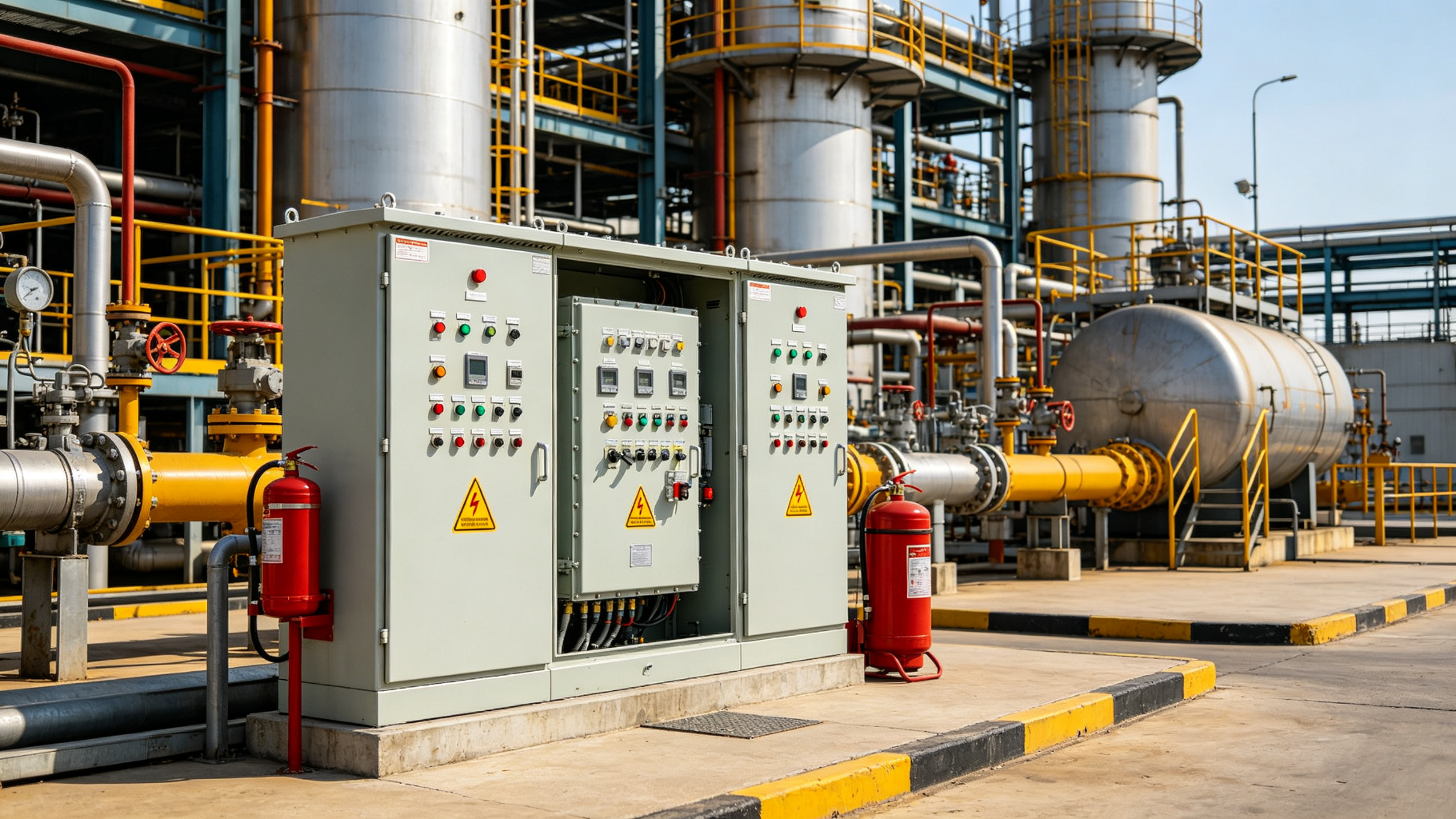
Technical guide on petrochemical fire for electrical fire protection
In petrochemical facilities, a single electrical spark can ignite a catastrophic explosion, which is why hazardous area classifications like Class I, Division 2 dictate every equipment choice. Fire suppression in these zones must not only extinguish flames but also avoid creating ignition sources—a challenge that passive patch technology meets with zero moving parts and no pressurized agents.
Petrochemical facilities present a difficult combination of classified electrical equipment, flammable hydrocarbon releases, and continuous process load. Motor control centers, variable-frequency drive cabinets, instrument marshalling panels, local junction boxes, and analyzer shelters are often located in Zone 1/Class I Division 1 or Zone 2/Class I Division 2 areas. A loose connection, failing contactor, tracked circuit board, or overheated semiconductor can produce an arc or hot surface at the same time that a nearby valve, flange, or vent may release a Group IIA, IIB, or IIC vapor.
Electrical fire protection in these areas cannot be treated as ordinary commercial cabinet protection. The device must coexist with explosion-protected Ex d, Ex e, Ex i, or Ex p equipment, survive corrosive coastal or refinery atmospheres, and act before a small internal fault becomes an external ignition source. QuellArmor passive clean-agent patches are intended as a close-proximity suppression layer within this broader hazardous-area strategy. This article discusses technical selection, application, and limitations for petrochemical electrical enclosures.
Even correctly selected Ex equipment can develop internal fault conditions. Bus-bar joints may loosen under thermal cycling; contactors can weld or erode; VDC link capacitors can degrade; and terminal blocks can develop resistive heating. In VFD enclosures, heat-sink temperatures under normal operation can approach 70–90 °C, while semiconductor failure or fan loss can produce localized temperatures well above component ratings.
The relevant hazard is not only flame ignition of solid insulation. If an arc occurs inside an enclosure that contains a flammable hydrocarbon-air mixture, flame can propagate through gaps, cable glands, or damaged seals. Equipment temperature classes T1 through T6 limit external surface temperature, but an internal fault can exceed those limits before protection devices isolate the supply. Therefore, suppression should be located where the fault begins, rather than relying solely on room-scale detection or gas extinguishing systems.
Petrochemical electrical enclosures commonly range from approximately 0.02 m³ for small junction boxes to 2 m³ or more for multi-section MCC buckets. In a nearly sealed enclosure, an incipient electrical fire may first appear as a localized hotspot or smoldering insulation, followed by arcing and rapid flame spread across polymeric cable materials. If hydrocarbon vapor is present, ignition can produce a pressure rise on a millisecond timescale.
This creates two distinct protection objectives. The first is suppression of a conventional electrical fire in normal or low-gas conditions. The second is early intervention before an internal fault provides a sustained ignition source to an explosive atmosphere. Passive thermal activation is useful here because it does not depend on control power, smoke detection, or manual release; however, it cannot replace primary explosion protection when a flammable mixture already fills the enclosure.
QuellArmor patches use microencapsulation to store FK-5-1-12 clean agent without a pressurized cylinder. The agent is contained within polymer shells that are held on a flexible backing sheet. FK-5-1-12 is electrically nonconductive, has an atmospheric lifetime of approximately five days, and leaves little or no residue on most electrical surfaces when discharged. Its boiling point is about 49.2 °C, but the microcapsule shell is engineered to remain intact until its rated activation temperature is reached.
Because the agent is stored in discrete capsules, a patch can be cut or mounted around internal obstructions in some configurations, subject to manufacturer instructions. There is no piping network, valve, solenoid, or pressure switch to inspect. This makes the product suitable for distributed electrical assets where active gaseous suppression would be expensive or difficult to maintain.
QuellArmor patches are offered with passive thermal activation thresholds of 80 °C, 140 °C, and 180 °C. When the capsule shell reaches its rated temperature, it ruptures and releases FK-5-1-12 directly into the enclosure. The agent vaporizes and interrupts the combustion reaction through a combination of heat absorption and chemical inhibition.
Selection requires a margin above normal operating temperature. As a general engineering rule, the activation threshold should be at least 20 °C above the maximum expected internal ambient temperature under normal load. The 80 °C variant is typically considered for instrument cabinets, PLC panels, and sensitive electronics where internal ambient remains moderate. The 140 °C variant is more common for MCCs, VFDs, and switchgear where bus bars and heat sinks run warm. The 180 °C variant may be appropriate where equipment is located near process heat, lighting fixtures, or high-temperature compartments, provided the higher threshold still provides useful response before component failure.
For total-flooding applications, FK-5-1-12 design concentrations commonly range from 4.5% by volume for electrical hazards to 5.5–6.0% where significant polymeric insulation, cable jackets, or hydrocarbon residues are present. At 20 °C, these concentrations correspond to approximate flooding factors of 0.62–0.85 kg/m³, after correcting for agent vapor volume. The required mass should be adjusted for the lowest expected enclosure temperature and net free volume, subtracting large rigid components where appropriate.
QuellArmor patches are normally specified by agent mass and enclosure volume rather than by visual coverage alone. Engineering guidance typically places patches within 300–500 mm of likely fault sources, such as:
For larger cabinets, multiple patches should be distributed across the upper interior surface so that discharged agent can reach separate compartments. Patches should not block ventilation openings, cover nameplates, obstruct racking mechanisms, or prevent safe removal of covers during lockout/tagout.
Mounting a patch inside an Ex-certified enclosure must not invalidate its certification. In Ex d flameproof enclosures, patches must not interfere with flamepaths, cover clearances, bolt torque, or pressure-relief paths. In Ex e increased-safety enclosures, the release mechanism should not produce sparks or hot particles; QuellArmor’s thermal rupture design avoids pyrotechnic initiators. In purged Ex p enclosures, the effect of continuous air exchange on agent retention should be evaluated.
Petrochemical sites may also require chemical-resistant backing materials for salt spray, hydrogen sulfide, condensate, or washdown exposure. The manufacturer’s published material compatibility data should be reviewed against cable insulation, conformal coatings, paints, and gasket materials. QuellArmor patches have a 5-year service life under specified ambient conditions. They should be visually inspected during routine electrical maintenance and replaced after discharge, physical damage, or at the end of the 5-year period.
FK-5-1-12 acts primarily by interrupting the flame chain reaction and absorbing thermal energy. In an incipient electrical fire, local discharge can reduce oxygen availability at the flame interface and cool nearby surfaces, which may prevent re-ignition after the electrical source is de-energized. In a small enclosed volume, early discharge may also reduce the rate of flame spread before the enclosure becomes fully involved.
However, a passive patch is not an explosion-protection system by itself. If a hydrocarbon-air mixture within its flammable range is ignited by an arc, pressure development can be faster than capsule response and agent mixing. The patch may suppress a resulting fire after ignition, but it should not be assumed to prevent all flame propagation or overpressure. It remains a supplementary safeguard alongside area classification, Ex equipment, gas detection, ventilation, isolation, and maintenance.
Specifiers should request enclosure-specific test data rather than relying on generic agent properties. Relevant evidence may include discharge tests at minimum and maximum ambient temperature, agent concentration measurements at representative locations, activation temperature verification, and material compatibility reports. Because passive patch devices may not fall within the scope of traditional gaseous system standards in all jurisdictions, the project authority having jurisdiction should review the documentation early.
QuellArmor documentation can support engineering decisions by identifying tested enclosure volumes, patch layouts, activation variants, and service conditions. The product is best validated for the specific cabinet geometry, fault location, and ambient range expected in the petrochemical facility. Open-door conditions, missing covers, unsealed cable penetrations, or forced ventilation can reduce agent retention and should be considered in the design.
Petrochemical hazardous-area electrical fire protection requires a layered approach. Primary Ex design prevents ignition of explosive atmospheres, while gas detection, ventilation, and electrical maintenance reduce both fuel and ignition probability. QuellArmor passive FK-5-1-12 patches add a close-proximity suppression layer that activates without external power or controls, making them useful for distributed MCCs, VFDs, instrument panels, and junction boxes.
Correct application depends on selecting the right activation temperature, calculating agent quantity for net enclosure volume, placing patches near likely fault sources, and preserving the integrity of Ex enclosures. The 80 °C, 140 °C, and 180 °C variants allow the design to be matched to normal operating conditions, while microencapsulation provides a 5-year service life without pressurized cylinders. When specified with realistic boundaries and validated by enclosure-specific testing, QuellArmor can form a useful part of a hazardous-area electrical fire protection strategy.
A: They can be considered as supplementary suppression devices, but installation must not compromise the enclosure’s Ex certification. Patches must not interfere with flamepaths, cable glands, bolts, gaskets, or other certified features, and the final arrangement should be reviewed by a responsible person or approved under the site’s Ex management process.
A: Select a threshold at least 20 °C above the maximum normal internal enclosure temperature, while remaining below the temperature expected during a dangerous fault. The 80 °C variant suits moderate-temperature electronics, while 140 °C and 180 °C variants are used where higher ambient or component temperatures would make a lower rating prone to nuisance activation.
A: Maintenance consists of periodic visual inspection during permitted enclosure access, checking for damage, contamination, adhesion, and signs of activation. Any replacement or repositioning must be done without altering Ex-critical surfaces or clearances and in accordance with site hazardous-area procedures.
A: Risks include arcing or sparking contacts, overheating relays or terminals, insulation failure, loose connections, and component faults that can ignite flammable gas or vapor inside or around the enclosure. ATEX/IECEx protection controls ignition sources, but supplementary suppression can help limit early-stage fire consequences.
A: Yes, FK-5-1-12 is electrically non-conductive and evaporates without leaving residue, so it is suitable for use around energized electronic and electrical equipment. It is intended as a localized supplementary suppression measure, not as a substitute for proper area classification, Ex-certified equipment, gas detection, or other mandatory safety systems.
FIREQUELL QuellPatch delivers automatic, maintenance-free clean-agent protection for electrical panels, battery cabinets and control rooms — designed to meet FM Approved, UL Listed, CE and UKCA requirements.
Request a Site Assessment