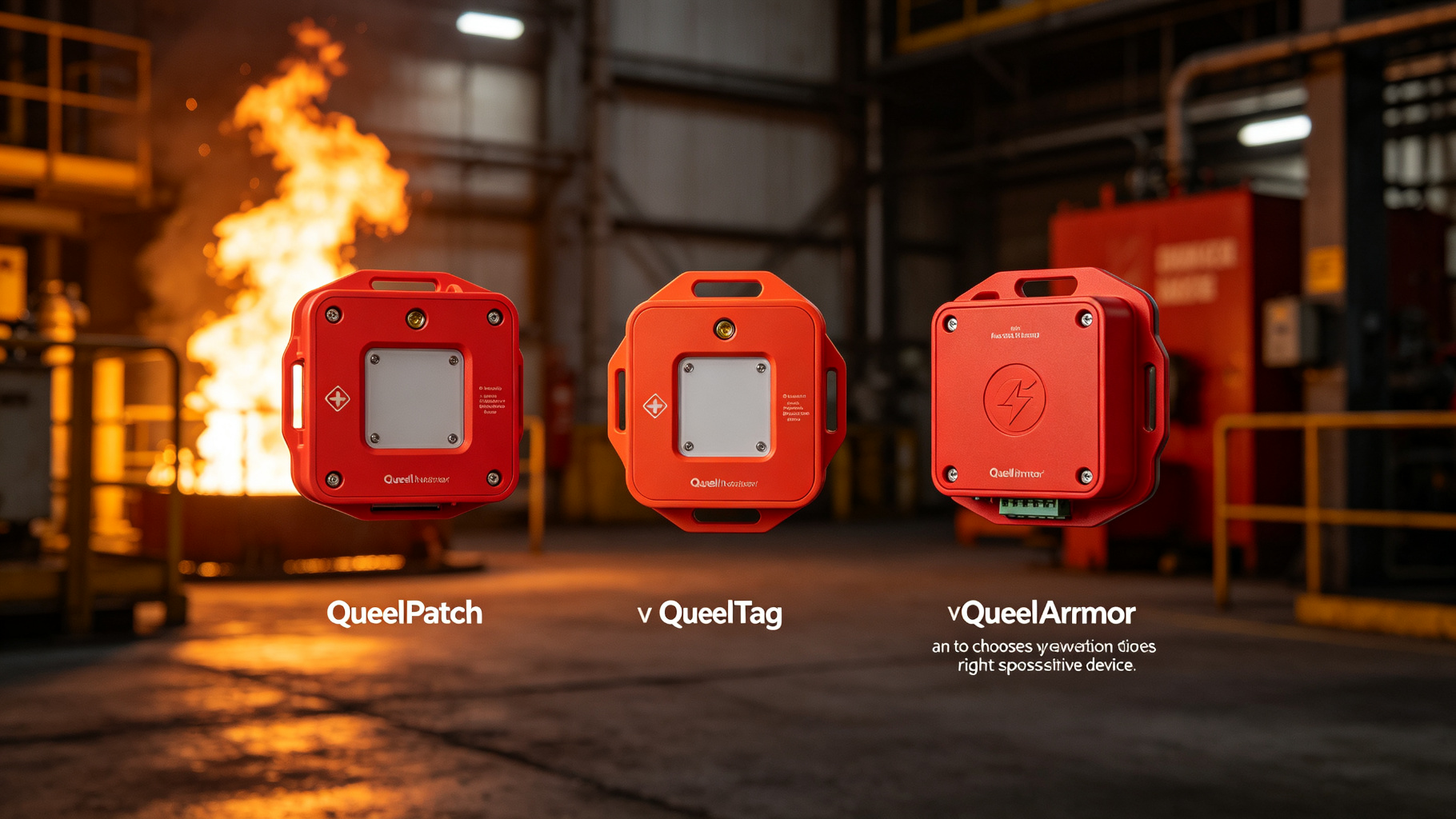
Technical guide on QuellPatch QuellTag QuellArmor for electrical fire protection
Choosing between QuellPatch, QuellTag, and QuellArmor can feel overwhelming, but the decision narrows to three variables: cabinet volume, fire risk profile, and installation constraints. Each product uses the same heat-activated chemistry, yet their form factors—flexible sheets, adhesive tags, or rigid armor—determine where and how they fit your electrical assets.
Electrical infrastructure fires often develop inside enclosed or semi-enclosed spaces: low-voltage distribution panels, UPS cabinets, PLC compartments, battery modules, cable junction boxes, and small switchgear compartments. In these locations, a passive suppression device can discharge clean agent directly at a heated fault before a flame becomes fully established. FIREQUELL’s three device families—QuellPatch, QuellTag, and QuellArmor—all use microencapsulated FK-5-1-12 clean agent and passive thermal activation, but they differ in agent loading, form factor, durability, mounting method, and intended enclosure volume.
Choosing among them is not a matter of selecting a single universal product. The correct device depends on the protected volume, expected ambient temperature, fault temperature, enclosure leakage, mechanical exposure, available mounting surface, and inspection access. This article compares the three families on engineering grounds and provides a structured basis for passive device selection.
Each product contains FK-5-1-12, a clean agent that is electrically nonconductive, leaves no residue, and has zero ozone depletion potential. Rather than storing the agent in a pressurized cylinder, FIREQUELL devices hold it in microencapsulated form within a polymer carrier. The capsules remain sealed under normal conditions. When the local temperature reaches the rated activation point, the capsule material softens or ruptures, releasing FK-5-1-12 vapor directly into the heated zone.
Because activation is thermal and passive, the devices do not require external power, fire detectors, control panels, or piping. Response is localized: the device nearest the overheating component generally discharges first. The tradeoff is that passive devices are not equivalent to engineered total-flooding systems. Their performance is sensitive to enclosure volume, air leakage, ventilation, and placement relative to the fault.
The three product families are differentiated by four practical variables: agent mass, physical size, mechanical protection, and activation temperature. A small QuellTag cannot deliver enough agent for a large panel compartment. A flexible QuellPatch may not survive high-vibration or abrasive environments. A QuellArmor unit may be unnecessarily large for a compact PLC module. The selection process should therefore begin with the enclosure geometry and hazard, not with the device itself.
QuellPatch is a flexible, laminated patch intended for flat interior surfaces such as panel doors, side plates, and equipment covers. A typical unit measures approximately 120 × 120 × 3 mm and contains about 35 g of microencapsulated FK-5-1-12. It is installed with a pressure-sensitive acrylic adhesive and is designed for nominal local volumes of approximately 0.03–0.07 m³ per patch, depending on enclosure leakage and device placement.
The standard QuellPatch activation temperature is 80°C, making it suitable for climate-controlled or indoor electrical spaces where normal ambient temperatures remain below approximately 50–60°C. It can also be specified with 140°C or 180°C activation for compartments that run warm under normal operation. Typical applications include low-voltage distribution panels, UPS cabinets, server-room subpanels, and control enclosures with clean, flat mounting surfaces.
QuellTag is a compact, rigid tag designed for restricted spaces and irregular mounting surfaces. A typical unit measures approximately 70 × 50 × 5 mm and contains about 15 g of microencapsulated FK-5-1-12. It can be secured with an integrated cable tie, magnetic mount, or mechanical fastener, depending on the variant. Its nominal protected volume is approximately 0.01–0.03 m³ per unit.
QuellTag is commonly specified with 140°C activation, reflecting its use in cable compartments, industrial control gear, and equipment where normal surface temperatures may exceed those in an office-grade panel. The 80°C and 180°C activation options are available for lower- or higher-ambient locations. Typical applications include cable bundles, PLC modules, small junction boxes, battery management compartments, and areas where adhesive patches cannot conform to the available surface.
QuellArmor is a mechanically reinforced device for harsher environments. A typical unit measures approximately 180 × 180 × 8 mm and contains about 75 g of microencapsulated FK-5-1-12. Its carrier includes a stainless steel mesh or similar reinforcing layer, and it is intended for screw or rivet mounting rather than adhesive-only attachment. Nominal local volume is approximately 0.06–0.15 m³ per unit.
The standard QuellArmor activation temperature is 180°C, which is appropriate for high-ambient industrial compartments, outdoor cabinets, and equipment where normal operating surfaces may reach elevated temperatures. A 140°C option is available for less severe locations. Typical applications include heavy-industry motor control centers, outdoor telecom or power cabinets, high-vibration machinery compartments, and dusty environments where a flexible patch could be abraded or dislodged.
The first selection check is volume. The nominal volumes above assume that the device is placed within approximately 300 mm of the likely fault location and that the enclosure is not heavily ventilated. Large door gaps, cooling fans, filtered vents, and open cable penetrations reduce agent retention and may require additional units or a different suppression approach.
For small compartments, a single QuellTag may be sufficient. For medium-sized panel interiors, one or more QuellPatch units may be appropriate. For larger or more mechanically severe compartments, QuellArmor provides higher agent loading and more robust mounting. If the enclosure is large, open, or subject to continuous forced ventilation, these passive devices should generally be treated as localized first-line protection rather than as a substitute for an engineered total-flooding system.
All three families can be specified with 80°C, 140°C, or 180°C activation. The selected temperature should provide a margin above the maximum normal ambient or surface temperature at the mounting location. A common engineering approach is to select an activation temperature at least 20–30°C above the highest expected normal temperature at the device surface.
Selecting too low an activation temperature can increase the risk of premature discharge during normal operation. Selecting too high a temperature may delay agent release until a fault has grown beyond its incipient stage.
QuellPatch requires a relatively clean, flat, rigid surface for adhesive bonding. It is not well suited to oily surfaces, rough concrete, or locations subject to repeated impact. QuellTag is more adaptable to curved or irregular surfaces and can be attached directly to cable runs or small modules. QuellArmor is preferred where vibration, abrasion, dust, UV exposure, or mechanical contact could damage a flexible patch.
Electrical clearance must also be maintained. None of the devices should be installed where they can contact live buswork, moving parts, or heat sinks that exceed the chosen activation temperature under normal operation. Mounting hardware should be selected to avoid creating new ground paths or reducing creepage and clearance distances.
For panel applications, QuellPatch is commonly mounted on the interior door or side wall facing breaker terminals, bus connections, or control transformers. QuellTag is often placed near cable terminations, PLC power supplies, or battery module terminals. QuellArmor is typically mounted on a rigid panel wall or frame in larger compartments. Devices should not be painted, coated, or covered with insulation, because doing so can alter heat transfer and activation behavior.
When multiple units are required, they should be distributed so that each high-risk component is within the effective range of at least one device. For long cable runs or vertical cable compartments, QuellTag units are commonly spaced at intervals of approximately 0.5–1.0 m, with closer spacing near terminations and splices.
All three products have a 5-year service life from the date of manufacture under normal specified storage and operating conditions. This period reflects aging of the microcapsule polymer, adhesive, and carrier materials. Annual visual inspection is recommended to verify that the device is still securely mounted, has not been physically damaged, and shows no signs of unintended release or degradation.
Units that have discharged, been exposed to temperatures above their rating, or reached their 5-year service life should be replaced. Expired or discharged devices should be removed and disposed of in accordance with local waste regulations for fluorinated materials and electronic hardware.
QuellPatch, QuellTag, and QuellArmor share the same passive FK-5-1-12 suppression principle but are intended for different engineering conditions. QuellPatch is appropriate for flat, clean surfaces in indoor panels and medium-sized compartments. QuellTag is suited to compact spaces, cable bundles, and irregular surfaces where a small, mountable device is needed. QuellArmor is designed for larger compartments and harsher mechanical or thermal environments.
Product comparison should focus on protected volume, leakage, activation temperature margin, mounting surface, and durability. The 80°C, 140°C, and 180°C activation options allow the devices to be matched to normal operating temperatures while preserving response to incipient overheating. When selected and placed correctly, these passive devices can provide localized suppression in electrical enclosures as part of a broader fire-protection program.
A: No. These are localized passive devices intended for small enclosures or specific fault points, not substitutes for code-required automatic sprinklers, fire detection, alarm systems, or engineered total-flooding systems. They are typically used to supplement broader protection by targeting high-risk components such as terminal blocks, relays, drives, or busbar connections. System design must follow applicable NFPA, local code, and insurer requirements.
A: Select a rating at least 20–30°C above the highest normal surface or air temperature at the mounting location to avoid nuisance activation. Use 80°C for controlled indoor spaces with normal ambient temperatures, 140°C for typical industrial compartments or warmer equipment locations, and 180°C only where high operating temperatures are expected. The goal is fast response to abnormal heating without activating under normal service conditions.
A: All three use the same passive thermal principle: microencapsulated FK-5-1-12 releases when the device reaches its rated temperature. The difference is form factor and target application: QuellPatch is a flexible patch for panels or component surfaces, QuellTag is a compact tag-style device for localized fault points, and QuellArmor is built for more robust coverage or higher-mechanical-protection applications. Selection should be based on enclosure size, mounting location, protected component, ambient heat, and required coverage area.
A: Do not size these devices like a total-flooding clean-agent system using room volume and a uniform NFPA 2001 concentration. They are localized products, so selection depends on the target fault point, device coverage area, mounting position, heat exposure, and enclosure geometry rather than total cabinet volume alone. For larger enclosures or multiple high-risk components, use multiple devices located at the specific hazards and follow the published engineering selection guidance.
A: Suitability depends on the specific product rating, ambient temperature range, moisture, chemical exposure, UV exposure, and mechanical conditions. The standard 5-year service life is based on specified indoor conditions, so harsh or outdoor applications require verification before installation. Choose the activation rating carefully for high-temperature locations and inspect devices more frequently where dust, oil, vibration, or weather may affect them.
FIREQUELL QuellPatch delivers automatic, maintenance-free clean-agent protection for electrical panels, battery cabinets and control rooms — designed to meet FM Approved, UL Listed, CE and UKCA requirements.
Request a Site Assessment