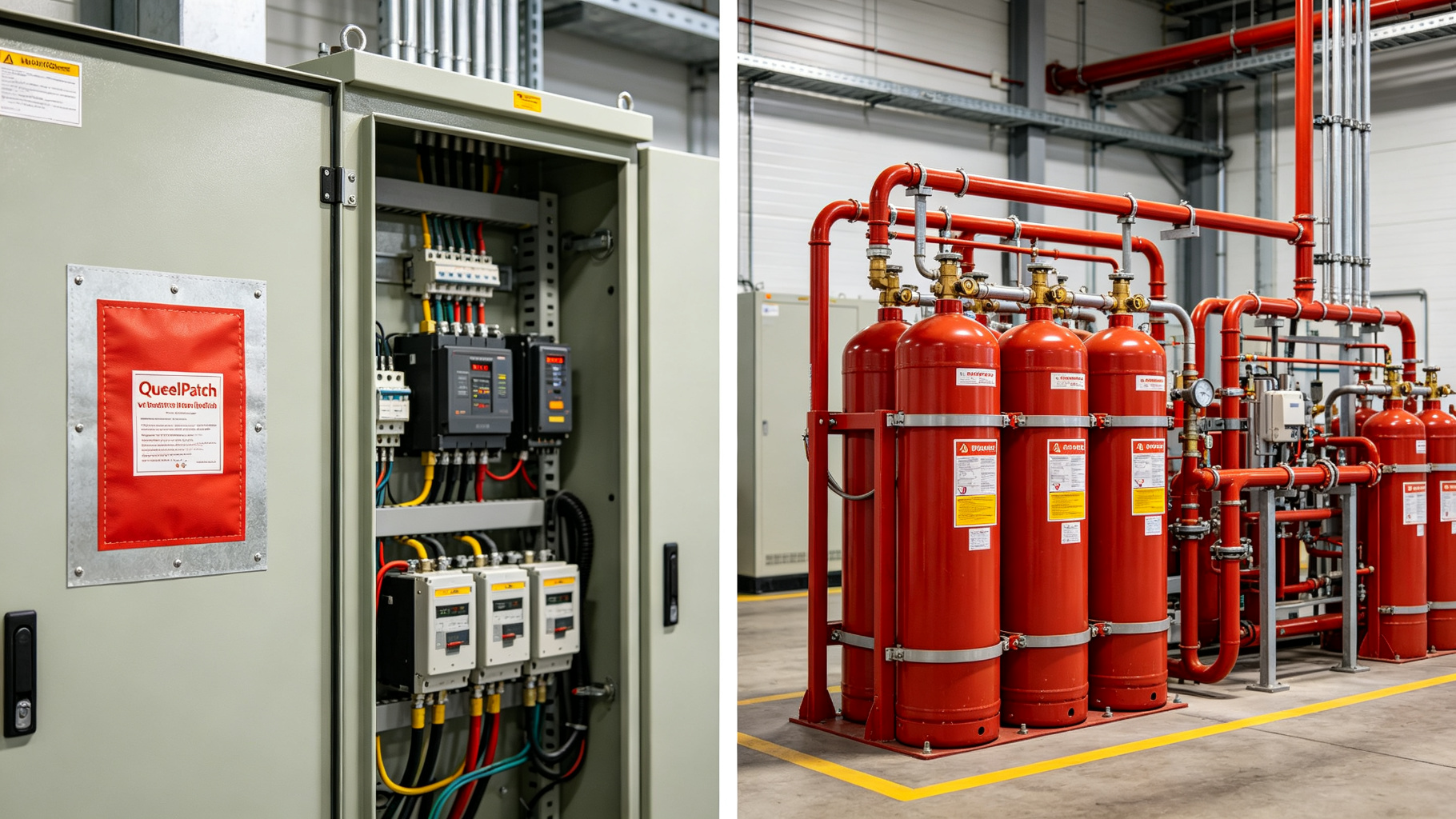
Technical guide on QuellPatch comparison for electrical fire protection
Traditional fire suppression in electrical cabinets often means clean agent systems that require cylinders, piping, and annual recharging—costs that add up over a system's 20-year lifespan. QuellPatch, by contrast, installs in minutes with no plumbing and no pressurized gas, prompting a direct comparison of upfront price versus long-term reliability.
Electrical infrastructure fires present a difficult suppression problem: ignition often begins inside sealed cabinets, cable compartments, busways, or motor-control-center buckets where a detector may be slow to respond and where water or residue can create costly secondary damage. FIREQUELL’s QuellPatch product line approaches this hazard differently from traditional suppression by placing a passive clean-agent source directly at or near the expected point of ignition. This QuellPatch comparison examines the engineering differences between patch-based point protection and traditional suppression, including activation logic, agent delivery, installation constraints, reliability, and maintenance. The goal is not to declare one approach universally suitable for every facility, but to provide a technical basis for a fire suppression comparison that matches the protection method to the hazard geometry, ambient conditions, and operational risk.
QuellPatch uses microencapsulated FK-5-1-12 clean agent contained in a flexible patch assembly. The agent is not stored in a pressurized cylinder; instead, individual microcapsules and the patch structure respond to heat. When the local temperature reaches the rated activation threshold, the capsule material and patch seal weaken, allowing the FK-5-1-12 to discharge as a vaporizing liquid. Because FK-5-1-12 has a boiling point near 49°C, it vaporizes rapidly after release and can interact with the flame zone through chemical interruption of the combustion chain reaction, along with a limited cooling effect.
The product line is offered with activation temperatures of 80°C, 140°C, and 180°C. These thresholds allow the patch to be matched to the normal operating temperature of the equipment:
Passive thermal activation means no external power, detector, control panel, or releasing circuit is required for the patch to operate. The tradeoff is that activation depends on heat reaching the patch itself; placement relative to the likely fire location is therefore a central design variable.
Traditional clean-agent systems typically use smoke or heat detectors connected to a releasing control panel. For electrical rooms, aspirated smoke detection or spot-type smoke detectors may provide early warning, while heat detectors may be used where smoke detection is impractical. To reduce false discharges, many systems require cross-zoned or coincident detection before agent release. Once the releasing sequence starts, stored FK-5-1-12 or another clean agent is discharged through piping and nozzles, often within approximately 10 seconds for listed total-flooding systems.
Sprinkler systems, by contrast, usually activate through individual fused links or glass bulbs at a rated temperature and deliver water to the surrounding area. They are effective at controlling fire spread across a room, but their response is tied to heat reaching the sprinkler head and their discharge may not occur until the fire has grown beyond the originating component. In both clean-agent and sprinkler installations, the trigger is separated from the ignition point by detection spacing, ceiling height, airflow, and equipment enclosure geometry.
A key distinction in a patch vs system comparison is how the agent reaches the flame. QuellPatch releases agent locally, inside or immediately adjacent to the protected sub-enclosure. There is no piping run, nozzle, or pressure drop between the agent storage and the fire. Microencapsulation also allows the agent charge to be distributed across multiple patches, so a single overheated component can activate only the nearest patch rather than discharging an entire building zone.
Because each patch contains a finite agent mass, performance depends on correct sizing for the protected volume. In a small, relatively sealed compartment, local discharge can develop an effective FK-5-1-12 concentration near the fire quickly. In an open, ventilated, or large volume, agent may dilute before reaching the required concentration. Design should therefore consider enclosure volume, leakage around doors and cable penetrations, airflow, and the location of the highest-risk components. The patches are generally intended for point or sub-enclosure protection rather than protection of an entire room.
Traditional clean-agent systems are designed as total-flooding systems. The agent quantity is calculated using the enclosure volume, and piping and nozzles are arranged to achieve a uniform design concentration throughout the protected space. For FK-5-1-12 systems, typical design concentrations for electrical hazards often fall in the range of 4.5% to 6.0% by volume, depending on the hazard classification, listing, and applicable standard. The system must also maintain that concentration for a specified hold time, often around 10 minutes, to prevent reflash.
That performance depends on enclosure integrity. Cable penetrations, unsealed openings, ventilation dampers, and door gaps can allow agent to escape. If the protected room contains internal barriers or closed equipment doors, agent may flood the room while reaching a lower concentration inside the specific cabinet where the fire began. Sprinklers avoid the enclosure-integrity issue but introduce water exposure, which can be damaging to electronics, buswork, and adjacent process equipment even when the fire is controlled.
QuellPatch is designed to be mounted inside or on electrical infrastructure, including cabinet interiors, cable compartments, and enclosed equipment sections. Its low profile and lack of pressurized storage reduce the need for pipe supports, nozzle penetrations, or large cylinder cabinets. Installation still requires respect for electrical clearances, creepage distances, and manufacturer equipment warranties. The selected activation temperature must remain above the maximum normal surface and air temperature at the mounting location to avoid unintended discharge.
Traditional suppression has a larger physical footprint. Clean-agent cylinders require wall or floor space, piping must be routed through the facility, and nozzles must be positioned to avoid obstructions. Enclosures may need pressure vents to manage discharge pressure peaks, and ventilation systems may require interlocks to shut down during agent release. These features are appropriate for large rooms, but they can make traditional systems difficult to retrofit into compact or densely arranged electrical equipment.
QuellPatch has a stated service life of 5 years under specified environmental conditions. Routine maintenance is primarily visual: checking for physical damage, adhesion loss, excessive heat exposure, contamination, or tampering. There are no pressure gauges to monitor, cylinders to weigh, or hydraulic piping networks to test. At the end of the service life or after activation, the patch is replaced.
Traditional clean-agent systems require more extensive commissioning and periodic maintenance. Detectors must be tested, control panels and releasing circuits checked, battery backup verified, cylinder pressure monitored, and enclosure integrity assessed. Sprinkler systems require control-valve supervision, gauge inspection, and periodic flow or trip testing. These activities support reliable system operation, but they also create recurring maintenance tasks and can require system impairment during servicing.
The reliability advantage of passive thermal activation is the removal of several external failure modes: power loss, detector contamination, wiring faults, control-panel failure, and solenoid or valve malfunction. A patch can respond even if the facility’s detection system is impaired. Microencapsulation also distributes the agent into small independent units, reducing the chance that a single point of failure disables all protection.
The residual risk is that a patch only activates when sufficient heat reaches it. If a fire starts in a location shielded from the patch, or if airflow moves heat away, activation may be delayed. The finite agent charge also means the patch may not provide an extended concentration hold time. The 5-year replacement interval addresses aging of the microcapsules, adhesive, and patch materials, but storage outside specified temperature or humidity ranges may affect service life.
Traditional systems provide broad coverage and established design methods, but their complexity introduces different vulnerabilities. Detectors can become dirty or be painted over, releasing panels can lose auxiliary power, cylinders can lose pressure, and piping can be obstructed or modified without recalculation. Cross-zoned detection, while useful for preventing false discharges, can delay release if one detector fails to respond. Enclosure leakage can reduce achieved concentration below the design value even if the discharge itself operates correctly.
Water-based sprinklers are mechanically reliable and effective for room-level control, but they may not suppress a fire inside a closed cabinet before significant equipment damage occurs. Clean-agent systems can also generate discharge noise and pressure transients, and post-fire refilling involves cylinder removal and recharge costs. In a patch vs system evaluation, these factors should be weighed against the need for room-scale protection and extended hold time.
This QuellPatch comparison shows that patch-based protection and traditional suppression address different parts of the fire-protection problem. QuellPatch places microencapsulated FK-5-1-12 directly at the hazard, uses passive thermal activation at 80°C, 140°C, or 180°C, and offers a 5-year service life with minimal infrastructure impact. It is particularly relevant for small, enclosed electrical compartments where local discharge can reach a fire before it spreads beyond the component of origin.
Traditional suppression remains appropriate for larger rooms, mixed hazards, and applications requiring a verified uniform concentration and extended hold time. A complete fire suppression comparison should consider enclosure volume, leakage, airflow, normal operating temperatures, maintenance resources, and the consequences of both fire and agent discharge. In many facilities, the most defensible approach is not a simple replacement of one method with the other, but a layered design that uses QuellPatch for point protection within equipment while retaining traditional systems where room-scale coverage is required.
A: Usually not by itself. QuellPatch is intended for localized protection inside equipment or sub-enclosures, while NFPA 2001 or local code may still require a total-flooding FK-5-1-12 system for room-level hazards. Any substitution or equivalency must be evaluated by a qualified fire protection engineer and approved by the authority having jurisdiction.
A: Select the activation temperature based on the maximum normal air and surface temperature at the mounting location, with a safety margin above routine operating conditions. The 80°C patch is commonly used in normal ambient electronics enclosures, the 140°C version where equipment runs warm, and the 180°C version in high-heat compartments where lower-rated patches could nuisance-activate.
A: No. The 5-year service life refers to the expected usable service period under specified conditions, but NFPA, IEC, and site reliability programs still require periodic visual inspection, condition checks, and replacement if the patch is damaged, activated, or exposed beyond rated limits. For critical B2B assets, best practice is to inspect QuellPatch during routine preventive maintenance and document condition per the manufacturer’s instructions.
A: QuellPatch is designed for localized, point-source suppression within equipment or sub-enclosures rather than a uniform room-level design concentration. For reference, NFPA 2001 FK-5-1-12 total-flooding designs commonly use roughly 4.5% to 5.9% by volume for Class A and Class C hazards and higher percentages for some Class B fuels, but actual QuellPatch effectiveness depends on enclosure size, leakage, fire location, and mounting. A fire protection engineer should verify coverage for the specific hazard.
A: QuellPatch is commonly applied inside electrical cabinets, server enclosures, battery compartments, and similar sub-enclosures where a compact local suppression device is needed, but project specifications should verify the exact UL, ULC, or other certification status for the selected model. Electrical and control-room designs may also need to align with NFPA 70, NFPA 75, NFPA 2001, or IEC-based requirements depending on the facility and authority having jurisdiction. Certification alone does not eliminate the need for correct placement, activation-temperature selection, and engineering review.
FIREQUELL QuellPatch delivers automatic, maintenance-free clean-agent protection for electrical panels, battery cabinets and control rooms — designed to meet FM Approved, UL Listed, CE and UKCA requirements.
Request a Site Assessment