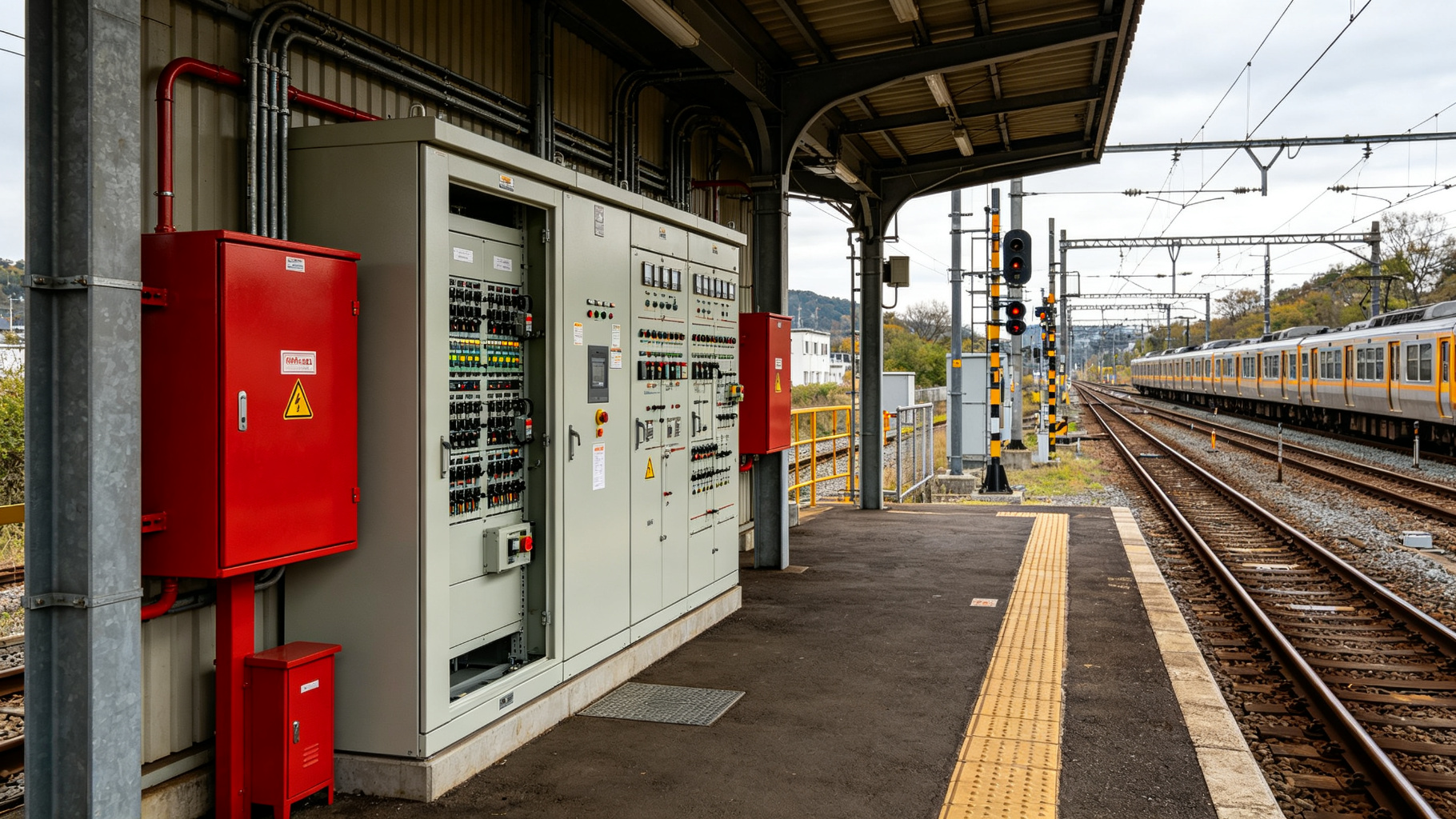
Technical guide on railway signal fire for electrical fire protection
A railway signal cabinet sits trackside, exposed to vibration, temperature swings, and vandalism—yet a fire there can halt train traffic for hours and cost thousands in delays. With no power source or external triggering available, passive suppression patches are emerging as the go-to solution, but their effectiveness depends on proper sizing and placement within the cabinet.
Railway signal cabinets contain interlocking, control, communication, and power equipment that directly affects train separation, switch operation, and grade-crossing logic. A railway signal fire starting in a terminal block, power supply, or backup battery can disable a block section before smoke reaches a detector. Many cabinets are unattended and located along right-of-way, on elevated structures, or in tunnels, so response times can be long and an incipient fault can become a service-disruption event.
Transit fire protection has historically relied on room-level gaseous systems, portable extinguishers, or smoke detection. Cabinet-level rail suppression is increasingly used as a first line of defense because it acts where the fire starts, without waiting for detection-to-discharge sequencing. The QuellTag product line uses passive, clean-agent patches containing FK-5-1-12 to provide localized suppression within signal cabinets. This article reviews the technical requirements for selecting, applying, and maintaining those patches.
Signal cabinets contain mixed-voltage equipment, including 24–110 V DC control circuits, 230/400 V AC feeders, relays, contactors, surge protectors, PLCs, and backup batteries. Common ignition mechanisms include loose or corroded terminals producing resistive heating, arcing from damaged wiring, failed capacitors, overloaded power supplies, and battery faults. Local arc temperatures can ignite nearby insulation even when upstream overcurrent protection operates.
The fuel load is modest but continuous: PVC and XLPE cable insulation, terminal blocks, polycarbonate covers, phenolic circuit boards, conformal coatings, labels, and battery cases. In an enclosed cabinet, flame spread may initially be slow, but heat can accumulate and cause cascading failure. Cable penetrations also allow smoke and hot gases to migrate into adjacent cabinets or ductwork.
Wayside cabinets experience vibration from train passage, thermal cycling, humidity, dust, and occasional water intrusion. Ambient temperatures may range from below -20°C to above 45°C, and solar loading can raise internal temperatures well above ambient. Tunnel cabinets may see high continuous temperatures and restricted access. Because maintenance windows are short, a passive device with no external power requirement and a defined service interval can be easier to sustain across a distributed network.
FK-5-1-12 is a fluorinated ketone clean agent that is electrically nonconductive and leaves no measurable residue after discharge. It has a short atmospheric lifetime and low global-warming potential relative to older halocarbon agents. For electrical hazards, design concentrations are typically 4.5% to 6% by volume, although local application within a cabinet may produce higher transient concentrations near the discharge point. The agent is compatible with most common cabinet materials, but testing is recommended for unusual connector plastics or legacy cable jackets.
QuellTag patches use passive thermal activation. The FK-5-1-12 is held in microencapsulated polymer shells. When local temperature reaches the rated activation point, the shells soften and internal pressure causes rupture, releasing agent directly over the protected area. No detector, control panel, or external power supply is required.
QuellTag patches are available with nominal activation temperatures of 80°C, 140°C, and 180°C. An 80°C patch may suit climate-controlled equipment rooms or low-power cabinets; a 140°C patch is generally appropriate for most wayside signal cabinets; an 180°C patch is intended for high-ambient tunnel, roof-mounted, or heat-exposed enclosures. A practical margin should be maintained between the activation rating and the maximum expected surface or air temperature under worst-case normal conditions.
Signal cabinets are not sealed test enclosures. Ventilation openings, gaskets, cable glands, and fans allow agent to escape. A patch can suppress a fire at its source, but it cannot be expected to maintain a uniform total-flooding concentration in a leaky enclosure. Design should treat patches as local-application devices positioned over high-risk components. Cabinet volume, leakage area, fan operation, and ignition location all influence performance, so placement should be validated by testing or supplier modeling representing the actual enclosure.
QuellTag patches are typically mounted on interior panels, cabinet roofs, or equipment doors directly above high-risk components. Priority locations include power supplies, DC/DC converters, terminal strips, contactors, relay banks, surge protectors, and battery compartments. Patches should not block ventilation, maintenance access, or indicator lamps and should be positioned so released agent can reach the likely flame zone without being deflected by cable bundles.
Coverage depends on patch size, cabinet geometry, and leakage. As a planning-level reference, a single patch may be considered for localized zones on the order of 0.2 to 0.5 m³ in partially ventilated enclosures, but large or high-risk cabinets may require multiple units. Final layout should follow the supplier application guide and, where available, cabinet-specific fire testing.
Railway cabinets experience repeated vibration and thermal cycling. Patches should be secured using the specified adhesive and mechanical fasteners where provided; adhesive alone may not be sufficient for long-term wayside service. Mounting surfaces must be clean, dry, and within the recommended temperature range during installation. Because QuellTag patches are passive, they do not connect to the signal system or fire alarm panel, but they can be used alongside detectors, remote monitoring, and automatic power shutdown.
Railway fire protection may reference EN 45545, NFPA 130, and local authority requirements. Clean-agent systems are often evaluated against ISO 14520 or NFPA 2001, but cabinet-mounted patches are local-application devices and may not fall within total-flooding system standards. Agencies should request test data replicating signal cabinet conditions, including enclosure volume, ventilation, vibration, thermal aging, and representative electrical ignition sources. For QuellTag, relevant evidence includes verification of activation at 80°C, 140°C, or 180°C, agent distribution, material compatibility, and performance after environmental cycling.
QuellTag patches have a specified service life of 5 years under intended operating conditions. Inspections should occur during normal signal maintenance or at least annually, verifying presence, secure mounting, and absence of damage, discoloration, or obstruction. Patches should also be inspected after extreme thermal events, major vibration incidents, or cabinet modifications. Units that have activated, show damage, or exceed 5 years should be replaced. Unlike pressurized cylinders, patches do not require pressure gauges or hydrostatic testing, but they still require documented lifecycle management.
Cabinet-level patches do not replace code-required detection, room suppression, ventilation control, or electrical preventive maintenance. A fire that spreads beyond the protected component or involves large cable quantities outside the cabinet may exceed patch capacity. QuellTag should be treated as one element of a rail suppression strategy that includes housekeeping, infrared inspection, power shutdown coordination, and emergency response procedures.
Railway signal cabinet fires combine electrical ignition sources, unattended operation, distributed locations, and tight maintenance windows. Passive clean-agent patches can provide localized suppression at the point of ignition, but performance depends on correct temperature rating, placement, and lifecycle management. FK-5-1-12 offers electrical compatibility and clean discharge, while microencapsulation and passive thermal activation allow operation without external power or controls. For most wayside applications, 140°C QuellTag patches provide a practical balance between response speed and resistance to normal thermal loading, with 80°C and 180°C variants for controlled or high-ambient environments. When applied as part of a maintained transit fire protection program, these patches can reduce the likelihood that a component-level fault develops into a major railway signal fire.
A: Choose the activation temperature above the highest normal air and surface temperature inside the cabinet, typically with a 20–40°C margin to prevent nuisance activation. The 140°C QuellTag is commonly used for wayside signal cabinets, while 80°C is suited to cooler, densely packed electronics and 180°C to high-heat or solar-exposed enclosures. Verify the selected rating against measured operating temperatures and the cabinet’s thermal profile before installation.
A: No. FK-5-1-12 is electrically nonconductive, evaporates cleanly, and leaves no residue, so it will not short-circuit boards, corrode contacts, or require cleanup after discharge. It is widely used for protecting electronic equipment and is compatible with common signal-cabinet materials, although unusual plastics, labels, or legacy components should be checked against the manufacturer’s compatibility guidance.
A: Railway signal cabinets can commonly reach 50–70°C internally from equipment load, and solar-exposed wayside enclosures may run hotter, with hotspots near power supplies or relays exceeding normal ambient conditions. This matters because suppression devices must activate reliably during a real fire while avoiding nuisance discharge caused by normal operating heat. QuellTag patches are therefore selected with an activation rating safely above measured peak temperatures.
A: Cabinet-level clean-agent systems should be evaluated against recognized standards such as NFPA 2001 for clean agent fire extinguishing systems and UL/ULC listing or equivalent third-party performance validation. Electrical safety and equipment compatibility may also be assessed under relevant IEC or local rail-industry requirements. For rail projects, specifiers should confirm that the installed device, agent, and enclosure configuration match the tested and listed arrangement.
A: QuellTag patches are designed for long, maintenance-free service, typically offering a 5-year service life in normal indoor or wayside cabinet conditions when installed per manufacturer guidance. Routine maintenance consists of visual inspection during normal signal-asset checks to confirm the patch is undamaged, securely mounted, and not exposed to abnormal heat or contamination. Replacement is required after activation, physical damage, or at the end of the rated service interval.
FIREQUELL QuellPatch delivers automatic, maintenance-free clean-agent protection for electrical panels, battery cabinets and control rooms — designed to meet FM Approved, UL Listed, CE and UKCA requirements.
Request a Site Assessment