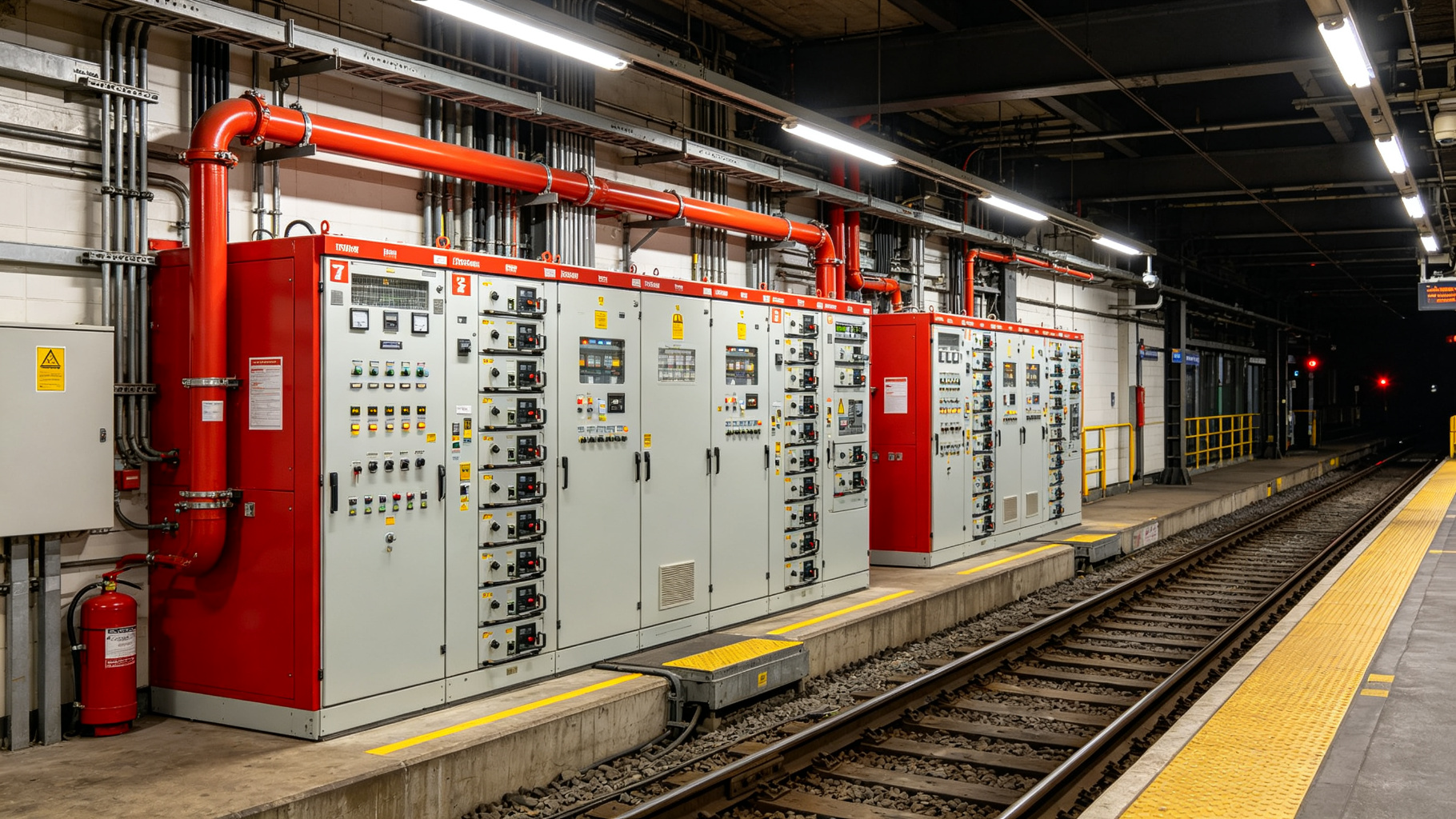
Technical guide on railway case study for electrical fire protection
When a traction power substation fault arcs across a DC bus, temperatures can exceed 5,000°C in milliseconds—long before a human responder can act. That's why railway operators are moving beyond detection-only strategies. This case study examines how electrical fire protection systems are engineered for rail environments, where vibration, dust, and high-voltage DC demand more than a generic solution.
Distributed trackside signal cabinets represent a high-value, high-risk asset class for passenger and freight rail operators, as unplanned electrical fires in these enclosures can trigger extended service disruptions, create signal failure risks for passing trains, and require costly replacement of specialized control hardware. This railway case study documents a 12-month transit fire protection trial conducted on a 92 km regional commuter rail network in Central Europe, where 42 wayside signal cabinets were fitted with QuellTag passive clean-agent suppression patches as part of a targeted risk reduction program. The rail deployment was designed to address gaps in existing fire protection for remote, intermittently monitored enclosures, where traditional piped suppression systems and manual response were associated with high maintenance costs and long incident response times. This analysis presents site-specific risk data, system design parameters, in-service performance results, and lifecycle cost comparisons from the trial.
Pre-deployment risk audits reviewed three years of incident logs across the network, identifying three confirmed thermal events in signal cabinets linked to loosened 400V AC copper terminal lugs, which generated resistive heating sufficient to ignite adjacent PVC cable insulation. Onboard temperature sensor data from fault events recorded hotspot temperatures ranging from 165°C to 210°C at the terminal block prior to insulation breakdown, with an average fault development time of 18 minutes from initial temperature rise to visible flaming. Each cabinet in the trial contained a standard set of components: 24V DC relay banks, 400V AC line filters and power supplies, fiber optic transmission modules, and programmable logic controller (PLC) interlocking hardware, all energized 24 hours per day. Cabinets were spaced at 2.2 km intervals along the route, with 68% of units located in areas with intermittent cellular connectivity for remote fault monitoring.
All trial units were IP55-sealed steel enclosures with external dimensions of 1800 mm x 800 mm x 600 mm, corresponding to an unobstructed internal free volume of 0.62 m³. Access to cabinets required a hi-rail vehicle, with maintenance teams only able to attend during a 4-hour overnight possession window scheduled four nights per week. Traditional total-flooding clean agent systems were evaluated prior to the trial, but were ruled out for most sites due to requirements for pressurized storage cylinders, distribution pipework, annual pressure testing, and hardwired control panels connected to the rail network’s supervisory system. Operators also noted that remote activation of these systems could be delayed or prevented by telecom outages, while dry chemical portable extinguishers mounted outside cabinets could not address incipient fires inside sealed enclosures before significant hardware damage occurred. Operator records indicated that prior signal cabinet fires caused an average of 6.5 hours of unplanned service delay, with associated repair and penalty costs averaging $128,000 per incident.
QuellTag patches use a microencapsulation manufacturing process to suspend FK-5-1-12 clean agent within 200–500 μm thermoplastic polymer shells, coated onto a reinforced self-adhesive polyester substrate. The system operates via passive thermal activation: when local temperatures reach the patch’s rated threshold, the polymer shells soften and rupture, dispensing agent directly at the developing fire seat to interrupt combustion chain reactions without requiring external power, pressure vessels, or control circuitry. Patches are available in three activation temperature ratings: 80°C for enclosures containing low-temperature-rated electronics with low ambient operating temperatures, 140°C for general electrical enclosure use aligned with common PVC insulation ignition thresholds, and 180°C for compartments near heat-generating components where elevated ambient temperatures are common. All variants carry a 5-year service life from installation, with no requirement for intermediate pressure testing or agent sampling. FK-5-1-12 is non-conductive and leaves no residual deposit after discharge, reducing post-event cleanup requirements for sensitive electronic hardware.
Design calculations used a 5.2% v/v FK-5-1-12 design concentration for Class C electrical fires, as specified in NFPA 2001, requiring a total agent mass of 0.74 kg per 0.62 m³ cabinet. Each standard QuellTag patch contains 0.18 kg of encapsulated agent, leading to a specification of five patches per cabinet. Temperature rating selection was matched to compartment conditions: four 140°C rated patches were allocated to AC terminal blocks and DC relay banks, where maximum measured ambient temperatures during summer operation did not exceed 68°C. One 180°C rated patch was installed 150 mm above the cabinet’s 400V line filter resistor, where surface temperatures could reach 95°C during peak load, to reduce the risk of nuisance activation. Patches were mounted to interior cabinet roofs directly above high-risk components, rather than distributed evenly across enclosure walls, to ensure agent was released within the thermal plume of an overheating component for faster suppression response.
Quarterly inspection data collected across all 42 cabinets recorded ambient external temperatures ranging from -22°C during winter months to 41°C during summer heatwaves, with internal cabinet temperatures peaking at 68°C in units exposed to direct midday sun. No nuisance activations were recorded across the trial period, even in cabinets fitted with 140°C rated patches. Trackside vibration levels were measured at 0.8–2.2 g rms across a 10–200 Hz frequency range during train passes, consistent with typical mainline rail operating conditions. Inspections found no adhesive delamination, unintended capsule rupture, or physical degradation of patches over the 12-month monitoring window. Patches also showed no signs of corrosion or moisture ingress following repeated periods of high humidity and driving rain, consistent with the sealed design of the host enclosures.
Seven months into the trial, a cabinet at kilometer post 37.2 developed a resistive fault on a 400V AC neutral terminal lug, which overheated and ignited adjacent cable insulation. Onboard temperature logging showed that the two 140°C patches mounted above the terminal block activated when local air temperature reached 141°C, dispensing agent and suppressing visible flaming within 8 seconds. The cabinet’s fault monitoring system sent an alert to the network control center 2 minutes after activation, and maintenance teams replaced the damaged lug and two activated patches during the next scheduled overnight possession, with no unplanned service disruption. Post-event inspection found heat damage limited to three cable ends within 100 mm of the fault, with no agent residue or damage to adjacent relay modules, fiber optic ports, or PLC hardware. The three remaining patches in the cabinet were inspected post-event and found to retain full agent charge and functional integrity.
The selected QuellTag configuration was tested to meet EN 50155 requirements for trackside electronic equipment, including vibration, thermal cycling, and humidity resistance. The FK-5-1-12 agent used in the patches is recognized for use in electrical hazard suppression under NFPA 2001 and ISO 14520 clean agent standards. As a passive device, the system did not require integration with the rail network’s existing safety instrumented systems, reducing validation requirements for deployment. The 5-year service life of the patches aligns with the operator’s existing 5-year signal cabinet overhaul cycle, allowing replacement to be scheduled during planned maintenance without additional site visits.
Total installed cost for the QuellTag deployment was $185 per cabinet, including materials and 15 minutes of installation labor during a routine inspection. This compared to a quoted cost of $1,240 per cabinet for a conventional piped inert gas suppression system with remote monitoring. Estimated annual maintenance costs for the QuellTag installation were $12 per cabinet, consisting of a visual check integrated into existing quarterly inspection routines, compared to $190 per cabinet annually for pressure testing, leak detection, and control panel calibration required for the piped system. These cost figures are specific to the trial operator’s maintenance schedule and access constraints, and may vary across rail networks with different labor costs or maintenance intervals.
This 12-month railway case study provides field data on the performance of QuellTag passive suppression patches as a transit fire protection solution for distributed signal cabinet assets. The trial found that microencapsulated FK-5-1-12 patches with temperature ratings matched to internal component conditions could withstand trackside temperature extremes and vibration without nuisance activation, while providing rapid suppression of an incipient electrical fire with no unplanned service disruption. The passive thermal activation design eliminated failure points associated with network-connected suppression systems, making the approach suitable for remote cabinets with intermittent connectivity. Additional long-term monitoring across a larger sample of cabinets in varied climate zones is planned to validate performance across the full 5-year service life, and to quantify reductions in incident-related costs over multiple operational cycles. The trial results suggest targeted, component-level patch placement can be a practical component of a layered fire protection strategy for rail signal infrastructure.
A: Yes. QuellTag is installed without drilling, pipework, or electrical disconnection, so self-adhesive patches can be fitted to interior cabinet surfaces during scheduled maintenance windows. This supports retrofit in trackside signal cabinets while minimizing signal downtime and possession requirements.
A: No. Only patches exposed to temperatures at or above their rated activation threshold rupture and discharge. Unaffected patches remain functional after a localized event because FK-5-1-12 is a clean agent that does not leave corrosive or conductive residue on cabinet components.
A: Typical risks include overheating power supplies, relay or terminal failures, short circuits, surge damage, and dust or moisture-assisted tracking in confined enclosures. The case study used site-specific risk mapping to identify high-risk cabinets and place suppression close to likely ignition points.
A: In the 12-month rail program, in-service performance was monitored through visual inspection and status checks during routine maintenance, with patches assessed for adhesion, damage, and activation indication. Because the system is passive, it does not require powered detection panels or continuous control wiring inside each cabinet.
A: QuellTag can support compliance when selected and installed as part of a documented fire-risk assessment aligned with applicable enclosure, rail, and electrical safety requirements. The case study assessed whole-lifecycle cost by reducing cabinet downtime, avoiding pipework or electrical retrofit, and limiting post-fire cleanup because FK-5-1-12 leaves no residue.
FIREQUELL QuellPatch delivers automatic, maintenance-free clean-agent protection for electrical panels, battery cabinets and control rooms — designed to meet FM Approved, UL Listed, CE and UKCA requirements.
Request a Site Assessment