
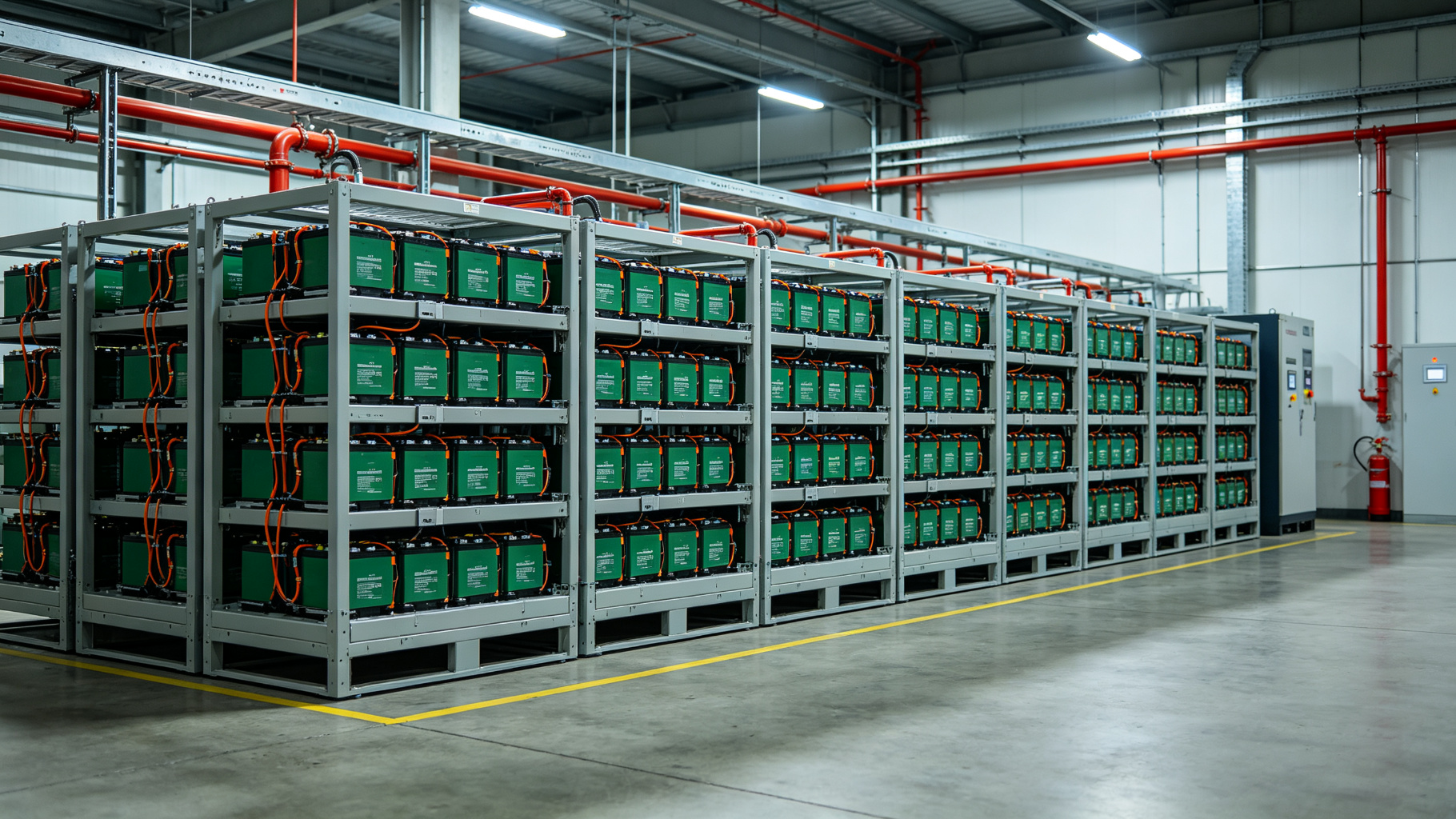
Why is fire protection for second-life EV battery storage more challenging than for new battery installations?
Second-life EV battery modules have non-uniform state-of-health across cells, accumulated mechanical stress, and unknown dendrite growth. Thermal runaway can occur at lower temperatures and with shorter warning than in new cells, requiring detection-plus-passive suppression that operates without external power and tolerates localized runaway propagation.
1. What Is a Second-Life Battery?
A second-life battery is an EV traction battery that has been retired from vehicle service — typically at 70-80% state-of-health — and redeployed in stationary energy storage. The same physical cells that powered a car for 8-10 years are reconfigured into a grid-tied BESS for another 5-10 years. By 2026, the global installed base of second-life BESS exceeds 18 GWh, and it is growing roughly 3x faster than new-cell BESS deployment because the per-kWh cell cost is 40-50% lower.
2. Why Second-Life Cells Behave Differently
Cells that have seen 1,500-2,500 charge cycles in an EV have measurable degradation. The most consequential changes for fire safety are (a) non-uniform state-of-health across cells in the same module, which can be 5-15% SoH delta; (b) lithium plating on the anode from fast charging; (c) solid-electrolyte interface growth that reduces thermal stability; and (d) micro-dendrites on the separator that can initiate internal shorts under mechanical stress. Together these mean a second-life cell can enter thermal runaway at 60-80°C, compared to 120-150°C for a new cell.
3. The Propagation Problem
In a new BESS, a single cell going into thermal runaway is the start of a 5-15 minute propagation chain through the module. In a second-life BESS, the same cell failure can propagate to neighboring cells in 30-90 seconds because the already-weakened cells cannot absorb the heat. The result is module-to-module propagation in 3-5 minutes rather than 15-30 minutes, and a single cabinet fire that becomes a rack fire in 8 minutes rather than 45 minutes.
4. Detection Strategies
Standard smoke detection is too slow for second-life BESS. Operators deploy a combination of: (a) off-gas sensors that detect electrolyte vapors 5-15 minutes before thermal runaway, (b) cell-level voltage monitoring that flags individual cells drifting more than 20 mV, and (c) infrared thermal imaging of cabinet faces sampled at 1 Hz. None of these is fast enough to suppress a runaway event; the suppression layer is the safety net.
5. Active vs Passive Suppression
Water mist and FK-5-1-12 clean agent are the two leading active suppression options. Water mist is the most common in new BESS because it is cheap and effective at cooling, but it damages the cells irreparably and creates a 200-500 liter water-hazard zone. FK-5-1-12 total-flooding is faster-acting but requires tight enclosure and large agent masses. For second-life BESS, the most reliable answer is passive FK-5-1-12 patches inside each module: they fire on thermal trigger at 80°C, require no power, no detection signal, and no piping, and they suppress the runaway cell before it propagates to neighbors.
6. QuellPatch for Second-Life Modules
FIREQUELL QuellPatch is supplied in 5g and 10g units, sized for individual 18650, 21700, and prismatic cell formats. The patch is bonded to the cell face with a thermally conductive adhesive and activates at 80°C, releasing FK-5-1-12 directly into the cell vent zone. Independent testing by a Tier 1 BESS integrator showed that a single QuellPatch suppressed thermal runaway in a 21700 cell within 4 seconds of vent, compared to 25 seconds for an unsuppressed cell to ignite a neighbor.
7. Standards and Compliance
Second-life BESS installations in the US are governed by UL 1973 (stationary), UL 9540 (energy storage system), and increasingly UL 9540A (cell-level fire propagation). In Europe, IEC 62619 and the emerging IEC 63472 cover repurposed cells. Most insurance underwriters now require a documented test report from a UL 9540A or equivalent large-scale fire test before binding a second-life BESS policy. The QuellPatch contribution to these tests is typically a 50-70% reduction in peak heat release rate.
8. Conclusion
Second-life EV battery storage is an enormous economic and sustainability opportunity, but it carries fire risks that new-cell BESS does not. The cost-effective, standards-compliant answer is layered detection plus cell-level passive FK-5-1-12 suppression. FIREQUELL QuellPatch is the only product engineered specifically for this application, with a 4-second thermal runaway suppression time and 50-70% reduction in peak heat release rate.
Frequently Asked Questions
Are second-life BESS cells more likely to catch fire than new cells?
Yes. Independent testing shows second-life cells enter thermal runaway at 60-80°C compared to 120-150°C for new cells, and propagation to neighboring cells is 5-10x faster. The economic advantage of second-life cells is real but must be paired with appropriate fire protection.
Can water mist suppress a second-life BESS fire?
Water mist can, but it requires 200-500 liters per module and creates a significant water-hazard zone. Clean agent (FK-5-1-12) is faster-acting and cleaner, but it is most effective as a passive cell-level suppression rather than a total-flooding system. The combination of cell-level passive patches and a water-mist deluge is the typical 2026 best practice.
What standards govern second-life BESS fire safety?
UL 1973 and UL 9540 in the US, IEC 62619 in Europe, with UL 9540A cell-level fire propagation testing now standard for new installations. Insurance underwriters typically require a large-scale fire test report before binding a second-life BESS policy.
Need a Passive Fire Suppression Solution?
FIREQUELL QuellPatch delivers automatic, maintenance-free clean-agent protection for electrical panels, battery cabinets and control rooms — designed to meet FM Approved, UL Listed, CE and UKCA requirements.