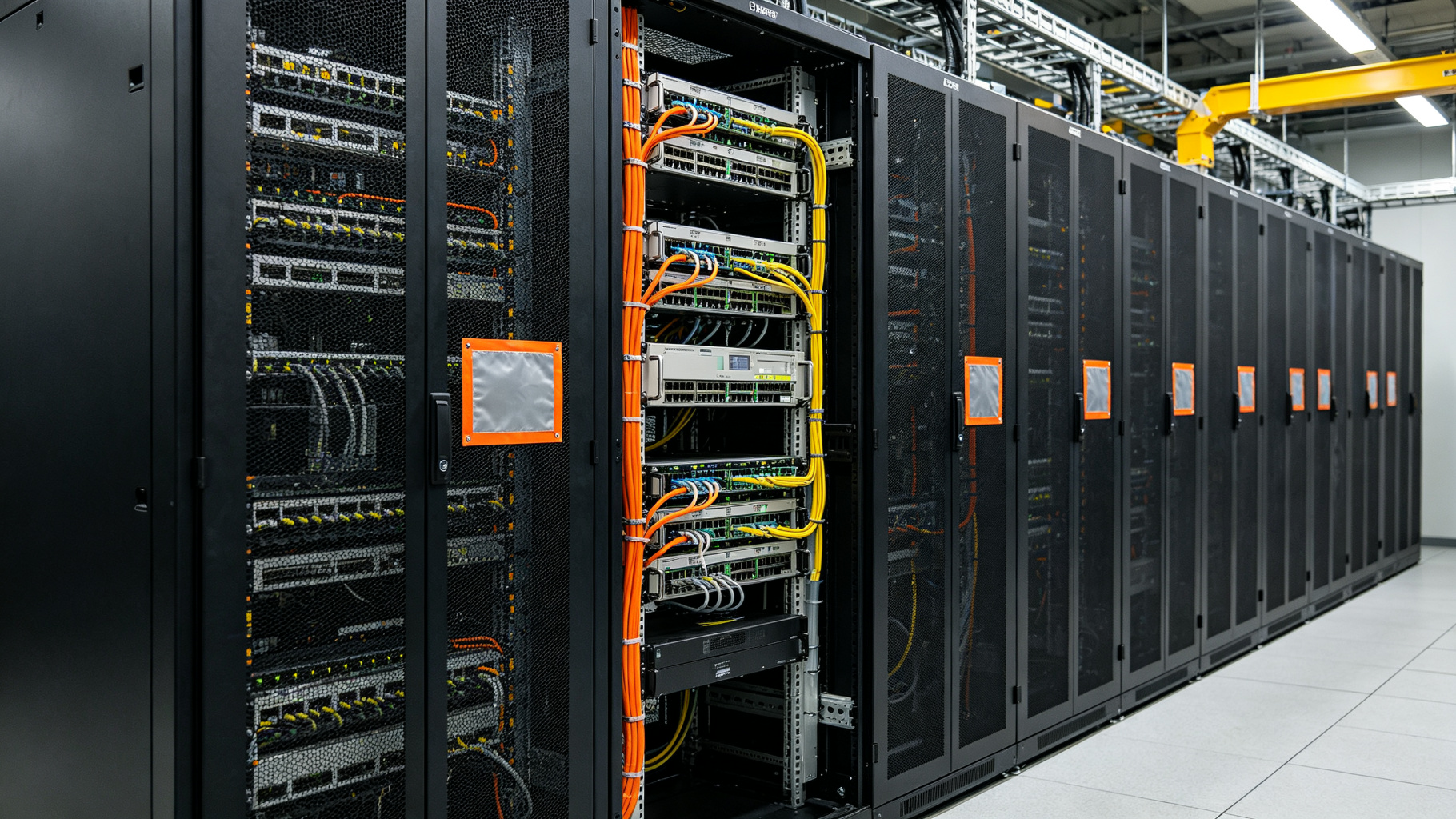
Technical guide on server rack fire for electrical fire protection
A single overheated server rack can shut down an entire data hall, costing tens of thousands of dollars per minute of downtime. Yet most racks rely on detection alone, leaving a critical gap between alarm and suppression. This guide focuses on electrical fire protection for IT equipment, where clean-agent suppression must be fast, non-conductive, and residue-free to protect both hardware and uptime.
A server rack fire rarely begins as a room-scale event. It typically starts at a single energized component—a failing power supply, a loose bus-bar connection, an overheated capacitor, or a battery module—and then spreads through cable bundles, plastic air baffles, and adjacent IT equipment. For facility managers, the objective of IT equipment protection is not only to extinguish a well-developed data center fire, but to interrupt the incipient stage before smoke propagation, thermal damage, and suppression-system discharge cause widespread outage.
Passive clean-agent patches such as the FIREQUELL QuellPatch line are engineered for this rack-level hazard. They use microencapsulated FK-5-1-12 agent and passive thermal activation to discharge directly at a heated surface without requiring pipes, detectors, panels, or external power. This article describes technical best practices for applying QuellPatch as part of a layered server suppression strategy, including hazard selection, activation-temperature choice, placement, airflow effects, inspection, and coordination with broader data center fire protection.
Modern server racks concentrate energized electrical loads in a small enclosure. Typical ignition sources include:
The fuel load is not large by warehouse standards, but it is continuous and well ventilated. Flame-retardant printed circuit boards, wire insulation, connector housings, fan modules, and plastic bezels can support localized flame spread once an external ignition source or sustained overheating is present. Server fans, while essential for cooling, also move hot gases and may carry flame or molten material across adjacent U-positions.
Room-level clean-agent systems are designed to achieve a uniform concentration after detection, agent release, and mixing. In practice, there can be a delay between the first overheating event and the moment smoke reaches a detector or crosses a confirming detection zone. During that interval, a server rack fire can damage multiple servers, contaminate cable bundles, and force shutdown of workloads beyond the initial rack.
A local passive device acts at the hazard itself. It does not replace building detection or total-flooding systems, but it can reduce the fire size during the first minutes and limit collateral IT equipment damage. This makes it particularly relevant in high-density racks, contained hot/cold aisles, and remote edge rooms where inspection frequency may be lower.
QuellPatch patches contain FK-5-1-12 clean agent held in microencapsulated form. The agent is sealed within small polymer shells that remain intact under normal ambient conditions. Because the shells store agent without a pressurized cylinder, the patch can be mounted directly inside a rack without piping, nozzles, or electrical interlocks.
When the capsules open, FK-5-1-12 is released as a fluid that vaporizes readily at elevated temperatures. FK-5-1-12 is electrically nonconductive and is commonly selected for IT equipment protection because it does not leave a dry powder or sticky residue under intended discharge conditions. It also has a short atmospheric lifetime, commonly reported as approximately five days, and a global warming potential near one, which reduces environmental persistence compared with some older halogenated agents.
Microencapsulation distributes the agent across the face of the patch. This allows the discharge to occur close to the target surface rather than relying on long agent transport from a remote cylinder.
QuellPatch uses passive thermal activation: the capsule shells respond to heat from the developing fire and rupture at a rated temperature. No manual input, power supply, or fire alarm signal is required. The product line offers activation ratings of 80°C, 140°C, and 180°C.
Rating selection should be based on measured surface and air temperatures under worst-case normal operating conditions, not on generic rack labels. Engineering considerations include:
Before selecting a rating, it is useful to record temperatures at the proposed mounting location during full-load stress testing. The selected activation temperature should be above the maximum documented normal temperature with an appropriate margin, but below the temperature at which adjacent combustible materials or insulation systems are expected to fail.
QuellPatch should be deployed by hazard zone rather than by simply attaching one patch per rack. A practical installation map should identify power supplies, PDUs, bus-bar connections, battery backup units, switch modules, and dense cable bundles. Patches are then mounted adjacent to those items, typically on rack side walls, interior roof panels, cable-management covers, or equipment brackets.
As a starting point for layout, patches are commonly placed within roughly 100–300 mm of the target hazard, with the exact distance adjusted for patch charge, local airflow, and enclosure geometry. A 42U rack may require patches at each PDU or bus-way connection, above the rear power-supply bank, and near any rack-mounted battery module. General IT equipment protection may also use intermediate patches along cable runs, but quantity should be based on the observed fuel load and airflow rather than rack height alone.
Patches should not be mounted directly on live conductors unless the specific assembly has suitable electrical and mechanical clearance, nor should they be attached to heatsinks or exhaust surfaces that may reach the selected activation temperature during normal operation. They should also be positioned so they do not block server inlet air, exhaust air, or maintenance access.
Server racks are intentionally ventilated. Front-to-rear airflow can move several hundred cubic meters of air per hour in a fully loaded rack, which can dilute a local agent discharge if the patch is poorly located. Best practice is to position patches so buoyant agent and local airflow carry the discharge toward the ignition source rather than immediately out of an exhaust opening. Side-wall or roof mounting near recirculation zones can be more effective than mounting directly in a high-velocity exhaust jet.
Unlike total-flooding systems, passive patches do not depend on whole-room integrity to achieve their initial effect. However, perforated doors, unsealed cable cutouts, and missing blanking panels can reduce local agent concentration. For racks with aggressive cooling or ducted exhaust, additional patches or minor baffling may be needed, provided the baffles do not interfere with equipment cooling.
QuellPatch is a local server suppression device, not a total-flooding system. It should be integrated with addressable smoke detection, very-early smoke detection, thermal monitoring, and the building’s clean-agent or pre-action water system. The passive patch may reduce fire severity before the central system discharges, but it does not provide occupant notification, manual release, or effective suppression of a deep-seated fire under appropriate design conditions.
Because FK-5-1-12 is used in both passive patches and engineered total-flooding systems, agent compatibility is generally not a concern. The room-level system must still be designed to the applicable standard, such as NFPA 2001 or ISO 14520, and room integrity testing remains necessary for total-flooding protection. In high-density AI or computing racks, higher heat loads and unusual battery configurations may justify a revised hazard analysis and closer coordination between rack-level and room-level protection.
QuellPatch patches have a stated 5-year service life under specified indoor environmental conditions. They are sealed devices and are not refilled or recharged. Maintenance consists primarily of visual inspection, typically performed during routine data center walks or annual fire-system inspections.
Inspection should verify that the patch remains securely bonded, that the microcapsule layer has not been crushed or punctured, and that there is no discoloration, heavy dust loading, oil contamination, or evidence of exposure to excessive heat. Installation records should include location, activation temperature, lot or serial number, installation date, and required replacement date. Patches should be replaced at the end of the 5-year service life, after activation, or after physical damage or exposure to temperatures above their rating.
Server rack fire protection is most effective when approached as a layered problem: control ignition sources, detect heat and smoke early, suppress at the local hazard, and maintain a properly designed total-flooding or building system. QuellPatch supports IT equipment protection by placing microencapsulated FK-5-1-12 agent directly inside the rack and releasing it through passive thermal activation at 80°C, 140°C, or 180°C.
Technical success depends on correct temperature rating, careful placement near power and battery hazards, realistic assessment of rack airflow, and documented replacement at the 5-year service interval. When applied as part of a broader data center fire strategy, the patches can reduce the consequences of an incipient server rack fire while central detection and suppression systems continue to provide facility-scale protection.
A: No. QuellPatch devices are supplemental local-application suppression for rack-level IT hazards and do not replace a code-driven total-flooding system. The overall data center strategy should still include detection, alarm, emergency response, and any clean-agent or water-based total-flood protection required by NFPA 75, NFPA 2001, or the authority having jurisdiction.
A: A 140°C rating is commonly used for general server rack interiors because it is above normal IT exhaust temperatures while still responding to incipient overheating. An 80°C rating may be suitable for enclosed or lower-temperature zones, while an 180°C rating should be reserved only for high-ambient areas where thermal mapping shows normal temperatures could cause nuisance response.
A: QuellPatch service life should be determined from the manufacturer’s labeled replacement interval and site inspection results, typically supported by periodic visual checks every six months. Replace the patch immediately if the thermal indicator changes color, the device is physically damaged, discharge has occurred, or the enclosure experiences an overheating event.
A: Yes. FK-5-1-12 is electrically nonconductive, leaves no residue, and is used for protection of electronic equipment in data center and electrical hazard applications. It is compatible with servers, switches, storage arrays, and busway or power distribution components when the QuellPatch is installed in the intended local-application location.
A: Mount QuellPatch near the highest-risk ignition sources, such as rack PDUs, busways, power supplies, cable bundles, and rear-door heat zones, while keeping it clear of fans, sliding equipment, and service access. The exact layout should be based on rack thermal mapping and the engineering layout so the 80°C, 140°C, or 180°C activation rating matches the local temperature profile.
FIREQUELL QuellPatch delivers automatic, maintenance-free clean-agent protection for electrical panels, battery cabinets and control rooms — designed to meet FM Approved, UL Listed, CE and UKCA requirements.
Request a Site Assessment