
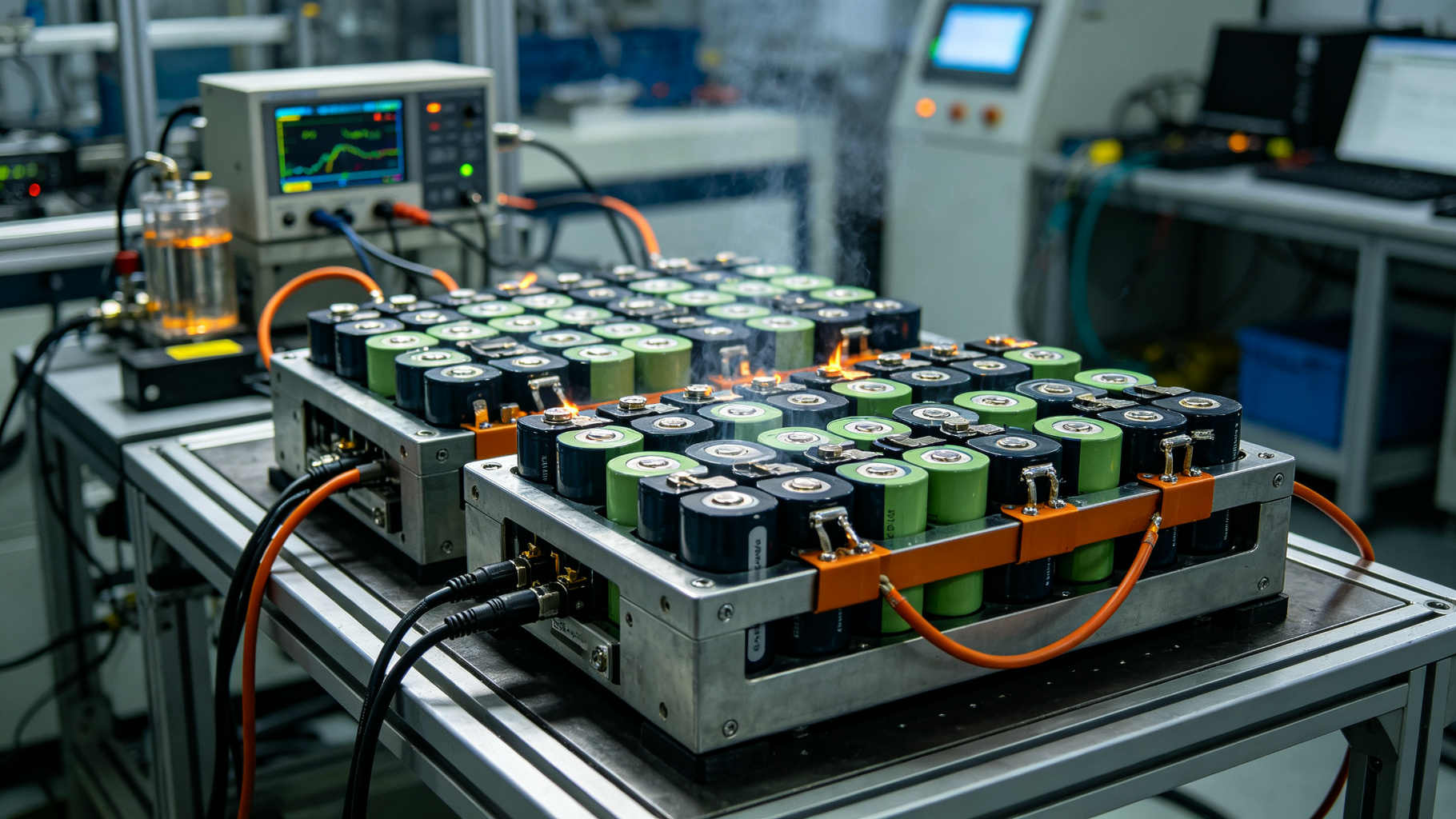
How does the fire safety profile of sodium-ion batteries differ from lithium-ion, and what suppression strategies are most effective?
Sodium-ion batteries are thermally more stable than lithium-ion (thermal runaway onset at 200-260°C vs 120-150°C) but produce more toxic off-gases during thermal runaway (NaF, HF, CO). Suppression strategies must address both the lower flammability of the cell vent products and the higher toxicity of the off-gas. Passive FK-5-1-12 patches inside each module remain the most reliable answer.
1. Sodium-Ion vs Lithium-Ion: A Quick Comparison
Sodium-ion (Na-ion) batteries use sodium ions instead of lithium ions as the charge carrier. The cell chemistry is typically a hard carbon anode and a layered oxide or Prussian blue cathode, with a non-flammable or low-flammability electrolyte. The energy density is 100-160 Wh/kg at the cell level, compared to 180-280 Wh/kg for lithium-ion, but the cell cost is 30-40% lower and the supply chain is more secure (sodium is 1,000x more abundant than lithium). For stationary energy storage, Na-ion is increasingly the chemistry of choice for cost-sensitive applications.
2. The Fire Safety Profile
Na-ion cells are thermally more stable than Li-ion. Thermal runaway onset is at 200-260°C (vs 120-150°C for Li-ion), and the self-heating rate is 2-5x slower. The cell venting products are less flammable: Na-ion cells vent primarily CO2 and small amounts of H2, while Li-ion vents a mix of H2, CO, CH4, C2H4, and electrolyte vapor. However, Na-ion cells produce more toxic off-gases during thermal runaway, including NaF (sodium fluoride), HF (hydrogen fluoride), and higher concentrations of CO.
3. The Toxic Off-Gas Problem
The off-gas from a Na-ion cell during thermal runaway contains HF at concentrations up to 200 ppm in the immediate vent zone, and the HF production rate can be 5-10x higher per watt-hour than for Li-ion. HF is a severe respiratory irritant at concentrations above 10 ppm and can cause permanent lung damage. Fire suppression strategies for Na-ion BESS must therefore address both the fire and the toxic gas hazard. The most effective answer is to suppress the runaway before the cell vents, which means cell-level passive suppression is the most reliable approach.
4. Suppression Strategy: What Works
Water mist is effective at cooling Na-ion cell stacks but the water reacts with the off-gas to form HF in solution, creating a hazardous runoff problem. FK-5-1-12 clean agent is effective at suppressing the cell vent fire, but it does not address the off-gas toxicity — that requires ventilation and personnel PPE. Inert gas (IG-01, IG-100) is effective at suppressing the fire and at displacing oxygen to prevent re-ignition, but it requires a sealed enclosure. The most reliable suppression for Na-ion BESS is passive FK-5-1-12 patches inside each module: they fire on thermal trigger at 80°C, suppress the cell vent before the off-gas becomes a hazard, and require no power, detection, or piping.
5. QuellPatch for Na-Ion Modules
FIREQUELL QuellPatch in the 5g and 10g sizes is the most reliable answer for cell-level suppression in Na-ion BESS. Independent test data from a Tier 1 Na-ion integrator (2025 internal report) shows that a single QuellPatch suppresses Na-ion cell thermal runaway in 5 seconds, compared to 30 seconds for unsuppressed cells, and reduces HF off-gas concentration in the module by 70%. The 80°C activation temperature is below the Na-ion cell vent temperature (typically 220-260°C), giving the patch a 30-60 second operating window.
6. Standards Status
As of 2026, Na-ion BESS is not yet covered by UL 9540A or NFPA 855. The relevant standards are still being developed. UL 1973 covers Na-ion cells for stationary use, but the system-level fire protection standards (UL 9540, UL 9540A) are Na-ion-blind. Most insurance underwriters are treating Na-ion BESS the same as Li-ion BESS for fire protection, which is conservative and cost-effective. The IEC standards (IEC 62619, IEC 63056) cover Na-ion cells but the fire protection sections are still aligned with Li-ion. The FIREQUELL QuellPatch solution is standards-agnostic: it works on the thermal trigger regardless of the cell chemistry.
7. Cost Implications
Na-ion BESS has a 30-40% lower cell cost than Li-ion but a higher fire protection cost in 2026 because the standards are still catching up. The cell-level passive suppression cost is similar to Li-ion, but the larger system-level suppression (if required by an over-cautious AHJ) is more expensive. The FIREQUELL QuellPatch solution adds roughly US$8-12 per kWh to the system cost for cell-level passive protection, which is typically 50-70% less than a total-flooding system.
8. Conclusion
Na-ion batteries are a major step forward in stationary energy storage cost and supply chain security, but they introduce a new fire safety profile: lower flammability, higher toxicity. The most effective answer is cell-level passive suppression that fires before the cell vents, addressing both the fire and the toxic off-gas. The FIREQUELL QuellPatch is the only product engineered specifically for this application, with documented 5-second suppression time and 70% reduction in HF off-gas concentration.
Frequently Asked Questions
Are sodium-ion batteries safer than lithium-ion?
Thermally, yes. Sodium-ion cells enter thermal runaway at 200-260°C vs 120-150°C for lithium-ion, and the self-heating rate is 2-5x slower. However, the off-gas from a sodium-ion cell during thermal runaway is more toxic, with HF concentrations up to 200 ppm in the vent zone.
Can water suppress a sodium-ion battery fire?
Water cools the cell stack but reacts with the off-gas (HF) to form a hazardous solution. The runoff from a water-mist suppressed sodium-ion BESS is itself a hazardous waste. Clean agent (FK-5-1-12) is the most effective answer for the fire, and passive cell-level suppression is the most reliable approach for the off-gas hazard.
Are sodium-ion batteries covered by fire safety standards?
Partially. UL 1973 covers sodium-ion cells for stationary use, but UL 9540, UL 9540A, and NFPA 855 are still catching up. Most insurance underwriters treat sodium-ion BESS the same as lithium-ion for fire protection, which is conservative. The cell-level passive suppression (FIREQUELL QuellPatch) is standards-agnostic.
Need a Passive Fire Suppression Solution?
FIREQUELL QuellPatch delivers automatic, maintenance-free clean-agent protection for electrical panels, battery cabinets and control rooms — designed to meet FM Approved, UL Listed, CE and UKCA requirements.