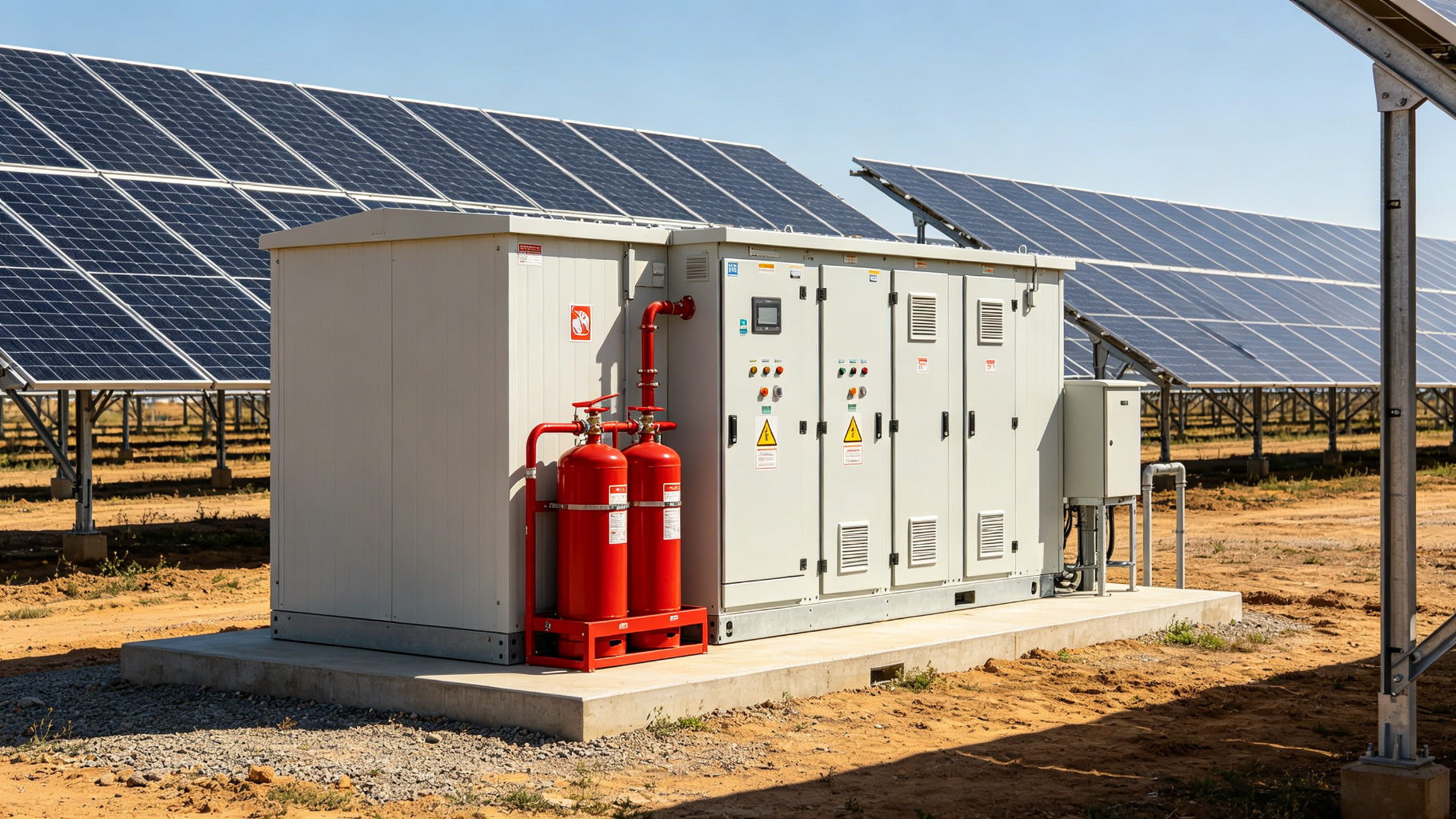
Technical guide on solar case study for electrical fire protection
Utility-scale solar farms are growing faster than the fire protection standards that govern them—and arc faults in DC combiners are a leading cause of costly outages. When a string inverter fails, the resulting fire can destroy adjacent modules and shut down a megawatt block. This case study analyzes how electrical fire protection systems are retrofitted into existing solar installations, balancing cost, reliability, and code compliance.
This solar case study reviews a PV fire deployment at a 60 MW single-axis-tracking solar farm using 24 central inverters. The site operator evaluated QuellPatch as a point-type inverter protection measure after recurring thermographic anomalies in DC isolators, terminal blocks, and capacitor compartments. The objective was to provide passive, local suppression for incipient enclosure fires without adding pressure cylinders, external power, or complex detection logic.
The deployment focused on fires originating inside inverter cabinets. It was not designed to replace building sprinkler systems, total-flooding clean-agent systems, or array-side DC rapid shutdown requirements. The following sections summarize the site risk baseline, patch selection calculations, installation workflow, and in-service observations.
The plant consists of 24 outdoor, 1500 V DC central inverters rated at 2.5 MW each. Each inverter includes three principal compartments: a DC isolator and combiner section, a forced-air-cooled power module containing IGBTs and DC-link capacitors, and an AC output/control section. The enclosures are rated IP54, but filtered ventilation openings, cable glands, and door seals create leakage paths that can affect agent retention.
Site ambient conditions frequently reach 43°C in summer, and inverter internal exhaust air was measured at 58°C during peak generation. These elevated temperatures reduce thermal margin and increase the importance of selecting activation ratings that respond to fault heating without activating during normal operation.
Before deployment, the engineering team reviewed three months of SCADA alarms, maintenance records, and thermographic surveys. The survey identified 11 terminations operating above 70°C, including two DC connector barrels at 92°C and 97°C under approximately 85% load. Normal surface temperatures reached 64°C on DC-link capacitor cans, 89°C on IGBT heat sinks, and 78°C on AC bus connections.
The principal ignition scenarios were loose or corroded DC terminations, degraded DC-link capacitors, IGBT thermal runaway, fan failure, and control-power supply faults. Because forced-air cooling supplies oxygen to the power module, a small incipient fire can develop quickly if not interrupted at the source.
QuellPatch uses microencapsulation to hold FK-5-1-12 clean agent within small polymer capsules distributed in a flexible patch matrix. During passive thermal activation, the capsule walls soften and rupture when exposed to the rated temperature, releasing FK-5-1-12 vapor directly at the protected location. The agent is electrically non-conductive and vaporizes without leaving powder or liquid residue on circuit boards or buswork.
Because the system requires no detector, control panel, or pressurized cylinder, it is suitable for distributed compartments where maintenance access is difficult and where adding active suppression hardware would be costly. The patches have a 5-year service life under specified indoor/outdoor enclosure conditions.
Ratings of 80°C, 140°C, and 180°C were selected by compartment, based on measured normal temperatures and expected fault growth rates.
Each selection included margin for solar loading, thermographic measurement uncertainty, and thermal lag between the hot surface and the patch.
The QP-150 patch contains 150 g of microencapsulated FK-5-1-12. The manufacturer’s loading guide for IP54 electrical compartments uses approximately 420 g/m³ for local protection, which corresponds to roughly 4.5% volumetric concentration under ideal mixing, with an allowance for normal enclosure leakage. For the ventilated power module, a 1.5 ventilation factor was applied because cooling airflow reduces agent residence time.
This yielded 14 patches per inverter and 336 patches across the site. Patches were mounted within 300 mm of identified ignition targets, near the upper portion of compartments where vapor could disperse downward, and at least 50 mm from uninsulated energized parts. They were positioned to avoid blocking airflow filters, fans, or maintenance access points.
Installation was completed during a four-day scheduled outage using two electrical crews. Each inverter was locked out and verified de-energized before compartment entry. Because the patches rely on adhesive bonding, mounting surfaces were cleaned with 70% isopropyl alcohol and lightly abraded where powder-coat finish was glossy. Installation was performed only when enclosure temperatures were above 10°C to support adhesive cure.
Crews installed DC-compartment patches first, followed by power-module and AC/control patches. In high-vibration areas near contactors and cooling fans, patches were secured with both the pressure-sensitive adhesive and stainless-steel mounting tabs. Each patch received a QR-coded label recording its location, activation rating, lot number, and installation date.
Quality checks included a visual clearance review, firm hand-pressure verification, and photographic documentation. The commissioning record also captured baseline thermographic images for comparison during future inspections.
Approximately 14 months after deployment, a fault occurred in the DC isolator compartment of one inverter. SCADA indicated DC undervoltage and ground-fault alarms. Maintenance personnel found that two 140°C patches in the compartment had activated. The third patch, located farther from the isolator, had not activated. The isolator assembly and adjacent wiring showed heat and soot damage, but no flame spread to the capacitor bank or adjacent compartments was observed.
According to the site maintenance report, the inverter returned to service after isolator replacement, compartment cleaning, and installation of replacement patches. This account is based on site records and was not independently witnessed by the manufacturer.
The patches carry a 5-year service life, after which replacement is recommended regardless of visible condition. The site adopted quarterly visual inspections for detachment, impact damage, or contamination, and annual thermographic inspections to identify new hotspots that might justify additional patches. Patches exposed to a major electrical event, even if not visibly activated, are flagged for replacement because internal capsule damage may not be apparent.
This solar farm fire deployment demonstrates a compartment-specific approach to inverter protection using temperature-rated, microencapsulated FK-5-1-12 patches. The design used measured thermal data to select 80°C, 140°C, and 180°C activation ratings and to calculate patch quantities based on compartment volume and ventilation. The reported DC isolator incident suggests that passive thermal activation can respond to localized overheating before a small fault extends beyond the ignition zone. As with any passive fire-protection measure, QuellPatch should be treated as one layer in a broader program that includes proper terminations, thermographic maintenance, arc-fault protection, and code-required suppression systems.
A: QuellPatches activate passively when microencapsulated FK-5-1-12 capsules reach their rated activation temperature. The polymer shells then rupture and release clean-agent vapor directly at the protected component, targeting early-stage inverter fires without requiring external power or a control panel.
A: Yes, they can be used in outdoor 1500 V electrical enclosures when the activation rating is selected above measured normal operating temperatures and mounting surfaces are clean, dry, and properly prepared. Installation must maintain required electrical clearances and follow the inverter manufacturer’s safety procedures, including lockout/tagout.
A: Over the 5-year service life, maintenance is limited to periodic visual checks for physical damage, adhesion loss, contamination, and evidence of discharge. No weighing, pressure testing, or electrical recharging is required because the FK-5-1-12 is sealed in microcapsules.
A: Common causes include DC arc faults, loose terminations, insulation breakdown, overheated IGBTs or capacitors, moisture ingress, and corrosion in outdoor cabinets. The case study based patch selection and placement on a site fire-risk baseline and known inverter failure modes.
A: FK-5-1-12 is electrically non-conductive and leaves no powder or liquid residue, making it suitable for energized electronics such as PV inverters. It suppresses early-stage fires at the source, reducing the risk of extended inverter downtime and cleanup damage compared with dry-chemical systems.
FIREQUELL QuellPatch delivers automatic, maintenance-free clean-agent protection for electrical panels, battery cabinets and control rooms — designed to meet FM Approved, UL Listed, CE and UKCA requirements.
Request a Site Assessment