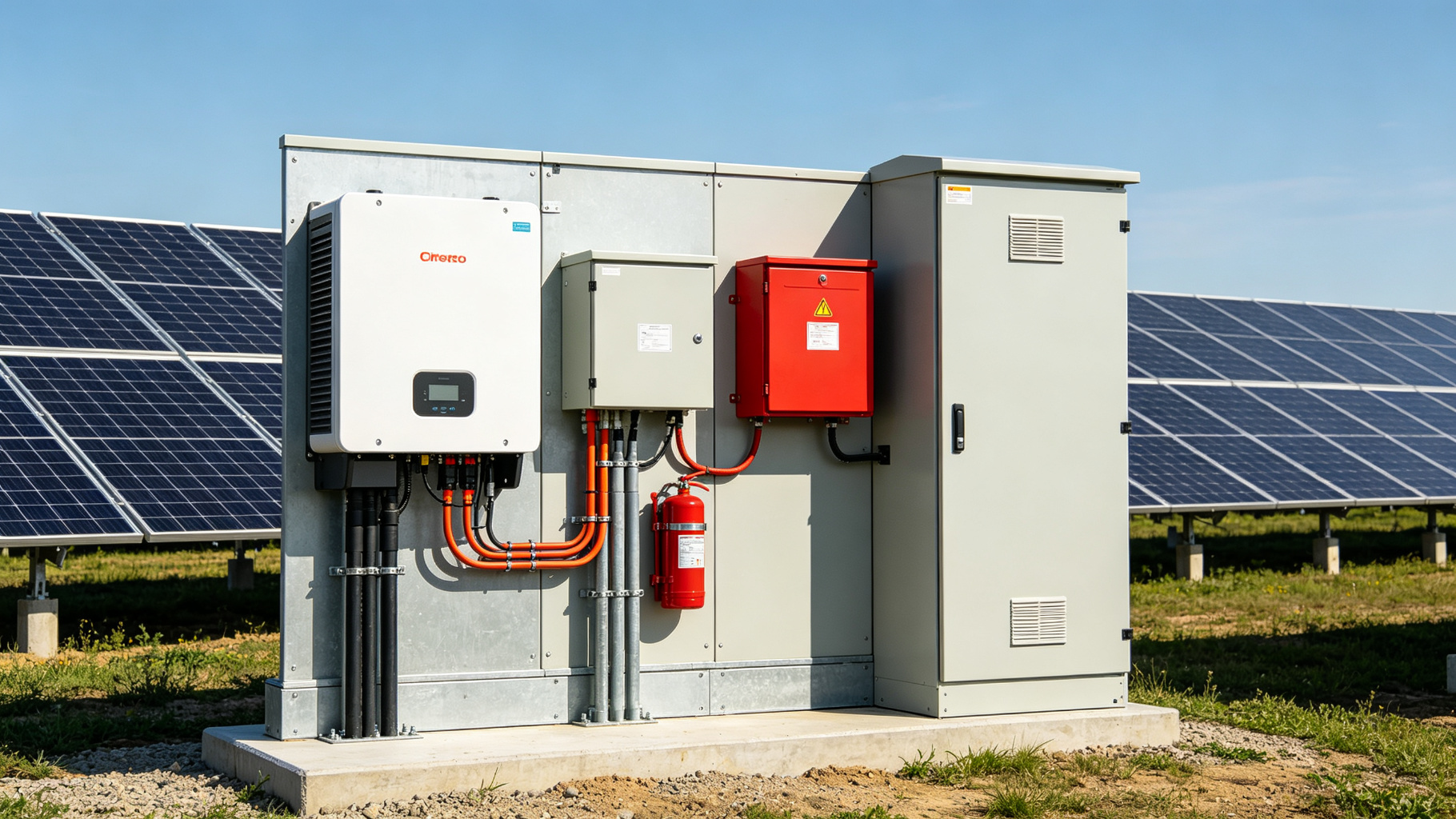
Technical guide on solar inverter fire for electrical fire protection
DC-side arc faults in solar inverters are notoriously difficult to detect—they can smolder for hours before a flame appears, and by then, the damage is done. Unlike AC faults, DC arcs have no natural zero-crossing, making them sustain longer and generate intense heat. This article dives into the unique challenges of DC-side fire protection, from arc-fault detection to passive suppression strategies that stop thermal runaway before it spreads.
Photovoltaic (PV) systems combine a continuously energized PV DC side with dense power-conversion electronics. A solar inverter fire often starts at a DC connector, isolator, or terminal block before reaching AC switchgear, and outdoor unattended enclosures can delay detection. This guide explains DC-side failure modes and how QuellPatch passive clean-agent patches support inverter suppression.
Because PV strings remain energized in daylight, rapid shutdown may not remove all DC hazard at the inverter input. Photovoltaic fire protection should therefore address incipient ignition at component level, not only building sprinklers or electrical tripping.
Commercial PV plants commonly operate at 1,000 V or 1,500 V DC. Unlike AC arcs, DC arcs have no natural current zero. A loose connector, broken strand, or contaminated isolator contact can sustain an arc at currents below fuse or breaker thresholds. Arc core temperatures can exceed 5,000 K, while polymer insulation and PCB substrates may ignite at 300–600°C. Series arcs are especially hard to detect because load current continues to flow; parallel arcs may be current-limited but can still carbonize surfaces and cause tracking.
High-risk areas include DC terminal blocks, MPPT fuses, disconnect contacts, busbar joints, electrolytic capacitors, and IGBT connections. Capacitor case temperatures may be rated 85–105°C, and IGBT heat-sink surfaces can reach 70–100°C under full load. A failed solder joint or degraded gate drive can push local temperatures well beyond these ranges. This creates a design constraint: a suppressor that activates too close to normal operating temperature may nuisance-discharge, while one with too high a threshold may allow a fire to develop.
Sprinklers are rarely located inside compact inverter compartments and can create cleanup and electrical concerns. Dry chemicals leave residue that may damage electronics. Pressurized gas systems require detectors, controls, piping, and ongoing maintenance. For distributed PV assets with many inverters, a passive local suppression product can reduce dependence on external detection and control power.
QuellPatch uses microencapsulated FK-5-1-12, a clean agent used for electrical hazards. The agent is held in polymer shells bonded to an adhesive patch rather than a pressurized cylinder. FK-5-1-12 is non-conductive, evaporates without residue, has an atmospheric lifetime near five days, and a global warming potential near 1. Its reported heptane cup-burner extinguishing concentration is approximately 5.9 vol%, a reference also applied to Class C electrical hazards. Microencapsulation eliminates cylinder leakage and allows defined agent mass to be placed directly beside the most likely ignition point.
Patches are rated for activation at 80°C, 140°C, or 180°C. When local temperature reaches the rating, microcapsule shells soften and rupture, releasing FK-5-1-12 into the boundary layer above the heat source. Activation requires no detector, panel, or external power, which is useful where PV DC side faults may interrupt control power.
The 80°C variant suits shaded control or termination compartments where normal surfaces stay below about 55–60°C. The 140°C variant is commonly used for power modules and ventilated string inverters with nearby surfaces up to roughly 90–110°C. The 180°C variant is intended for sealed, sun-exposed rooftop or desert enclosures where skin temperatures may exceed 120°C; it trades a slightly slower response for better nuisance-activation resistance. A margin of roughly 20–30°C above the maximum expected surface temperature is commonly applied.
Released FK-5-1-12 vaporizes and interrupts free-radical combustion reactions, with a modest heat-sink effect during vaporization. For inverter suppression, the objective is to suppress flame in surrounding insulation, plastics, and seals before spread, not to insulate an energized arc. If the DC fault remains energized, re-ignition is possible after agent dissipates, so coordination with protection devices is required.
Installation should follow a DC-input hazard survey. Typical locations include:
Patches are mounted on clean, dry surfaces within about 100–200 mm of the protected component, facing the likely flame plume. They should not be applied directly to heat sinks or energized busbars unless temperature compatibility is confirmed.
QuellPatch is a local-application product, not a total-flooding system, so volume alone does not set coverage. Engineering guidance typically combines a base grid across the compartment with extra patches at DC terminations. For reference, a 200 x 200 mm patch may protect a local zone on the order of 0.04–0.06 m³ in a tight inverter enclosure; larger central inverters require multiple units. In ventilated enclosures, placement close to the ignition source is more important than calculated volume because agent can escape through openings.
Before selecting a rating, review inverter operating data and, where feasible, measure surface temperatures under full-load summer conditions. If a heat sink reaches 115°C, a 140°C patch may be acceptable only on a cooler adjacent wall; a patch directly exposed to that temperature would require a 180°C rating or relocation.
QuellPatch complements, but does not replace, DC arc-fault circuit interrupters, overcurrent devices, and rapid shutdown. AFCIs can de-energize arcing circuits but may not act before a small flame develops. Rapid shutdown reduces voltage for responders but may not eliminate PV DC side energy in daylight. Passive suppression acts on the fire independent of sensors or control power and can help contain a solar inverter fire until isolation occurs.
QuellPatch units have a 5-year service life under rated conditions. Because they are not pressurized, they do not require gauge readings or hydrostatic tests. Visual inspection during scheduled inverter service should check adhesion, damage, contamination, or prior activation. A log of locations, ratings, installation dates, and replacement dates is recommended.
After discharge, FK-5-1-12 generally ventilates without residue. Personnel should follow lockout/tagout, allow cooling, and ventilate before re-entry. The root cause—such as a loose connector, failed capacitor, or tracking insulator—should be corrected, activated patches replaced, and insulation resistance and torque verified before re-energization.
Solar inverter fire risk is concentrated at the intersection of high DC voltage, sustained arcing, and combustible electronic materials. Sprinkler or total-flooding approaches often do not reach the component where a PV DC side fault begins. QuellPatch places microencapsulated FK-5-1-12 at high-risk terminations, power modules, and isolators, with passive thermal activation at 80°C, 140°C, or 180°C and a 5-year service life. Correct rating, placement, and coordination with AFCI and rapid shutdown are essential. Applied as part of a layered photovoltaic fire protection strategy, the patches can help reduce the chance that a small component fault escalates into a major system loss.
A: Base the choice on measured or nameplate maximum surface temperatures at the mounting point. The 140°C rating is commonly used for ventilated inverters where nearby surfaces stay below about 110°C, while higher-rated units should be selected for locations that run hotter. A 30°C margin above normal maximum surface temperature helps avoid nuisance activation while still responding to incipient DC-side fires.
A: FK-5-1-12 is electrically non-conductive and evaporates without powder, water, or oily residue. It is listed under UL 2127 for clean-agent extinguishers and is compatible with live electrical equipment, so most undamaged electronics can be returned to service after ventilation and normal post-fire inspection. Any circuit-board damage is typically caused by heat or smoke before suppression, not by the agent itself.
A: QuellPatch is a sealed, self-contained suppression device with no pressure gauge or scheduled internal servicing required under normal operating conditions. FIREQUELL recommends visual inspection at least annually and replacement after 10 years from installation, or immediately if the unit shows physical damage, activation, or exposure beyond its rated temperature range. Replacement should also follow any fire event, even if the inverter appears only lightly affected.
A: Place QuellPatch directly above the highest-risk DC-side ignition points, such as DC terminal blocks, fuses, contactors, busbars, capacitors, and isolated DC-DC converter sections. For best coverage, mount the patch within the manufacturer’s recommended distance, typically 0.3–1.0 m from the protected component, and position it so heat and flame rise toward the activation surface. In larger inverters, multiple patches may be needed to cover separate DC compartments or high-power modules.
A: FK-5-1-12 is recognized as a clean extinguishing agent under NFPA 2001 and is widely used for protection of electrical and electronic hazards. QuellPatch-type devices should also be evaluated against relevant appliance and fire-test standards such as UL 2127 and IEC 61107-series requirements where applicable. For PV systems, design should follow NFPA 852 for fire-safe PV installation and the AHJ’s requirements, with the device selected for the specific inverter volume and hazard.
FIREQUELL QuellPatch delivers automatic, maintenance-free clean-agent protection for electrical panels, battery cabinets and control rooms — designed to meet FM Approved, UL Listed, CE and UKCA requirements.
Request a Site Assessment