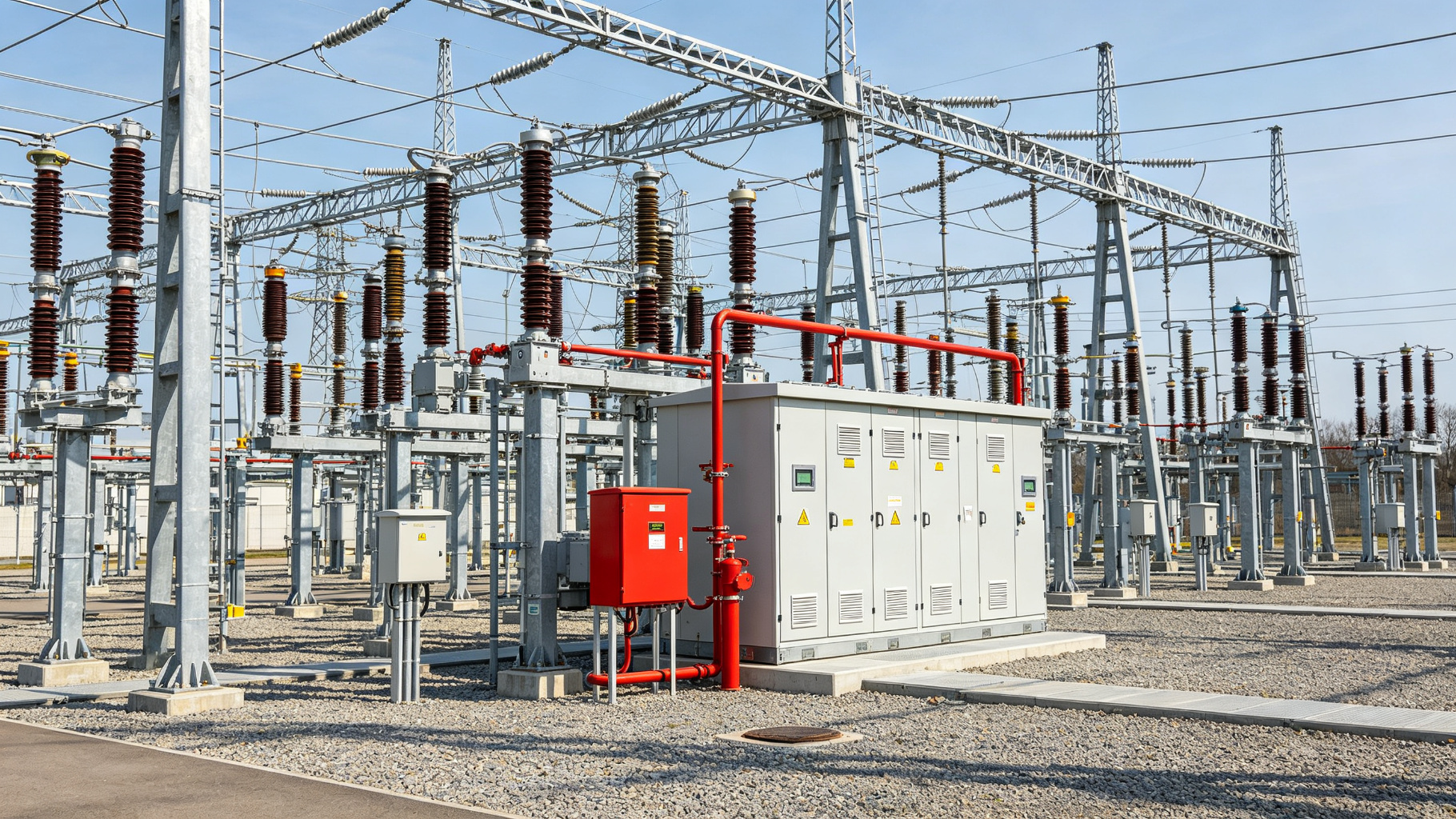
Technical guide on substation fire for electrical fire protection
Switchgear failures in substations account for a significant share of electrical fires, and when they happen, the consequences can be catastrophic—blackouts, equipment loss, and safety risks to personnel. Traditional fire protection often focuses on the transformer, but the switchgear itself is where many faults originate. This guide examines electrical fire protection strategies specifically for substation switchgear, from arc-flash mitigation to targeted suppression systems.
High-voltage substations and metal-enclosed switchgear concentrate continuous electrical energy, insulating liquids, polymer cable materials, and compact terminations in relatively small volumes. A substation fire may begin as a localized hot connection, tracking insulation failure, or bushing fault before developing into a transformer fire or multi-cubicle switchgear event. Because these assets are often unattended and energized, switchgear protection strategies must address both the initial ignition source and the time delay before manual response.
This article reviews the principal fire hazards in high-voltage substations and switchgear, examines limitations of common suppression approaches, and describes how QuellArmor passive clean-agent patches can be engineered for localized, incipient-stage protection. The focus is on compartment-level applications such as cable boxes, bushing pockets, on-load tap-changer enclosures, and switchgear cubicles, rather than replacement of large-transformer water-spray or deluge systems.
Oil-filled transformers contain large quantities of mineral or ester insulating fluid. Typical mineral oils have flash points in the approximate range of 140–160°C and fire points roughly 20–30°C higher, although values vary by fluid formulation. Ignition sources include bushing overheating, low-energy arcing in tap changers, winding insulation failure, and loose cable connections. A high voltage fire involving a transformer may start as vapor ignition near a leak, progress to a pressurized spray fire, and become a pool fire if the tank or radiator is breached.
Not all transformer-related fires begin on the main tank surface. Many incipient events occur in attached cable boxes, bushing turret areas, neutral grounding compartments, marshalling cabinets, and tap-changer drive enclosures. These spaces have lower fuel volume than the main tank but are difficult to monitor with conventional room-type detection.
Metal-enclosed switchgear presents a different hazard profile. Arc-flash events can release intense thermal energy in milliseconds, but the sustained fire that follows usually involves cable jackets, epoxy supports, insulating barriers, current-transformer blocks, and terminations. Common precursors include loose bolted connections, deteriorated heat-shrink insulation, contaminated bus supports, and cable termination tracking.
Switchgear cubicles are often compact, with volumes ranging from fractions of a cubic meter to several cubic meters. They may contain cable penetrations, ventilation openings, and gasketed doors that affect both fire development and agent retention. A substation fire in this type of equipment can spread through cable trenches, bus ducts, and adjacent cubicles if suppression is delayed.
Water spray and deluge systems are commonly used for large transformer fire exposure protection because they can cool tank surfaces and dilute or emulsify some insulating liquids. Their performance depends on properly sized water supplies, nozzle placement, detection logic, and drainage. In energized switchgear rooms, water-based systems require careful design because direct water application can create electrical shock hazards and insulation recovery issues.
Total-flooding clean-agent or inert-gas systems can protect switchgear rooms or transformer bunded enclosures, but they generally require a defined enclosure, controlled leakage, controlled discharge, and pre-discharge evacuation where personnel may be present. Piping, nozzles, control panels, and cross-zoned detection add cost and complexity. For distributed assets with many small compartments, a single total-flooding system may protect a broad room while leaving individual cubicles exposed to long detection and agent transport times.
Even when suppression is installed, the critical interval is the time from initial overheating to agent reaching the fuel. Spot smoke detectors may not respond quickly in sealed or ventilated cubicles, while linear heat cables require heat to reach the sensing element. Aspirated systems improve sensitivity but still depend on air transport and control-panel logic.
Enclosure integrity is another constraint. Cable penetrations, vent louvers, door gaps, and bus duct openings allow agent to escape. In total-flooding designs, leakage area and enclosure strength are calculated to maintain design concentration for a specified hold time. In older substations, retrofitting sufficient sealing can be difficult without impairing ventilation or access.
QuellArmor patches use microencapsulation to store FK-5-1-12 clean agent within a polymer patch matrix. FK-5-1-12 is an electrically nonconductive agent with zero ozone-depletion potential, a reported global warming potential near 1, and a short atmospheric lifetime. It leaves no powdery or sticky residue, which can reduce post-discharge cleaning requirements for electrical insulation, busbars, and electronic controls.
The microencapsulated structure divides the agent into many small cells. The patch remains fixed and inert until local heating causes the capsule shells to rupture. This passive thermal activation requires no external power, fire alarm panel, pneumatic line, or manual release. When activated, the patch releases agent directly into the compartment where the heat is occurring, rather than relying on piping from a remote cylinder.
QuellArmor patches are available with activation temperatures of 80°C, 140°C, and 180°C. The selected rating should reflect the normal operating temperature of the protected surface plus an engineering margin to avoid nuisance activation from solar gain, load cycling, or nearby hot components.
Layout is not based on arbitrary spacing alone. Engineering design considers compartment volume, expected leakage, ventilation, fuel location, and the distance from the patch to the likely ignition source. Because FK-5-1-12 vapor is heavier than air, placement above or adjacent to cable terminations, bus joints, and tap-changing mechanisms can improve local distribution in small enclosures.
For transformer applications, QuellArmor patches should be viewed as local protection for attached compartments rather than as a substitute for tank-surface deluge. Typical locations include cable boxes, bushing turret enclosures, on-load tap-changer control cabinets, neutral compartments, and marshalling kiosks. The 180°C rating is often appropriate where proximity to heated transformer surfaces or solar loading makes lower thresholds unsuitable.
For switchgear protection, patches can be installed on interior panel faces, cable termination compartments, voltage-transformer and current-transformer compartments, and busbar sections. The 80°C or 140°C ratings may be selected depending on measured full-load temperatures and manufacturer equipment ratings. In cable trenches and duct banks, patches can be positioned along tray runs or at penetration seals where early overheating is most likely. Surfaces should be clean, dry, and within the adhesive and environmental limits specified by the manufacturer.
QuellArmor patches have a manufacturer-rated 5-year service life under specified environmental conditions. Facility maintenance plans should include visual inspection during scheduled outages or at intervals consistent with the asset-management program. Inspectors should verify adhesion, patch integrity, label legibility, and absence of mechanical damage or prior activation. Patches should be replaced after discharge, physical damage, or at the end of the rated service interval.
Passive patches do not replace active fire protection, emergency response, or electrical safety procedures. They can complement total-flooding systems, linear heat detection, and transformer water spray by providing local agent release during the earliest heating phase. Any activation should be reported to the responding fire brigade, because a large transformer fire may still require cooling, foam, or water-spray operation after the patch has discharged.
Substation and switchgear fire hazards are defined by high energy density, energized equipment, distributed compartments, and insulating materials that can support rapid fire growth. Conventional deluge and total-flooding systems remain important for large transformer fire scenarios and room-level protection, but they may not address the first seconds of overheating inside a sealed cable box or switchgear cubicle. QuellArmor passive patches use microencapsulated FK-5-1-12 and passive thermal activation at 80°C, 140°C, or 180°C to deliver clean agent directly to the heated zone. With a 5-year service life and no reliance on external power, they can be integrated into a layered protection strategy when placement, temperature rating, compartment leakage, and maintenance are engineered for the specific high-voltage asset.
A: No. QuellArmor patches are designed for localized incipient-stage protection in attached electrical compartments such as cable boxes, bushing pockets, terminal chambers, and tap-changer enclosures. They do not provide the cooling capacity, bulk-fuel control, or area coverage of a transformer deluge or water spray system. For substation assets, use them as a complement to code-required suppression, not as a replacement.
A: Select the activation temperature based on the maximum normal surface or ambient temperature at the installation point, plus an engineering margin to prevent false activation. The 80°C rating is generally suited to cooler compartments, 140°C to typical indoor or protected switchgear locations, and 180°C to higher-temperature compartments or equipment with elevated normal heat. Use field temperature measurements or manufacturer heat-rise data before finalizing the rating.
A: No. QuellArmor is thermally activated and releases agent locally when the patch reaches its rated temperature, so it does not require external power, fire alarm wiring, detectors, or a suppression control panel to operate. This can be valuable in sealed cable boxes, bushing pockets, retrofits, and locations where adding wired detection is difficult. It still should be included in the site fire system maintenance and inspection plan.
A: QuellArmor patches are typically installed close to known ignition sources and enclosed electrical volumes, such as cable termination compartments, bus duct connections, breaker cubicles, relay or control sections, bushing pockets, and tap-changer compartments. Placement should target the area most likely to experience overheating or arcing while avoiding surfaces that normally exceed the selected activation rating. Installation must maintain appropriate electrical clearances and follow equipment manufacturer requirements.
A: QuellArmor has a specified service life of 5 years under intended operating conditions. In substation environments, inspections should check for adhesion, mechanical damage, UV or weather exposure, contamination, discoloration, and leakage. Replace patches at the 5-year interval, after activation, or when inspection shows damage or degradation.
FIREQUELL QuellPatch delivers automatic, maintenance-free clean-agent protection for electrical panels, battery cabinets and control rooms — designed to meet FM Approved, UL Listed, CE and UKCA requirements.
Request a Site Assessment