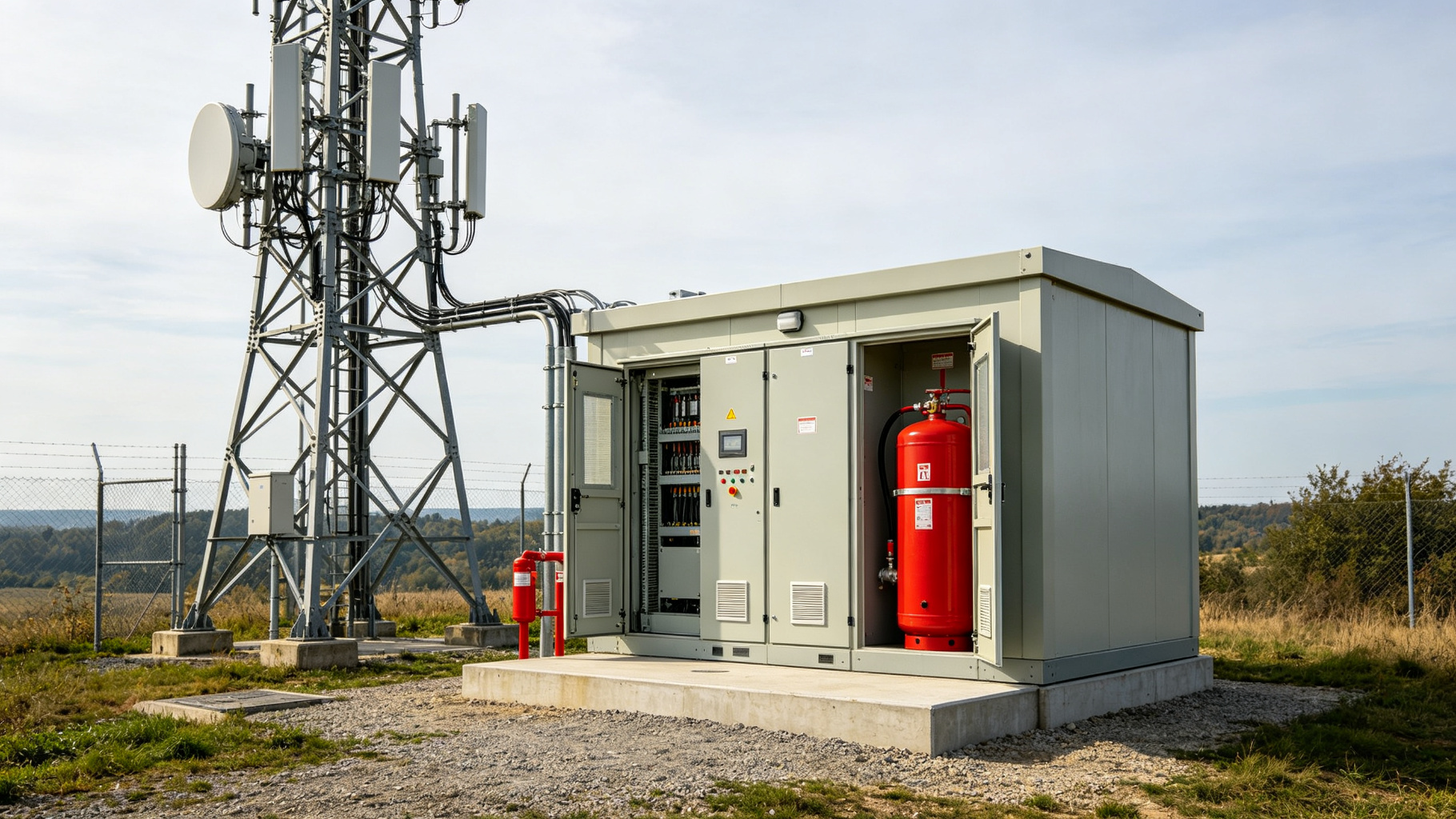
Technical guide on telecom fire for electrical fire protection
As 5G densifies networks, telecom base stations are being deployed in more remote and enclosed spaces—where a single electrical fault can take down service for thousands of users. Battery backups, rectifiers, and RF amplifiers all generate heat, and fires in these cabinets are notoriously hard to access. This article focuses on electrical fire protection for telecom base stations, covering compact suppression solutions that fit tight enclosures and harsh outdoor conditions.
As 5G network densification accelerates and edge computing capacity is integrated into distributed telecom infrastructure, telecom fire incidents have emerged as a leading cause of unplanned service outages, with cascading impacts on public safety, commercial operations, and network reliability. Effective base station protection requires solutions tailored to the unique constraints of remote, often unattended sites, while equipment room fire strategies must balance rapid suppression with minimal risk of damage to high-value electronic hardware. Traditional telecom suppression approaches, including total-flood gaseous systems and portable extinguishers, often leave critical gaps in protection for incipient fires that originate inside sealed equipment enclosures. This article examines site-specific fire risks in telecom environments, limitations of conventional suppression design, and the engineering parameters of QuellPatch, a passive clean-agent suppression product line engineered for targeted deployment in base stations and equipment rooms.
2023 data from the Global Telecom Infrastructure Safety Consortium reports that 61% of telecom base station fires originate in DC power infrastructure, including rectifiers, 48V backup battery strings, and distribution breakers, with an additional 22% tied to overheated RF power amplifiers and coaxial connector assemblies. Under normal peak load, internal enclosure ambient temperatures range from 35°C to 45°C, but a fault such as a loose busbar connection or failing capacitor can push local component temperatures to 100°C or higher in 90 seconds or less. For outdoor sites exposed to direct solar gain, baseline enclosure temperatures can be 15–20°C above outdoor ambient, reducing the thermal margin between normal operation and insulation degradation.
Fires in enclosed telecom cabinets follow a predictable propagation timeline: incipient smoldering of cable insulation or PCB material progresses to open flame in 2–3 minutes, and can spread across an entire equipment rack in 4–6 minutes, fed by continuous airflow from cabinet cooling fans. The majority of remote macro base stations have no on-site personnel, with average fire service response time of 22 minutes for rural tower sites, per the same consortium dataset. For tower-mounted antenna electronics and street-level small cells, access delays can extend response windows further, leading to total equipment loss in many reported incidents. In central equipment rooms, high-density cable bundles and plastic air containment barriers create additional pathways for smoke and flame spread between racks.
NFPA 2001 requires a minimum 10-minute hold time at design concentration for FK-5-1-12 total-flood systems, but 2022 industry audit data found that 68% of field-tested equipment rooms fail post-installation integrity testing after three years of service, due to unsealed cable penetrations, cooling unit gaps, and frequent rack add/move/change activity. Total-flood systems also rely on ceiling or rack-mounted smoke detectors, which only activate when combustion products escape the source enclosure, meaning a fire inside a sealed rectifier or battery module can grow for 2–3 minutes before detection. For distributed small cells and remote cabinets, total-flood systems are often cost-prohibitive, require pressure venting hardware, and depend on reliable site power and alarm connectivity that may not be available.
Manual portable extinguishers provide no value for unattended sites, and ABC dry chemical agents leave corrosive residue that requires replacement of 70–90% of exposed circuit boards, per major telecom equipment recovery guidelines, even for small incipient fires. Water-based sprinkler systems cause similar hardware damage and require lengthy post-discharge drying time before service can be restored. Pressurized automatic tube suppression systems, while localized, require annual pressure testing and are vulnerable to damage during cabinet maintenance, with reported leak rates of 12% over a 5-year service period in high-vibration outdoor cabinet environments.
QuellPatch consists of a 2mm thick flexible polymer substrate embedded with uniformly sized 200–500 micrometer microcapsules, each containing a calibrated charge of FK-5-1-12 clean agent. The microcapsule shell is a temperature-sensitive co-polymer engineered with a sharp rupture threshold, rather than a gradual melting point, so agent release is concentrated at the exact location of overheating rather than being dispersed by cabinet cooling airflow. FK-5-1-12 is selected for telecom use due to its zero ozone depletion potential, 5-day atmospheric lifetime, electrical non-conductivity, and material compatibility with FR4 PCBs, copper busbars, polycarbonate enclosures, and lithium-ion battery casings. The agent has a heat of vaporization of 122 kJ/kg, providing localized cooling as it vaporizes to reduce re-ignition risk. Each patch is sized to achieve a local 5.5% volume concentration in the 0.2 cubic meter zone immediately surrounding the patch, matching the minimum Class C fire design concentration specified in NFPA 2001.
The product line is offered in three activation temperature variants, each calibrated for specific telecom equipment operating ranges to minimize false activation risk. The 80°C variant is designed for lithium-ion battery string compartments and low-power RF electronics, where normal operating temperatures peak at 55–65°C; activation occurs well before the 120–150°C onset of thermal runaway for most LFP battery chemistries. The 140°C variant is intended for rectifier shelves, DC distribution panels, and busway connections, where peak full-load temperatures reach 75–95°C, providing a 45°C thermal buffer against temporary load surges. The 180°C variant is specified for high-heat zones near outdoor cabinet resistance heaters and diesel generator control panels, where nearby surface temperatures can reach 120–130°C during cold-weather operation.
QuellPatch operates via fully passive thermal activation, with no requirement for external power, fire alarm panel integration, or separate detection hardware, eliminating single points of failure from power loss or network outages at remote sites. The product has a 5-year service life, validated through accelerated aging testing aligned with IEC 60068-2-14 thermal cycling standards: 1000 cycles between -40°C and 85°C, 21 days of 95% relative humidity exposure at 40°C, and 1000 hours of UV exposure per ASTM G154 for outdoor-rated units. Internal manufacturer qualification testing measured average agent retention of 99.4% after accelerated aging equivalent to 5 years of field exposure, with no observed premature capsule rupture. Real-world service life may vary in extreme coastal or high-dust environments, so visual inspection during annual site visits is recommended.
For outdoor macro base station cabinets, recommended deployment uses one 100mm x 150mm patch per 0.2 cubic meters of enclosed compartment volume, mounted 100–200mm directly above high-risk components: one 140°C patch per rectifier shelf, one 80°C patch per 4-battery string module, and one 140°C patch per main DC breaker panel. For tower-mounted massive MIMO antenna enclosures, which are only accessed during scheduled tower climbs, 140°C patches are installed adjacent to power amplifier arrays during initial rigging, with replacement aligned to 5-year antenna maintenance cycles. Street-level small cells, which typically have 0.15–0.3 cubic meters of total enclosed volume, require only a single 80°C patch mounted above the integrated radio and backup battery module.
In central office and edge equipment rooms, QuellPatch is classified as a supplementary suppression device, not a replacement for code-required total-flood or sprinkler systems. Patches are installed inside individual 19-inch rack enclosures, sealed battery cabinets, and at 3-meter intervals along overhead cable tray runs where high-voltage DC cables are bundled. This layered approach contains incipient faults before they grow large enough to trigger total-flood discharge, reducing the risk of costly service interruptions from unintended system activation. Because patches contain no electronic components, they do not interfere with very early smoke detection apparatus (VESDA) or gas detection systems deployed in large equipment rooms.
Internal qualification testing simulated common telecom fire scenarios in a 0.4 cubic meter sealed enclosure with 2 m/s airflow, matching typical cabinet cooling fan velocity. In tests using a 150W overcurrent fault on 10AWG DC cable insulation, the 140°C patch activated 11 seconds after local cable temperature reached 141°C, and extinguished the resulting flame in 7 seconds, with no re-ignition during 10 minutes of post-discharge monitoring. In LFP battery thermal runaway tests, a single 80°C patch mounted 120mm above a 280Ah prismatic cell activated at 78°C cell surface temperature, reducing peak adjacent cell temperature by 44°C and preventing propagation to neighboring cells in 8 of 10 test iterations. Results may vary based on enclosure sealing, airflow rate, and fault energy, so site-specific testing is recommended for high-capacity battery deployments. Peak agent concentration in test enclosures was measured at 4.2%, below the 10% cardiac sensitization NOAEL for FK-5-1-12.
Telecom fire risk continues to evolve as network architectures shift toward distributed, high-density radio and edge compute hardware, much of which is deployed in unattended locations with limited access for emergency response. Conventional telecom suppression approaches leave measurable gaps in protection for incipient fires that originate inside sealed enclosures, where early suppression can prevent major outages and equipment loss. QuellPatch provides a passive, low-maintenance layer of base station protection, with calibrated activation temperatures and microencapsulated FK-5-1-12 agent tailored to the operating profiles of telecom hardware. When deployed as part of a layered equipment room fire strategy that includes code-required detection and total-flood systems, the product can reduce the likelihood of major fire events and lower total cost of ownership for network operators. Proper variant selection, adherence to coverage guidelines, and 5-year replacement cycles aligned with routine maintenance support consistent performance across diverse deployment climates.
A: No. QuellPatch is a localized incipient-suppression device for sealed or semi-sealed equipment zones, not a replacement for code-mandated total-flood gaseous suppression in large central-office equipment rooms. It is best used to add protection inside cabinets, racks, battery compartments, or remote enclosure hot spots.
A: Select a variant with an activation temperature at least 15°C above the maximum measured operating temperature of the component being protected. The 80°C variant suits controlled, low-temperature equipment spaces; 140°C is common for normal indoor telecom cabinets; 180°C is typically used for high-heat or outdoor sun-exposed enclosures.
A: Common ignition sources include overheated rectifiers and power supplies, loose busbars or terminations, lithium or VRLA battery faults, damaged wiring, and overloaded DC distribution components. Fires often start as localized hot spots inside a sealed cabinet before smoke or heat reaches room-level detectors.
A: Room total-flood systems are designed around enclosure volume and enclosure integrity, but they may not address a fire starting deep inside a small cabinet, power shelf, or battery compartment. They also require pressure monitoring, controlled discharge, maintenance access, and sometimes electrical interlocks that are difficult to sustain across unmanned sites.
A: The quantity depends on cabinet volume, layout, airflow, and the location of high-risk components such as rectifiers, batteries, and DC distribution blocks. Placement should target the highest-risk ignition zones rather than treating the patch as a simple room-protection device; Firequell can provide configuration guidance for specific cabinet layouts.
FIREQUELL QuellPatch delivers automatic, maintenance-free clean-agent protection for electrical panels, battery cabinets and control rooms — designed to meet FM Approved, UL Listed, CE and UKCA requirements.
Request a Site Assessment