Technical guide on telecom case study for electrical fire protection
When a telecom operator loses a remote cabinet to fire, the cost is not just the hardware—it is the downtime, the service outage, and the safety risk to nearby personnel. Real-world incidents reveal patterns: cable faults, battery failures, and suppressed detection. Analyzing these cases shows where passive protection fits and where active systems fall short.
This telecom case study reviews a 420-site QuellPatch rollout completed for a regional mobile network operator (MNO) with mixed urban, suburban, and rural coverage. Over a three-year review period, the operator recorded 14 confirmed base station fire events, with approximately 68 percent originating in DC power plant, rectifier, battery, or busbar compartments. Mean service restoration time was 11.5 hours, and three events caused partial loss of coverage for public-safety users on shared sites.
Legacy total-flood clean-agent systems were present in only 18 percent of walk-in shelters and did not protect pole-mounted power cabinets, rooftop radio racks, or remote radio distribution boxes. The operator required a passive, electrically nonconductive suppression layer that could be installed during routine maintenance without adding power, network connectivity, piping, or frequent inspection. The following sections summarize the engineering basis, telecom deployment sequence, and field observations from the first 18 months after rollout.
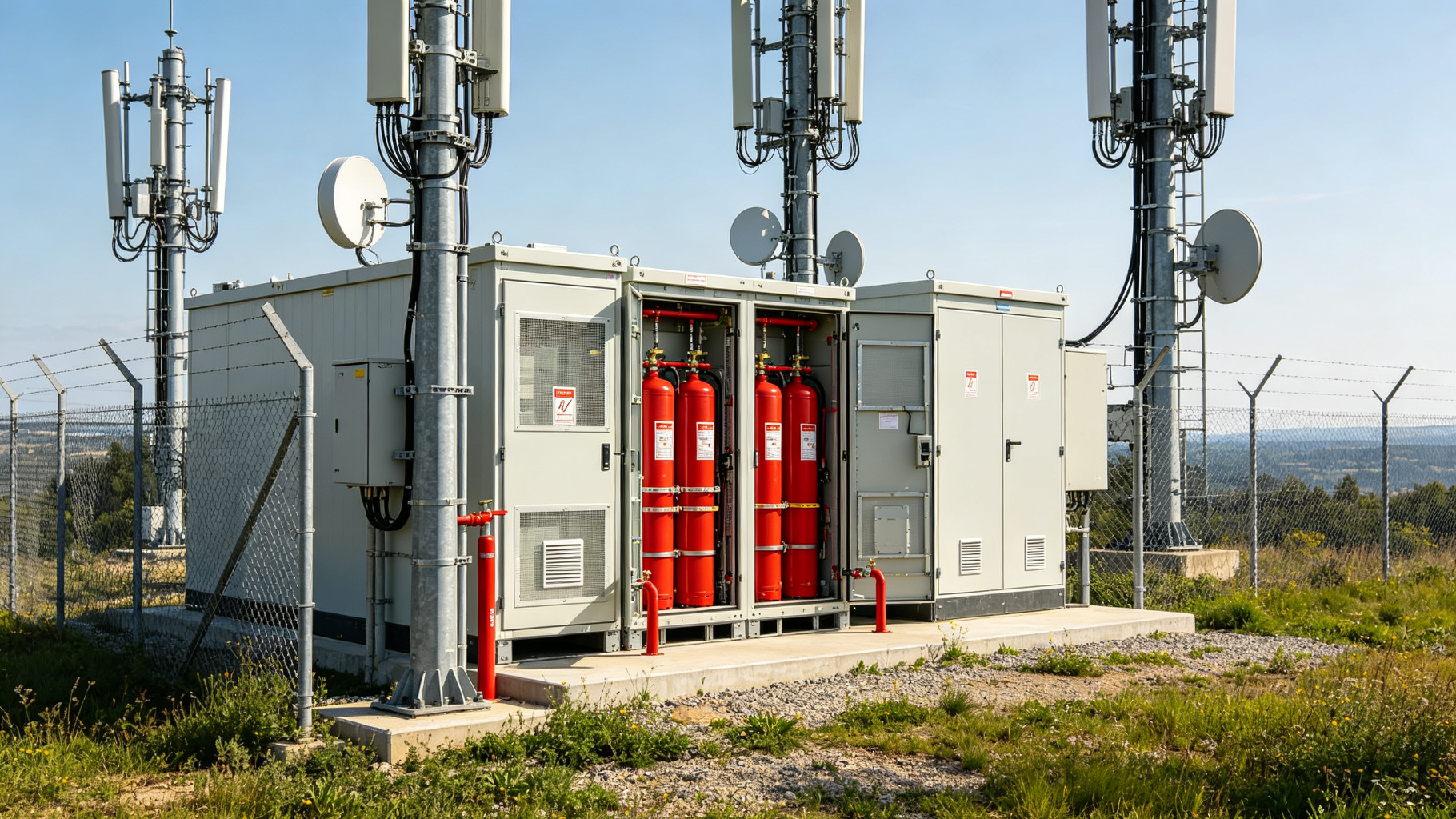
The 420 sites were divided into four physical classes: 146 ground-based equipment shelters, 172 pole-mounted power and radio cabinets, 74 rooftop equipment racks, and 28 in-building distributed RAN or edge equipment rooms. Review of incident reports found the following ignition-source distribution:
The typical failure sequence involved a loose or resistive connection, localized heating, insulation degradation, electrical tracking, and then flame spread along cable bundles. Because most sites were unattended for four to six weeks between visits, early containment at the component level was identified as a key network protection measure.
The QuellPatch product line uses microencapsulated FK-5-1-12 clean agent held in a pressure-sensitive patch. Each patch contains discrete polymer shells that rupture when the patch surface reaches its rated activation temperature, releasing agent directly at the heated zone. The mechanism is passive thermal activation: no control panel, battery, detector, or network signal is required.
FK-5-1-12 is electrically nonconductive and volatilizes after discharge, reducing residue concerns on circuit boards, connectors, and power contacts. The specified patches have a 5-year service life under normal indoor and outdoor equipment-compartment conditions. The operator selected the product as a local-application supplement within individual cabinets and shelves, not as a replacement for room-scale total-flood systems.
Before full telecom deployment, engineering crews performed thermal mapping at 32 representative sites during peak traffic and summer ambient conditions. Measured normal operating temperatures included:
These measurements were used to select activation ratings that provided margin above normal and abnormal-but-nonfire operating temperatures while remaining below temperatures associated with sustained cable ignition and flame spread.
QuellPatch units were specified in three activation ratings: 80°C, 140°C, and 180°C. Placement followed compartment-specific thermal data rather than a single site-wide rating.
The design guide used one 100 x 150 mm patch per 0.12–0.18 m³ of enclosed equipment volume, with at least one patch per identified ignition source. Rectifier shelves typically received two patches mounted on inner side panels facing the heat sinks. Battery strings received one patch per tier within approximately 200 mm of terminal or connection areas. Patches were not applied directly over bare energized busbars, moving fan parts, or ventilation openings.
FK-5-1-12 is compatible with many common electrical and electronic materials. The patch adhesive was evaluated for use on powder-coated steel, aluminum, ABS, and polycarbonate surfaces; installers avoided applying patches over painted labels or flexible cable insulation. In louvered or heavily ventilated cabinets, patches were placed closer to the expected ignition source, and additional units were installed when free ventilation area exceeded approximately 5 percent of the panel surface. Because these are local-application devices, the design did not rely on achieving a room-scale total-flood concentration.
The rollout was completed in 12 weeks by two-person crews. The first visit consisted of site survey, thermal mapping, and location marking using a cardboard template. The second visit occurred during a scheduled maintenance window. Surfaces were cleaned with 70 percent isopropyl alcohol and allowed to dry before each patch was pressed into place for approximately 30 seconds.
Average installation time was 20–35 minutes per outdoor cabinet and 60–90 minutes per ground shelter. Equipment was de-energized where feasible. Where live work was necessary, crews followed site electrical safety rules, including insulated tools and arc-flash PPE. No drilling, hot work, or system shutdown of the radio network was required for most installations.
Each patch received a printed asset tag with a QR code, activation rating, installation date, and 5-year replacement date. Photographs of each mounted patch were uploaded to the operator’s CMMS. Commissioning checks verified adhesive bond, clearance from live parts, correct rating, and absence of shell damage.
Maintenance was integrated into existing semi-annual site visits. Technicians inspected patches for edge lift, bulging, discoloration, shell rupture, or physical damage. No weighing, pressure testing, battery replacement, or electronic monitoring was required. Damaged or activated units were replaced immediately, and all units were scheduled for removal and replacement at the end of the 5-year service life.
During the first 18 months after rollout, the operator reported 11 thermal incidents in protected equipment. In nine incidents, patches released agent and damage was limited to the source component, such as a failed rectifier diode or a resistive battery terminal. Those sites remained on air or returned to service within approximately 20 minutes. In two incidents, patches activated but fire spread through unsealed cable openings into adjacent compartments; both events required manual response and resulted in outages of 4–6 hours.
Based on operator temperature logs and physical evidence, there were no confirmed failures of a patch to activate when its surface reached the rated temperature. These findings are based on operator-reported data and have not been independently verified for all sites.
No nuisance activations were reported among 140°C or 180°C patches. Two 80°C patches in a rooftop battery cabinet bulged but did not rupture after a cooling-fan failure; an internal logger recorded 77°C at the patch surface. Crews replaced those units with 140°C patches and added fan-failure alarms to the site monitoring system. The event reinforced the need for site-specific rating selection rather than uniform use of the lowest-temperature rating.
During winter conditions, no adhesive failures were reported at temperatures as low as -28°C. Three patches in a cabinet with repeated condensation showed minor edge lift; they were replaced after surface cleaning and relocated away from the drip path.
According to operator logs, mean restoration time for base station fire events in protected compartments fell from 11.5 hours to 1.8 hours. Year-over-year fire-related site downtime decreased by an estimated 78 percent. These results are specific to this operator’s site mix, maintenance program, and installation quality and may not be representative of all network configurations.
The QuellPatch rollout provided a passive, local-application suppression layer in telecom compartments that were not protected by room total-flood systems. The technical success of the deployment depended on compartment thermal mapping, correct selection among 80°C, 140°C, and 180°C ratings, placement near likely ignition sources, and control of ventilation and cable openings. The 5-year service life and visual-only inspection requirement reduced maintenance burden compared with active systems that require periodic weighing, pressure testing, or battery replacement.
Field experience also identified limitations. Patches did not prevent fire spread through unsealed cable penetrations, and low-temperature ratings required careful use in high-ambient rooftop cabinets. QuellPatch should therefore be treated as one component of a layered fire-protection strategy that includes detection, ventilation, compartmentation, equipment maintenance, and emergency response.
A: No. QuellPatch is a local-application FK-5-1-12 device for individual outdoor cabinets, shelves, rectifiers, or component zones, not a room-scale total-flood replacement. If NFPA 2001, local code, or the authority having jurisdiction requires shelter-level protection, a total-flood clean-agent system, detection, and alarm arrangement are still required.
A: Base the rating on thermal mapping of the specific compartment under worst-case solar load and equipment operation. Use 80°C for conditioned or lower-temperature spaces, 140°C for rectifiers and general power equipment, and 180°C only for high-ambient cabinets where normal operating temperatures would otherwise cause nuisance activation.
A: No. FK-5-1-12 is a clean, electrically nonconductive agent that leaves no residue and is widely used for protection of electronics and electrical hazards under NFPA 2001 clean-agent system criteria. It is suitable for telecom cabinets containing circuit boards, power supplies, rectifiers, and battery-related electrical components when the device is selected and located for the intended hazard.
A: A 140°C QuellPatch is commonly selected for outdoor rectifier and general power cabinets because it is above typical controlled equipment operating temperatures but still responds to incipient overheating. For compartments with sustained high solar load or high normal surface temperatures, thermal mapping may justify an 180°C rating to avoid premature activation.
A: Commissioning should include verifying the correct activation rating, mounting location, secure adhesion or bracket fit, and unactivated thermal indicator condition. The site record should include cabinet ID, patch serial/lot data, installation date, measured enclosure temperature, and inspector signoff so future inspections can compare condition and replacement timing.
FIREQUELL QuellPatch delivers automatic, maintenance-free clean-agent protection for electrical panels, battery cabinets and control rooms — designed to meet FM Approved, UL Listed, CE and UKCA requirements.
Request a Site Assessment