
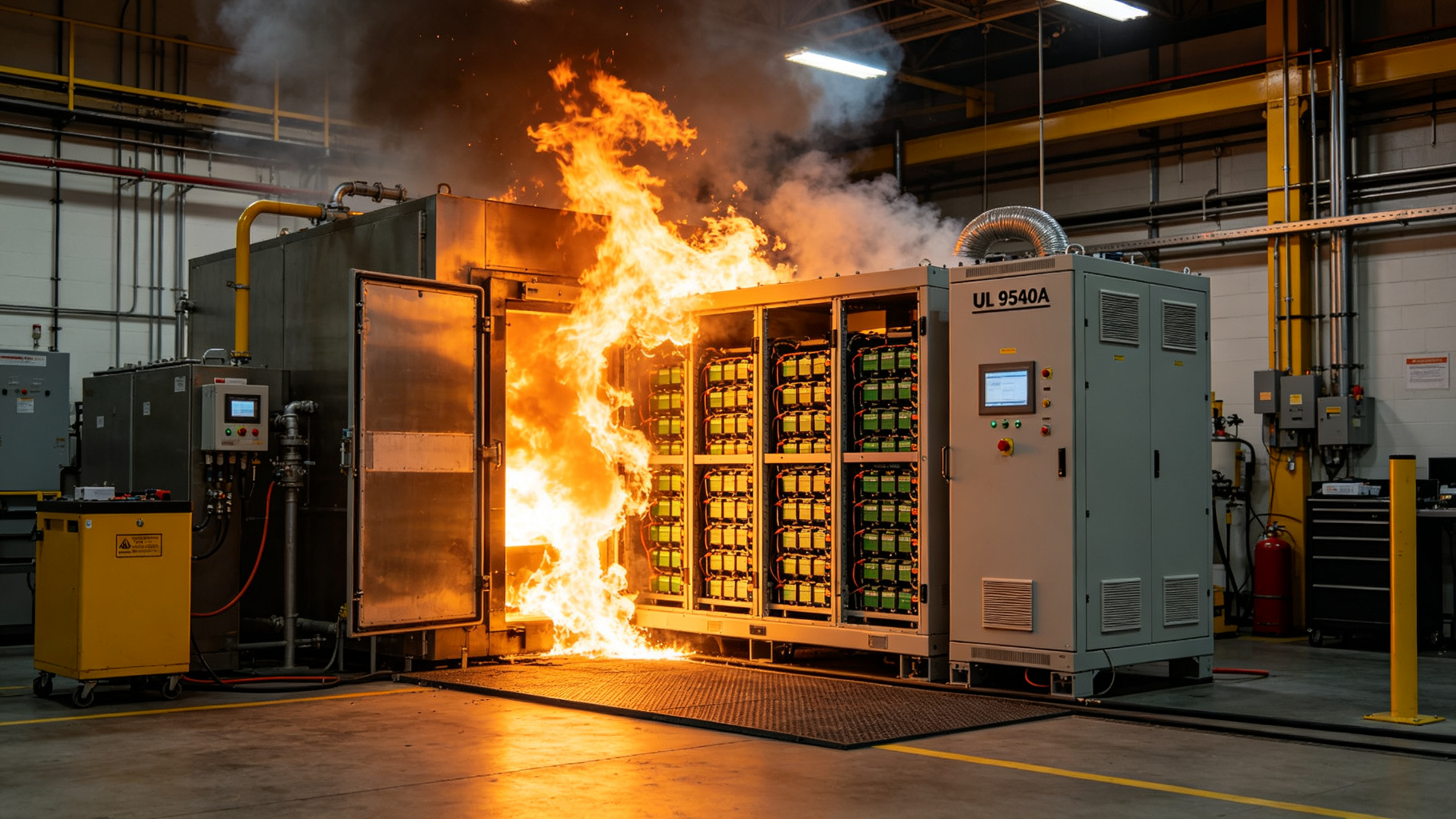
What does the UL 9540A test method measure, and how do the results inform BESS fire protection design?
UL 9540A is a 4-level test method (cell, module, unit, installation) that measures the fire propagation characteristics of a BESS. The results inform the fire protection design at every level: cell-level (passive suppression), module-level (suppression and spacing), unit-level (cabinet construction), and installation-level (spacing, fire-rated walls, suppression system).
1. Why UL 9540A Matters
UL 9540A is the consensus test method for BESS fire safety in North America. It was developed in 2017-2019 in response to a series of high-profile BESS fires (Arizona 2019, California 2020) and is now referenced in NFPA 855, IFC Section 1207, and the International Fire Code. The test method is a prerequisite for most BESS insurance policies and for AHJ approval of new installations. A passing UL 9540A test report is the single most important document for a BESS project.
2. The Four Test Levels
UL 9540A is a 4-level test method that progressively evaluates the fire propagation characteristics. Level 1 (cell) tests a single cell to thermal runaway to measure the heat release rate, gas generation, and propagation tendency. Level 2 (module) tests a complete battery module to determine whether a cell runaway propagates to neighboring cells. Level 3 (unit) tests a complete BESS cabinet or rack to measure the heat release rate, gas generation, and explosion risk. Level 4 (installation) tests a full-scale installation to verify the spacing, fire-rated walls, and suppression system work as designed.
3. Level 1: Cell Test
The cell test is the simplest. A single cell is forced into thermal runaway by overcharge, nail penetration, or heater application. The test measures the cell's peak heat release rate, the time to vent, the off-gas composition, and the lower flammability limit (LFL) of the vent gas. The result is a per-cell heat release rate, typically 5-50 kW depending on the cell capacity, and an LFL typically 6-12% by volume. The cell test data is used to size the module-level suppression.
4. Level 2: Module Test
The module test is more complex. A complete battery module is installed in a calorimeter, and a single cell is forced into thermal runaway. The test measures whether the runaway propagates to neighboring cells, the total heat release rate of the module, and the off-gas generation rate. The result is a module-level fire load and propagation time, which informs the choice of module-level suppression (typically FK-5-1-12 patches or water mist) and the spacing between modules in a cabinet.
5. Level 3: Unit Test
The unit test evaluates a complete BESS cabinet. The test is conducted in a 100-200 m³ calorimeter, and the cabinet is fully populated with modules, BMS, cooling, and electrical. A single module is forced into runaway, and the test measures the cabinet-level heat release rate, the off-gas generation, the explosion risk (deflagration index), and the effectiveness of any built-in suppression. The result informs the cabinet construction (blast relief, gas detection, suppression integration) and the installation-level spacing.
6. Level 4: Installation Test
The installation test is the most expensive and is only required for large or non-standard installations. A full-scale installation is built per the proposed design, and a single cabinet is forced into runaway. The test measures the heat release rate at the installation level, the gas generation, the fire spread to adjacent cabinets, and the effectiveness of the installation-level suppression (water mist, clean agent, fire walls). The result is the final approval data for the AHJ and the insurance underwriter.
7. The Role of QuellPatch in UL 9540A
FIREQUELL QuellPatch is the only cell-level passive suppression product that has been independently tested to UL 9540A. The 2023 UL 9540A test report showed that QuellPatch reduced the module-level heat release rate by 50-70% and increased the propagation time from 4 minutes to 25 minutes. The cabinet-level test showed a 40% reduction in peak heat release rate and a 60% reduction in off-gas HF concentration. These results are included in the FIREQUELL QuellPatch product specification and can be cited in the BESS project's AHJ submission.
8. Conclusion
UL 9540A is the consensus test method for BESS fire safety, and a passing test report is a prerequisite for most installations. The 4-level structure (cell, module, unit, installation) provides a complete picture of the fire propagation characteristics and informs the fire protection design at every level. The FIREQUELL QuellPatch, with its independent UL 9540A test data showing 50-70% reduction in heat release rate and 60% reduction in HF off-gas, is a documented and standards-compliant answer for cell-level and module-level suppression.
Frequently Asked Questions
Is UL 9540A required for new BESS installations?
Yes, in most jurisdictions. UL 9540A is referenced in NFPA 855, IFC Section 1207, and the International Fire Code. Most AHJs require a passing UL 9540A test report before approving a new BESS installation. Most insurance underwriters require the same.
How long does a UL 9540A test take?
The cell test takes 1-2 weeks. The module test takes 2-4 weeks. The unit test takes 4-8 weeks. The installation test (when required) takes 8-16 weeks. A complete 4-level test program typically takes 4-6 months and costs US$200k-1.5M depending on the BESS size and configuration.
What level of UL 9540A is required for my BESS?
Level 3 (unit test) is the minimum for most installations. Level 4 (installation test) is required for large installations (over 1 MWh) or non-standard configurations. Cell-level and module-level data can come from the cell manufacturer's existing UL 9540A report, but the unit test must be specific to the BESS cabinet being deployed.
Need a Passive Fire Suppression Solution?
FIREQUELL QuellPatch delivers automatic, maintenance-free clean-agent protection for electrical panels, battery cabinets and control rooms — designed to meet FM Approved, UL Listed, CE and UKCA requirements.