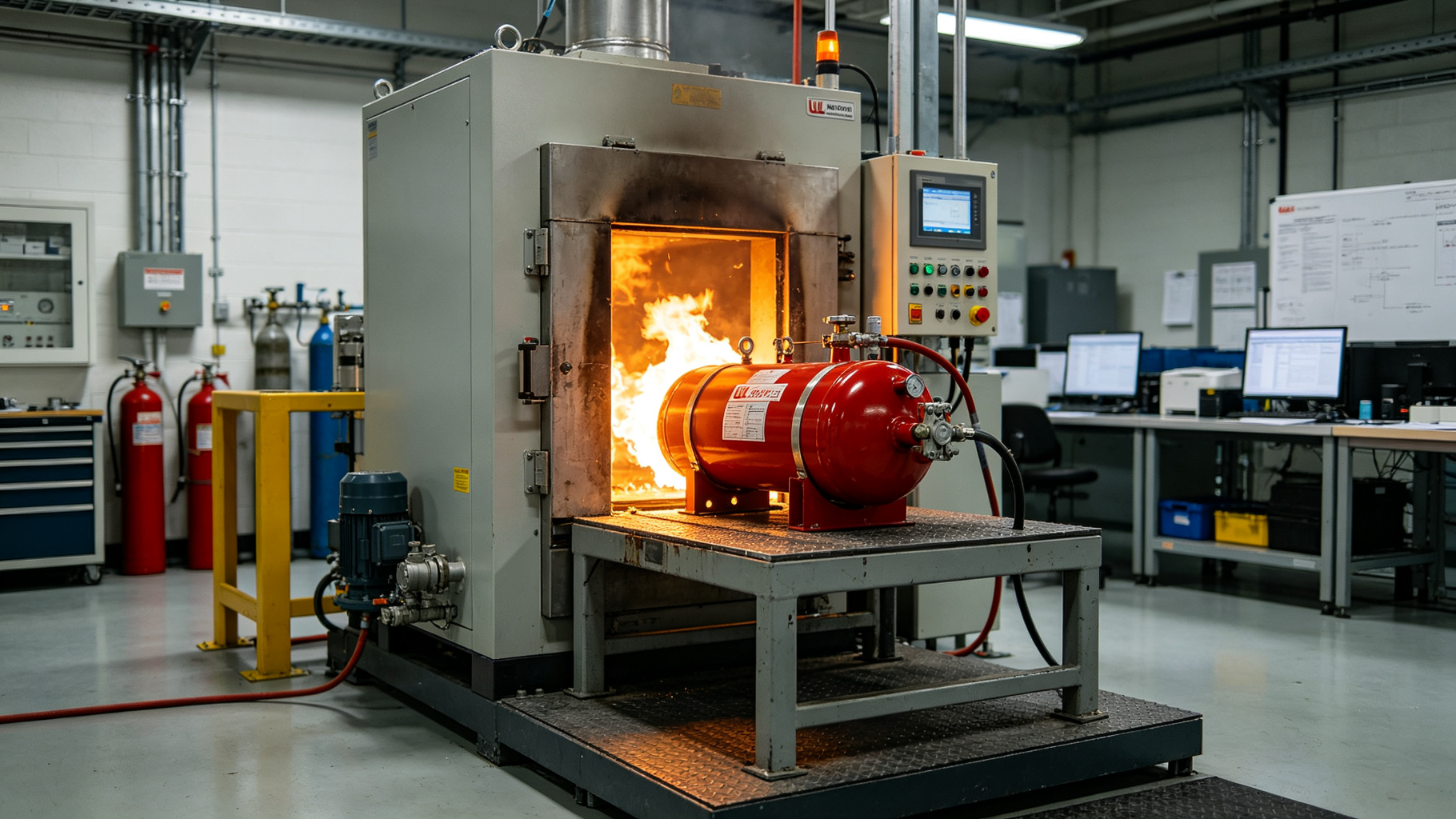
Technical guide on UL listing for electrical fire protection
Selling fire protection equipment in North America often hinges on one question: is it UL listed? The listing process is not a single test but a series of evaluations that verify performance, durability, and manufacturing consistency. For buyers, understanding what UL certification actually covers—and what it does not—prevents costly mistakes in product selection.
For passive electrical-enclosure suppression, a UL listing is not a single test pass; it is a third-party agreement that a product meets a published UL standard under repeatable manufacturing conditions. For FIREQUELL QuellPatch, this matters because the device has no control panel, pressure vessel, or piping: a polymer patch carrying microencapsulated FK-5-1-12 clean agent is bonded inside an enclosure and releases agent only when local heat reaches its rated set point. This article explains how UL certification is structured for such products, the fire product testing that supports each claim, and the engineering evidence required to keep the listing active.
UL first assigns the project to a product category and UL standard based on the device’s intended function, agent, and activation method. QuellPatch falls in the halocarbon clean-agent family because it uses FK-5-1-12, a fluorinated ketone that vaporizes on discharge and interrupts the combustion chain reaction without leaving conductive residue. The test program typically draws on UL 2166 for halocarbon clean-agent extinguishing units, UL 711 for small-fire performance benchmarks, and sealed-device requirements from UL 2127 where they apply to non-rechargeable products. UL does not “approve” a generic technology; it lists a specific configuration for defined enclosure volumes, mounting locations, ambient limits, and activation temperatures.
Engineered FK-5-1-12 systems rely on hydraulic calculations, nozzle placement, and supervised discharge. QuellPatch instead depends on distributed microcapsules and passive thermal activation. This shifts UL review toward shell chemistry, adhesive bond durability, and local agent distribution. The listing may therefore include conditions such as maximum enclosure volume, minimum and maximum patch spacing, acceptable leakage rates, and restrictions on forced-air cooling during a fire. These conditions become part of the installation instructions and are audited during follow-up services.
The formal UL process begins with a technical submittal that allows UL to understand how the patch is constructed and how it is expected to perform. For QuellPatch, this package typically includes:
Because the product is passive, UL also reviews failure modes: incomplete shell rupture, premature release from high ambient temperature, adhesive detachment, and agent loss through permeation. The submittal must show that the patch remains safe during normal electrical enclosure conditions, including temperature cycling, vibration from contactors, and humidity.
FK-5-1-12 purity and fill mass are verified by chemical assay. Microcapsule samples are measured for shell wall consistency, particle-size distribution, and rupture behavior. UL compares production samples to the qualified formulation; a change in shell polymer, capsule diameter, or agent loading generally requires retesting. For electrical applications, the submitted data also includes post-discharge dielectric withstand and corrosion information to support use near energized buswork and circuit boards.
Fire product testing begins with bench-scale and enclosure fires representative of electrical hazards. UL reviews whether the discharged agent reaches a sufficient concentration near the fire source. For FK-5-1-12, typical Class B design concentrations range from about 4.5% to 6.0% by volume, depending on fuel and enclosure geometry; QuellPatch charge sizes are calculated to achieve the required concentration within the listed enclosure volume under specified leakage. Tests may use heptane pan fires, polymer-insulated cable bundles, and energized electrical component mockups. Pass/fail criteria include flame knockdown, no reflash within a defined observation period, and no sustained burning of the patch itself.
Because patches are local devices, mounting position matters. Testing evaluates patches on side walls, near top-mounted bus, and adjacent to typical ignition sources such as terminal blocks. The resulting listing identifies acceptable locations and the number of patches required per volume class.
Each activation variant—80°C, 140°C, and 180°C—is tested separately. In controlled oven and radiant-heat tests, patches are exposed to ramped and steady temperatures to confirm that shells rupture at the rated set point and release agent rather than slowly seeping or remaining intact. The lower 80°C variant is generally used where early intervention is needed near heat-sensitive electronics; the 140°C and 180°C variants suit higher ambient locations such as motor control centers or outdoor cabinets, reducing the chance of nuisance release. UL also tests below activation temperature to verify that normal operating heat does not cause release.
Microencapsulation is central to this review. The shell must contain FK-5-1-12 for years but respond rapidly when local heating occurs. UL examines capsule response after vibration, impact, and thermal cycling, since cracked or agglomerated capsules could reduce agent delivery or create uneven activation.
The 5-year service life is supported by conditioning and retention testing rather than visual inspection alone. Samples undergo accelerated aging, commonly including dry-heat storage at approximately 54°C for a defined period, followed by chemical assay, activation testing, and adhesive-bond checks. UL may also evaluate humidity, salt fog for outdoor enclosures, and low-temperature discharge. After conditioning, patches must still activate within the rated range and deliver the specified agent mass.
Enclosure compatibility testing assesses whether the adhesive remains bonded to painted steel, stainless steel, and common thermoplastic surfaces, and whether discharged agent or shell residue affects labels, wiring insulation, or clearances. Results define any surface-preparation requirements and prohibited mounting locations.
Before a UL listing is issued, a UL representative inspects the manufacturing facility. The inspection verifies that production processes, incoming material controls, and test equipment can reproduce the qualified product. For QuellPatch, critical controls may include capsule batch traceability, FK-5-1-12 fill weight, adhesive lot verification, and activation-temperature sampling. The manufacturer must maintain a documented quality program and retain records for UL review.
A representative UL certification project for a passive suppression patch often follows this sequence:
For a new microencapsulated product, total elapsed time commonly ranges from 7 to 13 months. Schedule drivers include formulation changes after failed tests, availability of representative enclosures, ambiguous concentration calculations, and findings during the factory inspection. Using pre-validated FK-5-1-12 agent data and production-like prototypes can reduce delay, but fire product testing cannot be shortened if samples fail activation or retention criteria.
After listing, UL conducts periodic Follow-Up Service inspections, usually quarterly, to verify continued conformance. Material or design changes require UL review before being incorporated into listed product.
The UL listing process for QuellPatch ties every product claim—FK-5-1-12 concentration, 80/140/180°C activation, 5-year service life, and passive thermal activation—to test data and production controls. For facility engineers, this means the patch selected for a motor control center, UPS cabinet, or junction box should be applied only within the listed enclosure volume, ambient range, and mounting conditions documented in the certification. Understanding the process helps distinguish between a product that has demonstrated performance in a single demonstration and one that is subject to ongoing UL certification and surveillance.
A: UL listing is generally not a U.S. federal mandate, but it is frequently required by electrical codes, authorities having jurisdiction, insurers, and corporate facility standards. A UL listing demonstrates that samples were tested to a recognized standard and that production is subject to ongoing follow-up audits.
A: A typical UL project for this type of product ranges from 7 to 13 months, including documentation review, fire and environmental testing, and the initial factory inspection. The timeline can extend if prototype samples fail activation, fire-performance, durability, or production-control tests and require redesign.
A: Yes. Different activation-temperature variants are evaluated within the listing program to confirm that each device activates within its rated range and performs consistently under the applicable test conditions. UL also reviews critical construction differences so a listed variant cannot be changed without appropriate evaluation.
A: The applicable standard depends on product type, intended use, and mounting location. For electrical-enclosure fire devices, UL evaluates the product against the relevant fire-test and construction requirements in the applicable UL standard, while installation may also need to align with NFPA 70/NEC, NFPA 72, and other local codes.
A: After listing, UL conducts periodic manufacturing audits and follow-up services to verify that shipped products continue to match the tested design. Manufacturers must maintain controlled documentation, critical-component controls, and test records; material or design changes may require UL review before the product can carry the listing mark.
FIREQUELL QuellPatch delivers automatic, maintenance-free clean-agent protection for electrical panels, battery cabinets and control rooms — designed to meet FM Approved, UL Listed, CE and UKCA requirements.
Request a Site Assessment