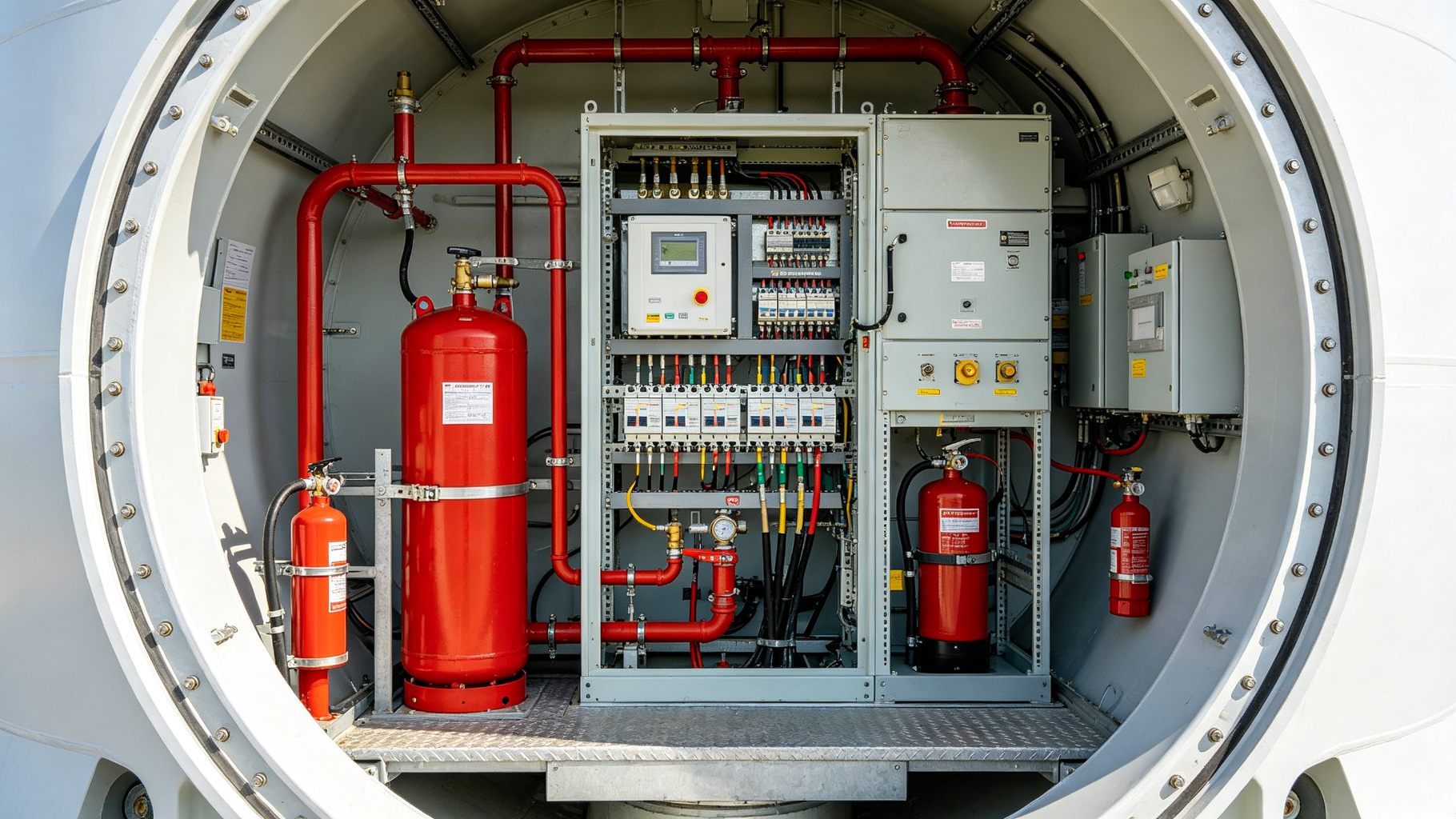
Technical guide on wind turbine fire for electrical fire protection
A fire inside a wind turbine nacelle is a rare but catastrophic event—reaching the blaze is nearly impossible once it starts, and the nearest fire crew may be hours away. With components like generators, converters, and hydraulic systems packed into a confined space, the protection strategy must work without human intervention. This is why nacelle fire protection demands a different approach than typical industrial applications.
Wind turbine fires are low-frequency but high-consequence events. A nacelle contains high-voltage switchgear, frequency converters, transformers, capacitors, slip rings, hydraulic systems, brake resistors, and composite enclosures in a compact, elevated space. When a wind turbine fire develops, access is difficult, response times are long, and downtime, component replacement, and emergency mobilization costs can be substantial. Effective nacelle protection therefore depends less on a single discharge event and more on matching the suppression method to the location, ventilation, and maintenance realities of the turbine.
This article examines the technical constraints that make wind energy fire safety unusually difficult and describes how component-level, passive clean-agent patches in the QuellArmor product line can be integrated into a layered turbine suppression strategy. The focus is on incipient electrical fires in cabinets, converters, and similar enclosed nacelle compartments, where early thermal intervention can reduce the chance of escalation.
Many nacelle fires begin with electrical failures rather than open-flame sources. Common precursors include loose terminations, tracking on insulator surfaces, capacitor degradation, IGBT module failures in converters, contactor welding, and overheated busbars. These faults can produce localized temperatures well above the 60–80°C surface range typical of normal power electronics. In some failure modes, internal arcing or resistive heating may raise component surfaces to 120–200°C before visible flame appears.
The initial fire is often concealed inside an electrical cabinet or cubicle. By the time smoke reaches a nacelle smoke detector or flame is visible through ventilation openings, burning insulation, circuit boards, cable jackets, and structural plastics may already be involved. Local suppression at the component level is useful because it attacks the fire while it is still confined to the enclosure where it started.
Nacelle airflow can dilute smoke and move heat away from ceiling-mounted detectors. Aspirating systems improve sensitivity but still require transport time through sampling pipes, while line-type heat detectors may only respond after heat reaches the cable or sensor location. Passive thermal activation addresses this timing problem by placing the suppression agent close to the heat source.
QuellArmor patches are available with activation temperatures of 80°C, 140°C, and 180°C. This allows the design to distinguish normal operating temperatures from abnormal heating: 80°C may be appropriate for climate-controlled or low-temperature control enclosures, 140°C for general electrical and converter cubicles, and 180°C for compartments near brake resistors or other high-temperature surfaces where a lower threshold could create nuisance response risk.
Nacelles operate across wide ambient ranges, often from approximately -40°C to 55°C, with solar loading, humidity, salt exposure offshore, and continuous vibration. Pressurized cylinders, electromechanical detectors, control panels, and releasing solenoids must remain functional under these conditions for years. Vibration can affect electrical connections, detector alignment, and gauge reliability, while offshore corrosion increases inspection and maintenance burdens.
QuellArmor patches are flexible, adhesive-mounted devices with no pressure vessel, solenoid, or external control circuit. Their construction uses a multilayer carrier and microencapsulated FK-5-1-12 clean agent. The absence of pressurized storage can reduce maintenance associated with cylinder pressure gauges, hydrostatic testing, and releasing hardware, although the patches still require periodic visual inspection and correct surface preparation during installation.
Nacelles are intentionally ventilated to remove heat from converters, transformers, and generators. Cable penetrations, access doors, heat exchangers, and louvers also create leakage paths. Conventional total-flooding clean-agent systems depend on sufficient enclosure integrity to maintain design concentration for a specified hold period, often around 10 minutes. In a ventilated nacelle, achieving that hold time may require automatic damper closure, fan shutdown, and enclosure sealing—all of which add complexity and failure points.
Localized patches do not rely on a well-sealed nacelle volume. They are installed inside the specific cabinet or compartment where an incipient electrical fire is most likely to occur. This can suppress the fire before it enters the larger ventilated nacelle space. It is important to recognize, however, that patches are not a substitute for total-flooding protection in high-fire-load compartments where an engineering assessment identifies a need for whole-volume protection.
A conventional gaseous turbine suppression system typically includes detection, a control panel, releasing panel, cylinders, piping, nozzles, and interlocks for ventilation shutdown. In a nacelle, these components must be routed around existing equipment and supported on structures that are subject to vibration. Maintenance may require climbing the tower, removing cabinet panels, and arranging cylinder replacement or recharge. Offshore sites face additional weather and logistics constraints.
Another limitation is that a centralized discharge is usually a single event. If a concealed electrical fault rekindles after the agent has dissipated, there may be no remaining suppression capacity unless a reserve system is provided. Distributed passive patches can provide multiple independent response points, each activated only by local heating.
Electrical nacelle hazards require an agent that is electrically nonconductive, noncorrosive, and low in residue. FK-5-1-12 is a clean agent commonly used in electronic and electrical hazards because it vaporizes readily, does not leave conductive residue, and has an ozone depletion potential of zero, a global warming potential near 1, and an atmospheric lifetime measured in days. It is stored as a liquid under pressure in conventional systems but vaporizes at approximately 49°C at atmospheric pressure.
QuellArmor uses microencapsulation to contain FK-5-1-12 without nitrogen pressurization. The agent is held in tiny polymer capsules within the patch. When the patch reaches its rated activation temperature, the capsules release agent directly into the protected enclosure. This passive thermal activation requires no external power, detector signal, or control logic, reducing the number of intermediate steps between fault heating and agent delivery.
Each QuellArmor patch consists of a protective outer layer, a microencapsulated FK-5-1-12 agent layer, and an adhesive backing for mounting inside electrical enclosures. The patches are designed to be installed on interior surfaces facing the hazard, such as above busbars, converter modules, capacitor banks, contactors, or cable termination zones. When local temperatures reach the selected rating, the patch releases agent toward the protected equipment.
The three activation ratings support different nacelle microclimates. An 80°C patch may be used in sealed control cabinets with low normal surface temperatures. A 140°C patch is commonly suited to converter and power distribution cubicles. An 180°C patch may be considered near resistors, braking systems, or other components that run warm under normal operation. The selected rating should provide margin above the maximum expected normal surface temperature while remaining below the temperature at which significant insulation or component damage is anticipated.
Patch sizing is based on the net internal volume of the enclosure, leakage area, obstruction by equipment, and the expected fire scenario. Larger compartments may require multiple patches distributed to cover separate ignition zones rather than relying on one device. Installation should follow manufacturer spacing and volume guidance, with patches positioned so that released agent is not blocked by cable trays or structural members.
QuellArmor patches have a specified 5-year service life under documented environmental conditions. Routine inspections can be incorporated into normal turbine O&M walks and should check for physical damage, adhesive lifting, contamination, or evidence of prior activation. Patches should be replaced after activation, visible damage, or at the end of their service life. Because the devices are passive, there is no pressure gauge to monitor, but inspection remains necessary to confirm that the mounting surface and patch condition are acceptable.
Wind energy fire safety is most effective when passive suppression is combined with other controls. These include proper electrical installation and torque practices, thermal imaging during maintenance, arc-resistant equipment where appropriate, smoke and heat detection, E-stop and remote shutdown, compartmentation, and emergency response procedures. QuellArmor patches are intended to address incipient electrical fires at their source and may reduce escalation risk, but they do not remove the need for ignition-source control or code-required protection systems.
For high-fire-load areas such as hydraulic power units, main transformers, or lubrication systems, the engineering assessment may require additional suppression, drainage, containment, or ventilation controls. The patches are best viewed as a component-level layer within a broader nacelle protection design rather than as a universal solution for every nacelle hazard.
Wind turbine nacelle fire protection is complicated by compact geometry, concealed electrical ignition sources, forced ventilation, vibration, and difficult maintenance access. Conventional total-flooding systems can be effective, but they depend on detection, controls, enclosure integrity, and regular servicing. Passive clean-agent patches offer a different approach: placing microencapsulated FK-5-1-12 directly within electrical cabinets and compartments, where it can be released by passive thermal activation at 80°C, 140°C, or 180°C.
QuellArmor patches can be integrated into turbine suppression designs to provide localized, independent response to incipient electrical faults. Their 5-year service life and lack of pressurized cylinders may reduce maintenance burden in both onshore and offshore nacelles. Proper activation-temperature selection, enclosure-specific sizing, and correct placement are essential. When combined with detection, maintenance, and operational controls, component-level passive suppression can strengthen nacelle protection against the early stages of a wind turbine fire.
A: Generally, no. QuellArmor is intended as localized, supplemental protection for electrical cabinets, converters, controllers, brake or hydraulic adjacent components, and other component-level nacelle hazards. It is not a universal replacement for code-required total-flooding gaseous systems designed for the larger nacelle volume. Use it to improve point protection while retaining the required nacelle-level suppression strategy.
A: Choose the rating based on the maximum normal surface temperature at the protected component, plus an engineering margin to avoid activation from solar gain, nacelle heat, or equipment operation. Lower-temperature 80°C patches may suit climate-controlled or cooler cabinets, while 140°C and 180°C ratings are more appropriate for hotter converter, inverter, brake, or mechanical spaces. Use measured operating temperatures across summer and winter conditions before selecting the rating.
A: QuellArmor has a specified service life of 5 years under intended installation and environmental conditions. In wind turbines, periodic inspection should verify adhesion, abrasion, vibration damage, contamination, moisture, discoloration, and leakage. Replace the patch at 5 years, after activation, or if inspection finds damage that could affect reliability.
A: No. QuellArmor patches activate thermally when local temperatures reach the selected 80°C, 140°C, or 180°C threshold and do not require external power, detectors, alarm wiring, or a control panel to release agent. This makes them useful for sealed cabinets and component-level hazards where wiring, access, or downtime is a constraint. They can still be used alongside turbine fire alarm and total-flood suppression systems.
A: Common nacelle ignition sources include electrical converters and inverters, capacitors, contactors, transformers, connection cabinets, brake resistors, hydraulic components, and high-resistance electrical connections. QuellArmor is placed close to these localized hazards to release FK-5-1-12 clean agent at the incipient stage. It is best suited to enclosed or semi-enclosed component spaces, not as the sole protection for the entire nacelle volume.
FIREQUELL QuellPatch delivers automatic, maintenance-free clean-agent protection for electrical panels, battery cabinets and control rooms — designed to meet FM Approved, UL Listed, CE and UKCA requirements.
Request a Site Assessment